← technopuritan.com · a working analysis of the Techno-Puritan corpus · companions: The Assembly Concordance · The New Religion Census · Proper Worship Practices · Eshet Chayil · The Seventh Day
The Genesis Ledger
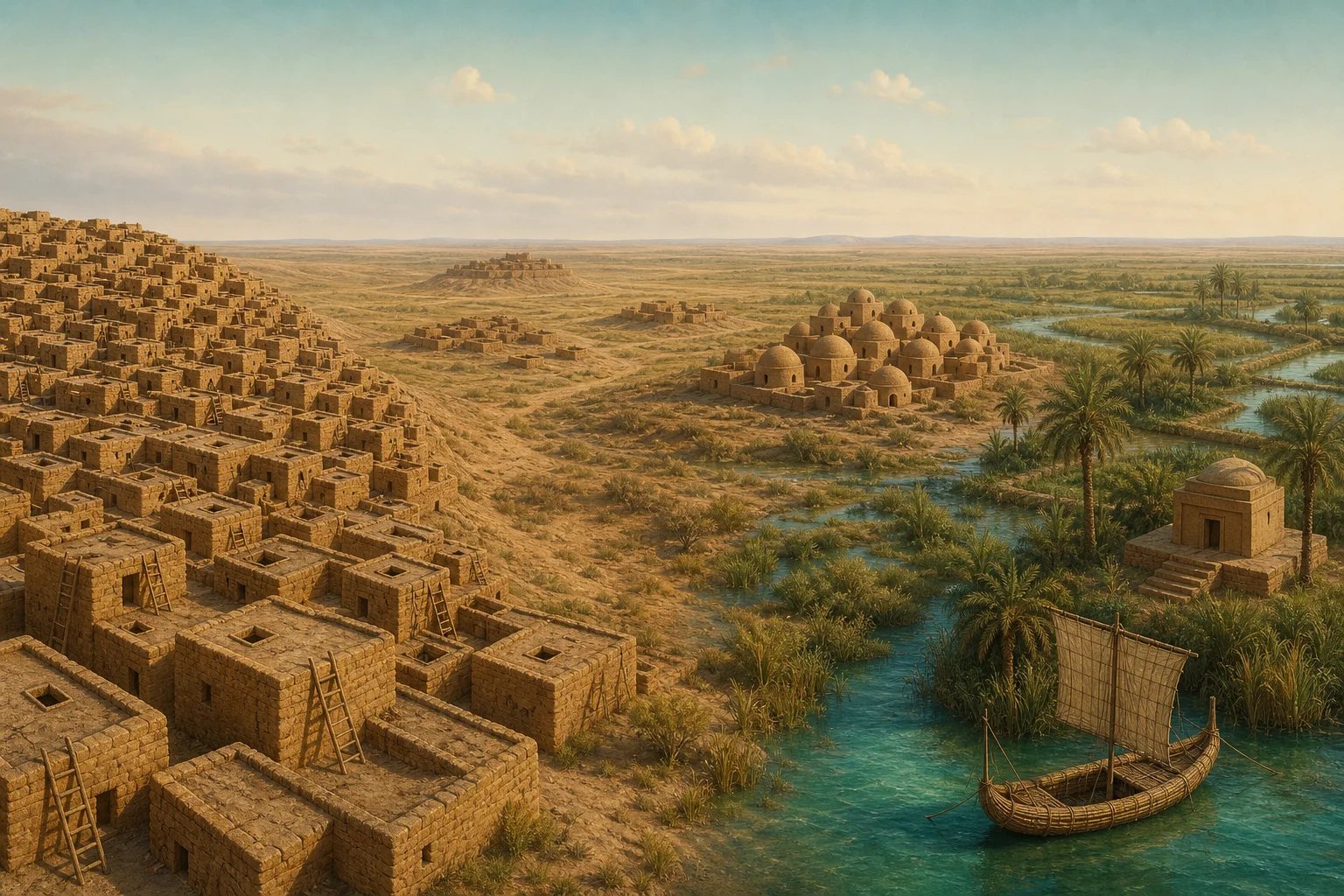
Everyone skips the begats. Adam lived 930 years, Seth became a father at 105, Methuselah made it to 969 — obviously mythical, so we read past them. Here's the bet this page makes: those numbers are a ledger. They are a chronological record of the cultures our line passed through, carried across four thousand years of hand-copying because the people copying it believed it mattered. The test is brutally simple. We pinned one number — Adam's year zero = the founding of Çatalhöyük, the first farming metropolis, radiocarbon-dated to 7100 BC give or take decades — and read one biblical year as one real year. That's the entire model. No scaling, no per-name adjustments; every date on this page is forced by that single choice. If the numbers were invented, they should land nowhere. Instead the Flood computes to 5444 BC and hits the largest cultural extinction event in Near Eastern prehistory. Every match below is graded, every miss stays on the page, and every choice we made is written down. If we were sliding things around until they fit, you'd see the knobs, and there aren't any.
The Garden has coordinates
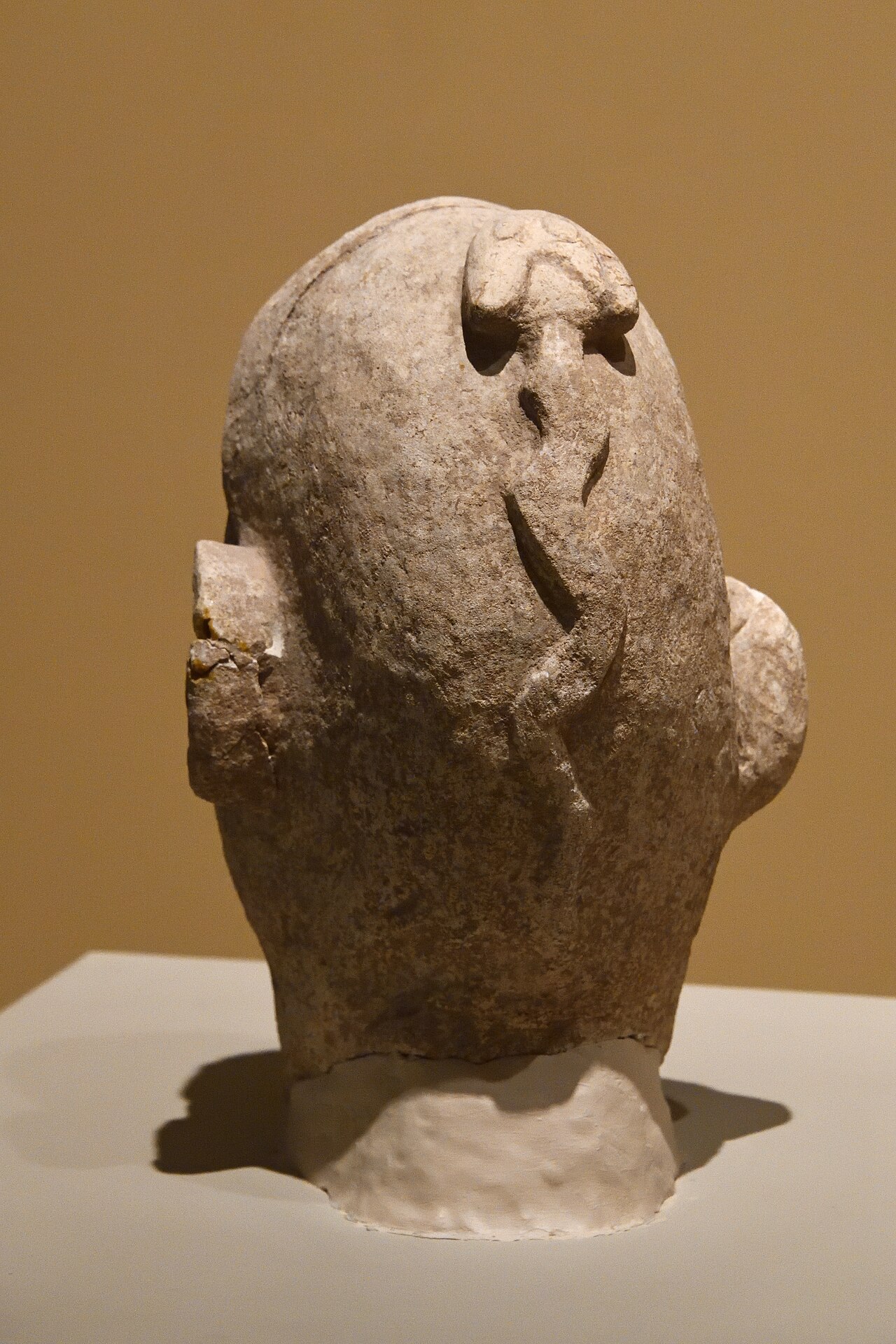

Genesis never hid where Eden was — we just stopped reading it as a place. “A river went out of Eden to water the garden, and from there it parted into four headstreams” (Gen 2:10), and two of the four get named flat-out: the Tigris and the Euphrates. Both rise in the Taurus foothills of southeastern Turkey. A garden upstream of those headwaters puts you in the hills around Urfa. And what did archaeology find in the hills around Urfa? Göbekli Tepe — the oldest monumental sanctuary on Earth, ~9600 BC, built by foragers on a ridge looking down over the Harran plain. Einkorn wheat, the first crop humans ever domesticated, was domesticated at Karacadağ — visible from the site. And the most common creature carved on Göbekli's pillars? Snakes.
People assume Eden means no work. Read it again — Adam is put in the garden “to work it and keep it” (Gen 2:15). What's missing is rain, not work: “the LORD God had not caused it to rain upon the earth… but a flow (ʾēd) went up from the ground and watered the whole face of the soil” (Gen 2:5–6). That word ʾēd is cognate with Akkadian edû — the annual flood. Farming with no rain, where the water rises from below? That's floodwater farming on the banks of seasonally flooding rivers, and it happens to be the easiest agriculture humans ever practiced: tend the wet banks, harvest, done. No plough, and no praying for rain. Which flips the curse completely. The curse isn't that work begins — it's that the water stops coming to you. “By the sweat of your brow you will eat bread” is the move to dry-ground field agriculture, and the tradition scores that move, accurately, as a catastrophe. The skeletons back it up: when humans switched to full farming, height dropped, teeth rotted, lifespans shortened, and childbirth got more dangerous. “You shall surely die” is population data. The full argument is elsewhere in the corpus: see TP 14, “The Adam & Eve Story Does Not Say What You Remember”, and TPS 52 on the pre-Adamite question.
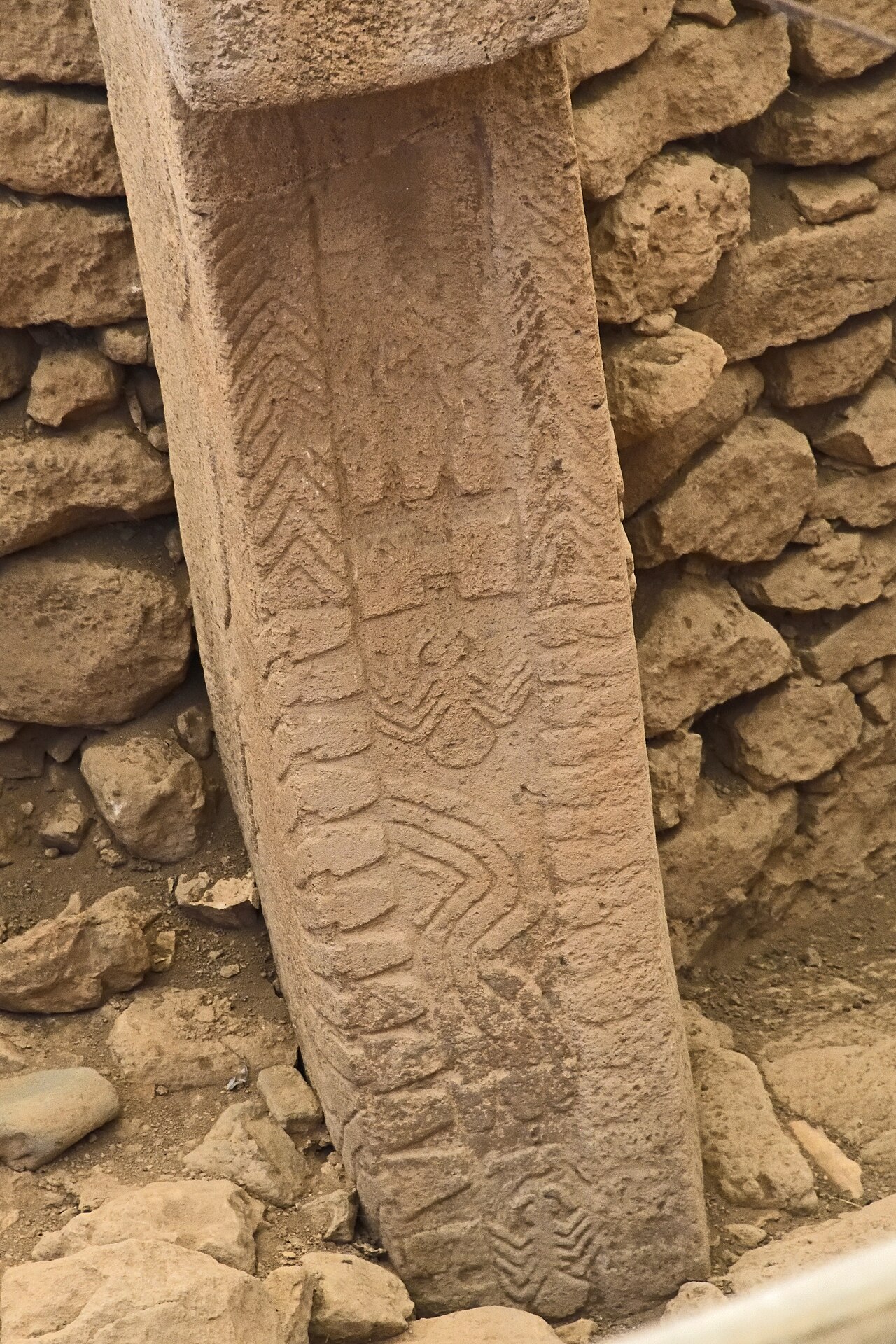

So the tradition reads the Garden as a period, not a point: from Göbekli Tepe's founding (~9600 BC) to the founding of Çatalhöyük (7100 BC) — twenty-five centuries when humanity gardened without yet being owned by fields. Göbekli itself went out of use mid-window, around 8000 BC. The ledger below picks up at the exact moment the Garden era ends: Adam's year zero is the first fully agricultural metropolis. Put the narrative and the chains together and you get continuous coverage from 9600 to 2000 BC. One more thing makes the memory literal rather than poetic: all of this happened inside the early-Holocene humid period — the same planetary wet phase that made the Sahara green. The Urfa hills really were garden country then. The drying came later, in steps, so by the time anyone wrote this down, the green world it describes had been gone for millennia. The scribes were copying an accurate climate memory that looked like myth from where they sat. Last detail before you scroll: Göbekli Tepe overlooks the Harran plain, which drains into the Balikh river — the same valley where the ledger's northern villages sit, and where Abraham's grandfather and great-grandfather survive as town names. The story opens, and the family hands off, in one watershed.
Abraham's family tree is a street map
In Genesis 11, the last three names before Abraham are people: Serug, his great-grandfather; Nahor, his grandfather; Terah, his father. Now here's what the cuneiform record — Assyrian itineraries, the Mari letters — turned up, with no help from the Bible: real towns in the Harran district carrying the same names. Sarugi is modern Suruç, about 45 km west of Harran. Til-ša-Turahi, “the mound of Turah,” sits on the Balikh just south. Nahur shows up in the Mari letters, same country. Abraham's ancestors are the towns of his family's home district. And the text keeps pointing there: Terah moves the family to Harran (Gen 11:31); Abraham's servant fetches Rebekah from “the city of Nahor” (Gen 24); Jacob runs to Harran (Gen 28). Did the clan name its ancestors for its towns, or its towns for its ancestors? Doesn't matter — either way, the tail of this genealogy is real, local memory wearing its home geography. (Speculative bonus: a town called Paliga sat where the Balikh meets the Euphrates. Possibly Peleg.)
And it's all one watershed. Göbekli Tepe stands at the top of the Harran plain; the plain drains south as the Balikh, past Tell Sabi Abyad — the northern village world you'll meet in the ledger below — and the pedigree's towns line the same water. The tradition opens at the top of this map and hands off to Abraham at the bottom of it.
Schematic — positions approximate, rivers simplified. Nahur's exact site is debated; the Mari letters place it in the upper Khabur country, east of the Balikh.
The ledger, laid over the dirt
The whole model in one picture. Blue bars are archaeological cultures at their published, radiocarbon-anchored dates — we didn't touch those. Orange bars are the ten patriarchs at the dates the anchor forces — we couldn't touch those. Each culture sits directly above the patriarch the model maps to it, and the numbered circle at each patriarch's death is graded by how close it lands to an independently dated boundary: green = strong, yellow = close, orange = the date hits a real boundary but which culture it names is still open. Watch what the orange bars do at the red line. Hover anything.
The century the Flood points at
This is the part that should move a skeptic. The Flood date isn't fitted to anything — it's the sum of nine numbers plus six hundred, anchored once. And the century it lands in contains: the total absorption of every regional culture into one package (the Ubaid), the founding of the temple tradition at Eridu, the earliest evidence of sails anywhere on Earth, and the sea standing above today's shoreline. "All flesh was wiped out; one household survived and repopulated the earth" is a fair one-sentence summary of what the archaeology shows.
The second chain: Genesis 11's mythic head, decoded
Genesis 11 turns out to be two records spliced together: a real family pedigree (its fathering ages are ordinary human 29–35) carrying an inherited mythic payload (its lifespans: 600, 438, 433, 464, 239, 239, 230, 148, 205 — total 2,996 years). Read as a king-list — durations laid end to end — and slid freely through the Flood→Abraham window, the payload locks at both ends: it begins at the completion of the Flood transition (~5000 BC) and ends at the fall of Ur (2004 BC) — the event that historically scattered the families of Ur, and the text's own handoff from myth to family memory. Hover everything.
The choices made, and why
- Split the list at its seams. Genesis 11's fathering ages are human-scale except exactly two — Shem's 100 and Terah's 70 — sitting precisely at the head-weld (to the Flood) and the tail-handoff (to Abraham). So the fathering ages are read as the family's real pedigree, and the lifespans as the inherited payload.
- Chain the payload sequentially, not by overlap. A Mesopotamian-descended fragment's native format is the king list — durations end to end (the Sumerian King List's post-Flood section is literally this) — unlike Genesis 5's unique overlap-chain. Splicing a king list into a pedigree would relabel its durations as “lifespans”: the format conversion is predicted by the splice, not assumed.
- Slide, don't weld. There is no reason the fragment starts at the Flood's onset, so the anchor was left free. The window pins it anyway: 2,996 years must fit between 5444 BC and Abraham's era — under 450 years of slide freedom, and ~5100–4900 BC if the chain is to reach him.
- The lock. At anchor 5000 BC the chain locks at both ends: it begins where the Flood transition completes (matching the king-list convention that the record resumes after the flood is over) and ends at the sack of Ur — with the Uruk period's start (off ~38), the Uruk collapse (off ~35, opening Peleg's “days” exactly where Gen 10:25 puts the division of the earth), the Fara period (off ~13), and the end of the Early Dynastic world (off ~7–23) falling on internal boundaries along the way. The Akkadian Empire — the first empire — gets the shortest slot, and Terah's ends as Ur falls.
- Disclosure. The anchor was found by noticing that the payload's sum equals the HUT-completion→Ur-fall span — but the search criterion (“the anchor should be a major civilizational event”) was stated before the answer, and both endpoints satisfy it. One free parameter; two boundary conditions met simultaneously; five internal boundaries within ~15–80 years.
- Caveats — this chain is one tier below the Genesis 5 core. Middle chronology only (the short chronology shifts the third millennium ~64 years later and loosens the Ur lock); boundaries in this span are dense, so individual hits are weak evidence — the force is the joint fit; and the numbers are Masoretic only, from the list that carries no checksum and demonstrably drifted across traditions.
Who these people actually were
Reconstruction plates (unpopulated on purpose — this tradition takes idolatry seriously) and a capsule history of each culture in the mapping. If you've never heard of Halaf or the Ubaid, start here: these are the civilizations-before-civilization your history class skipped.
Every match, graded — misses included
This is the honest core of the page. Each patriarch's computed death against the nearest independently dated boundary — and read the offset column slowly: a model with one input is missing by 6 years here, 13 there, ~35 over there, across seven millennia of prehistory. Grades: strong = inside a dated window or within ~60 years; close = within ~150 or against a fuzzy boundary; slot fits, identity open = the date lands on a verified boundary but which named culture it belongs to is unresolved — the honest state of mid-6th-millennium archaeology, and exactly the stretch where the Genesis 4/5 name-doublets cluster. We grade our own weak rows so you don't have to.
| Patriarch | Computed (BC) | Matches | Offset | Grade | Note |
|---|
Which flood? And why is it even here?
The trap is assuming “the flood” is one thing. Asking which flood misses the point. Three distinct things wear the name. An age of floods: the tradition's deep memory spans the entire post-glacial drowning of the world — the Gulf shoreline advancing up to a kilometer a year across its flat basin (the sea visibly eating the land within single lifetimes, standing above today's shoreline 5500–4000 BC, exactly bracketing the ledger's boundary), the Black Sea reconnection ~5600 BC, real villages sitting drowned offshore (Atlit-Yam, under the Mediterranean since ~6300 BC), catastrophic river floods every few generations — and the 8.2-kiloyear event itself was triggered by the planet's largest freshwater outburst flood. Water ending worlds was the recurring catastrophe class of that region's remembered past; that is why the era-divider is water and not fire, and why it needs no single referent — punctuation must be generic to function. Yet its placement is not arbitrary: a tradition carrying many flood memories, forced to pin “the Flood” once, should pin it where the water stood highest — and the ledger's boundary (5444 BC) sits at the onset of the regional highstand (~5500 BC). Many floods made the glyph; the highest water dates the pin. The story: the ark narrative (one warned man, a boat, the storm, the birds, the mountain) is standard Mesopotamian flood literature — Ziusudra, Atrahasis, Utnapishtim — anchored by Sumerian tradition to a real river-flood at Shuruppak, ~2900 BC, twenty-five centuries after this boundary; Genesis's own telling is braided from two versions (40 days vs 150; pairs vs sevens), a circulated literary package, not a dated observation. The glyph: in Mesopotamian historiography “the Flood” was the standard punctuation between deep time and historical time — the Sumerian King List literally breaks its list with “then the Flood swept over.” A compiler joining the ledger (which ends at the transition's onset) to the king-list fragment (which begins at its completion) needed an era-divider at the seam, and the Flood was the glyph that meant exactly that. So the story is not out of order: it is an archival marker at the correct boundary, dressed in the best-known flood literature available — and where Sumer, whose archive rebooted after its own 2900 BC catastrophe, moved the marker to its recent flood, the branch carrying the checksummed archive kept the older anchor. The archaeology says the older anchor is the real one.
And the classic embarrassment becomes a prediction. Patriarchs living through the flood is fatal to literal readings — the Septuagint's Methuselah survives it by 14 years, and the Samaritan text re-engineered three lifespans so that everyone drowns on schedule. Under the boundary reading, overlap is the expected behavior: transitions take centuries, lineages straddle them, and Noah's 350 post-Flood years are simply the transition's own duration. The ancient editors' visible discomfort — their tidying — is itself evidence that these numbers originally described something nobody drowned in. Punctuation, not event.
The three floods people call “the Flood”
Three real events carry the popular attribution, and the argument over “which one is the real Flood” usually treats them as competitors. Score each on three tests — does it fit the ledger's date (5444 BC)? does it fit the ark narrative's details? does it fit the tradition's own geography? — and they stop competing: each ends up with a different job.
The Persian Gulf inundation
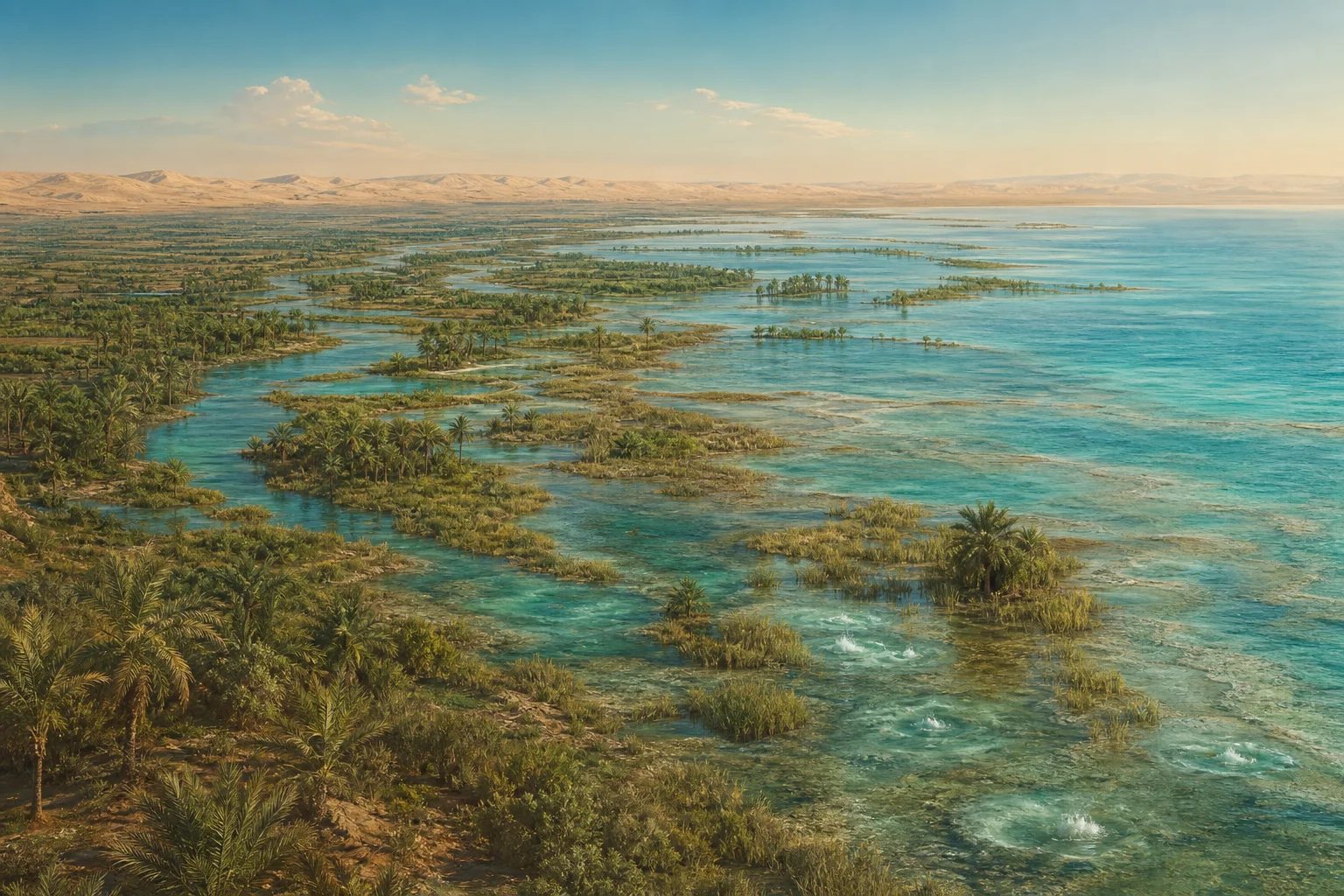
The post-glacial sea filled the Gulf basin and stood above today's shoreline exactly across the ledger's boundary — advancing up to a kilometer a year over some of the flattest land on Earth, fast enough to eat a family's country within living memory. It drowned the tradition's own source geography (the pre-Ubaid coastal world; Eridu ends up at the waterline), which is why the era-divider sits where it does. What it lacks: a storm, a single night of terror, a reason to build a boat. The text remembers it anyway, with the right physics: “the springs of the great deep burst forth” (Gen 7:11) — the water that rises, not falls. The sea-level record is solid; only the “lost civilization beneath it” add-on is speculative.
most likely the water that dated the pin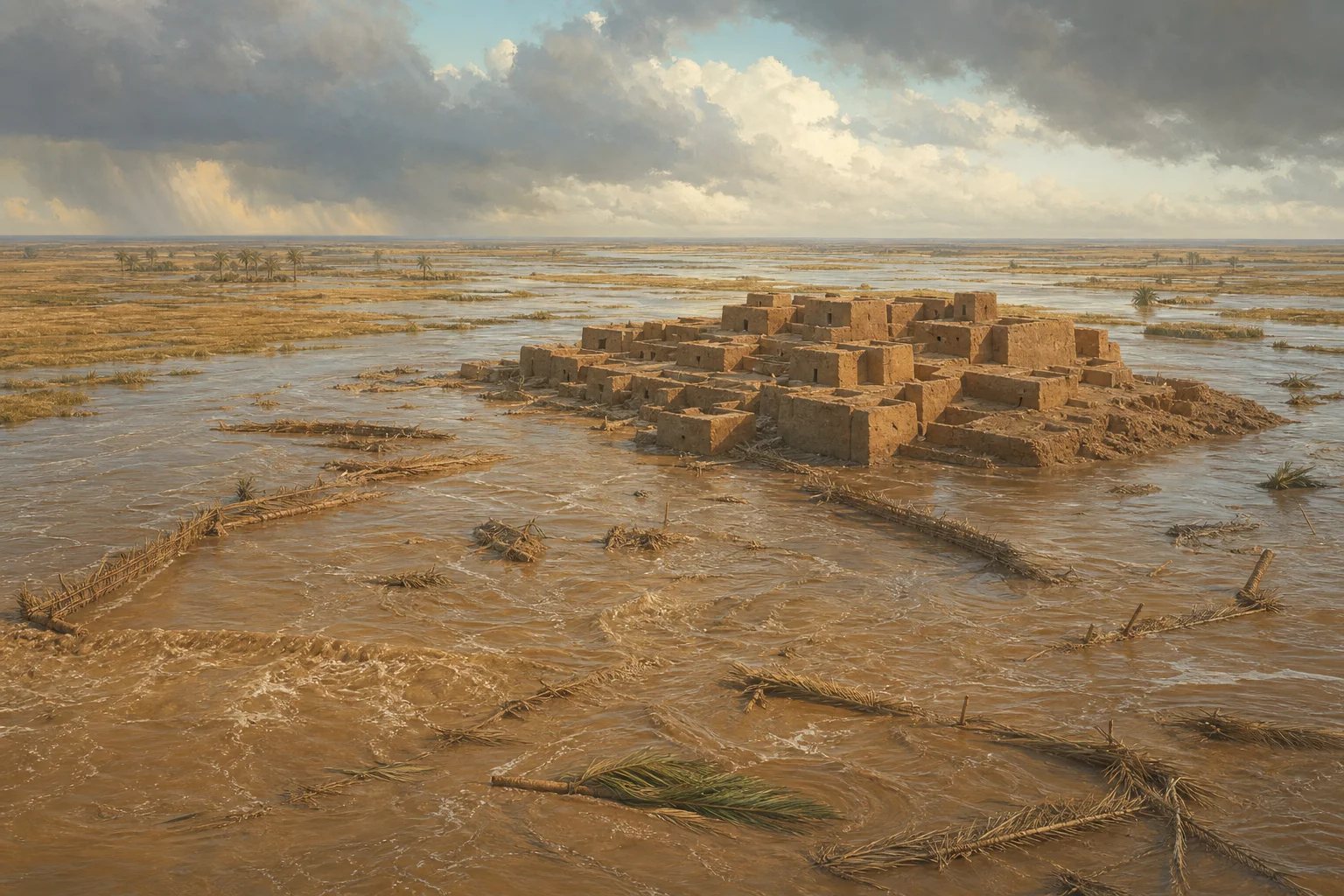
The Shuruppak river flood
A real flood stratum separates the Jemdet Nasr and Early Dynastic layers at Shuruppak (and Kish) — and Mesopotamian tradition itself makes the flood hero a man of Shuruppak. This is where the ark package comes from: a river flood is the disaster that motivates a warned man, a boat, animals aboard, a landfall. But it falls 2,500 years after the ledger's boundary, and it was local — a terrible season for one river district, not the end of a world. It is the flood of the story, re-anchored by Sumer as its own era-marker after its archives rebooted. And the narrative's own weather report seals the attribution: Genesis's flood arrives with forty days of rain and a storm — river-flood meteorology. Rain cannot raise the ocean, but rain is exactly what buried Shuruppak. The text even files both floods side by side in a single verse (Gen 7:11): “the springs of the great deep burst forth” — the water that rises, the Gulf — “and the floodgates of the heavens were opened” — the rainstorm, the story.
the story's flood — not the date's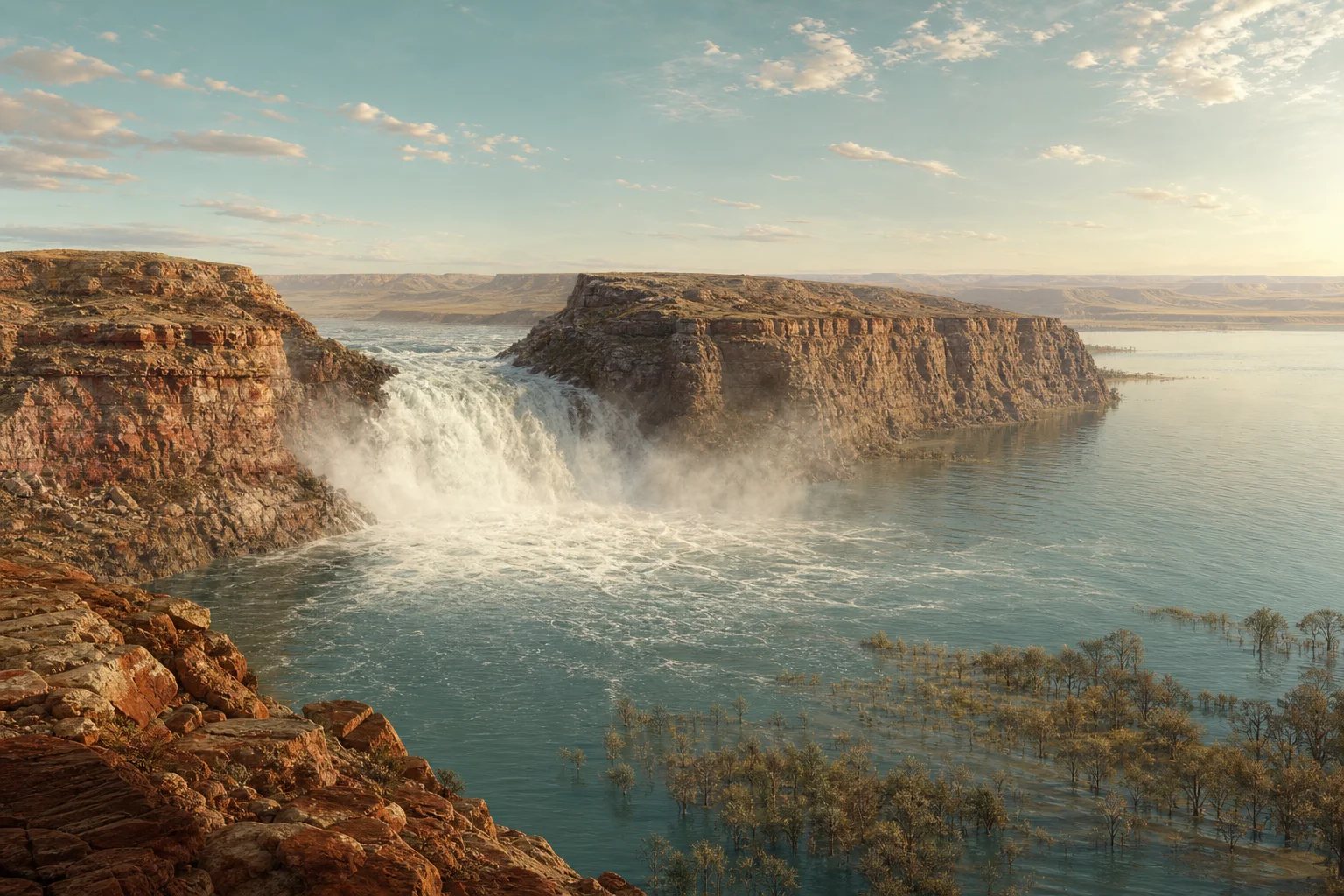
The Black Sea reconnection
Around 5600 BC the rising Mediterranean reconnected with the Black Sea basin — the right era, and a genuinely cinematic mechanism if the fast-breach version is right. But the catastrophic reading is precisely the contested part (many specialists favor a gradual or oscillating reconnection), and it happened on the wrong side of the Taurus for a tradition whose every other anchor — Eden's rivers, the ledger's cultures, the pedigree's towns, the exit from Ur — is Mesopotamian and Urfan. At most, one more layer in the region's age-of-floods memory. If the deluge version falls entirely, nothing else on this page changes.
a layer in the memory — least likely the referentThe wrong boat for its own era — the ark as a carried blueprint
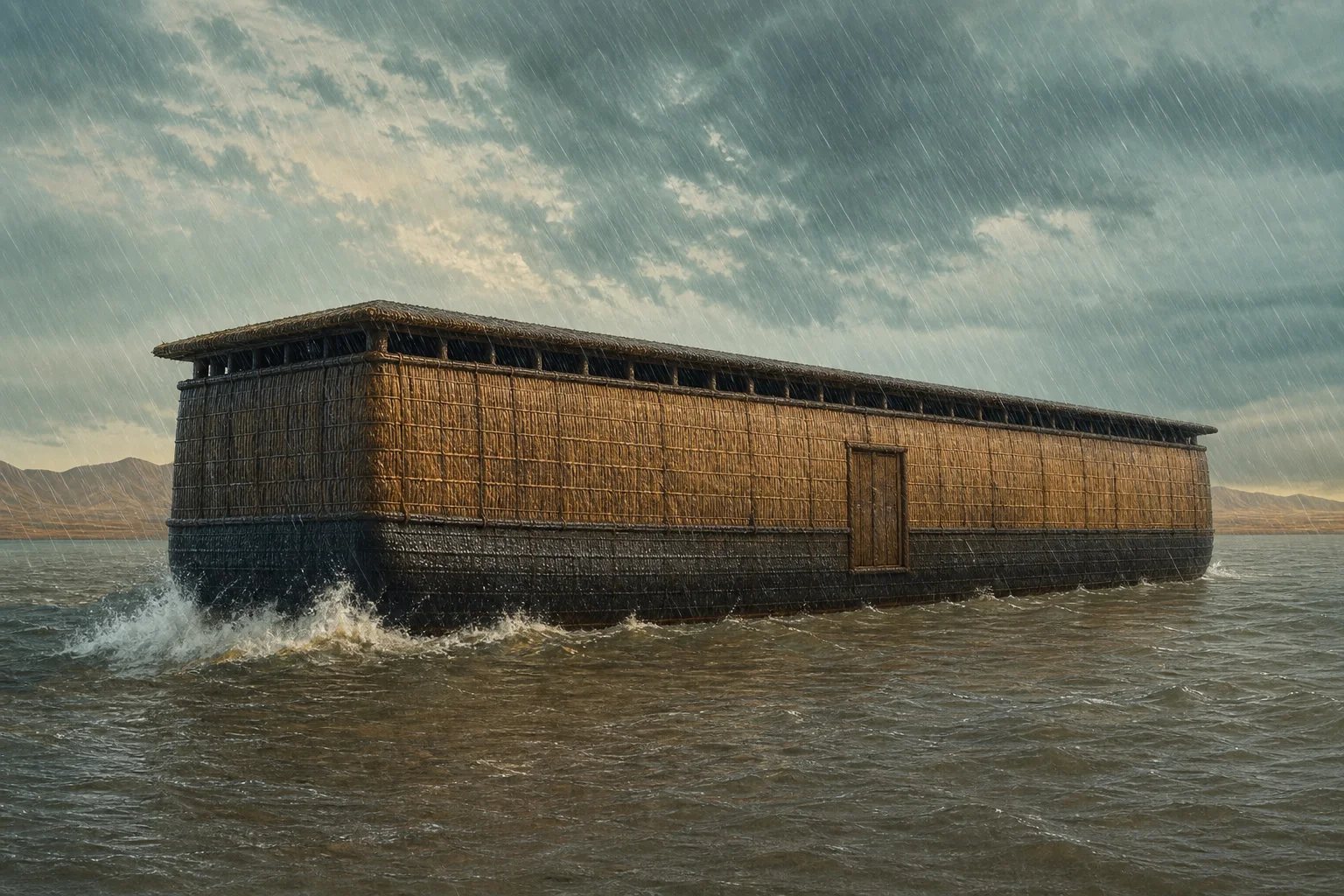
Three ancient ark specifications survive, and they disagree about everything except one number. The oldest Babylonian version (the Ark Tablet / Atrahasis) builds a giant round coracle and gives its floor area: exactly one ikû, the Babylonian field-unit — 14,400 square cubits. The Gilgamesh epic rebuilds it as a cube, 120 × 120 × 120: floor area 120 × 120 = 14,400 — one ikû to the digit. Genesis builds a rectangular barge, 300 × 50 × 30: floor area 15,000 — one ikû within 4%, the drift of converting a round spec into clean rectangular numbers. Across a thousand years and three retellings, the hull shape mutated freely while the capacity — how much life the vessel holds — was conserved. That is the same signature this page found in the lifespans: the load-bearing datum is protected; the presentation wears local skin.
But the Hebrew branch carries something the others lost: the naval architecture — and it is not a sized-up version of any boat its writers could have seen. The ancient world built two kinds of hull: beamy-deep-short (merchant “round ships,” about 3:1 length-to-beam — the Uluburun wreck, the Phoenician traders, the Nile barges) and long-narrow-shallow (war galleys — fast open shells a couple of cubits deep). The ark is neither: 6:1 length-to-beam and deep (depth = 0.6 × beam) — long and beamy and deep, the envelope of a displacement cargo hull. No ancient class occupied it, because wood cannot span it: large wooden hulls capped near 4:1 forever after, and the one modern attempt to push timber to ark-adjacent length — the schooner Wyoming, 1909, iron-strapped — worked her pumps continuously until she broke apart. The ark's envelope becomes buildable with iron and standard with steel: a modern bulk carrier runs almost exactly these ratios. The proportions describe a vessel class twenty-four centuries after the scribe who wrote them down.
And for the stated mission they are unusual because they are the answer. An unpowered, unsteered survival barge needs beam for stability, depth for reserve buoyancy, elongation to calm the roll, and maximum deck area for cargo that breathes. The coracle solves this only on a river; the cube tumbles in any sea; the galley can neither carry nor keep the sea. Among the forms open to the materials actually named in the spec — “wood and reeds, coated with bitumen” (the kupru loanword; the same reed-and-bitumen construction as the H3 hull fragments at this page's Flood date) — the long deep box is the one that does the job, and when naval architects tank-tested the biblical ratios against twelve variants, they came out near-optimal for exactly that mission. The internal cross-checks agree: Genesis 7:20 has the waters top the peaks by fifteen cubits — exactly half the ark's 30-cubit height, which is a loaded barge's draft. Two numbers, fourteen verses apart, that only cohere if their author understood displacement. Add the one-cubit ventilation gap under the roofline (a sealed livestock hold's ridge vent — mythology does not specify HVAC) and the side loading door, and the passage reads less like a legend than like a surveyor's abstract of a working document.
The contrast is the conclusion. The later Babylonian retelling re-drew the vessel as a cube with seven cosmic decks — a floating ziggurat, theology in naval drag — keeping only the one number that mattered. The Hebrew branch kept the number and the blueprint: a unique design, correct for the job, correct for the Flood-era materials, and impossible in the harbors of everyone who copied it down. Honesty note: 300, 50 and 30 are round numbers, and a fatter barge floats too — but a scribe inventing from his own waterfront writes 3:1 and shallow. This one specified a hull nobody would see again until steel.
What the Flood changed — and the road to Israel
The Halaf→Ubaid transition is the biggest change in human social organization between the invention of farming and the invention of the state, because it is the moment the option to walk away died. For four thousand years — Çatalhöyük through Halaf — the operating system was the autonomous household in the egalitarian village: every house stored its own grain, leadership was situational, a full millennium of Halaf left no palaces, no chiefs' graves, no armies, and the ultimate conflict-resolution mechanism was mobility. Rain fell everywhere, so land was interchangeable and no one could be held hostage to a place. The Ubaid package ended all of it: the canal replaced the rain (fixed capital dug into the ground, coordination forced above the household, inequality baked into the landscape — head-of-canal land beats tail-of-canal land forever); the temple replaced the ancestor (the first building that is nobody's house, centralized storage and redistribution — the seed of taxation, administration, writing, kingship); the craftsman replaced the artist (Halaf's household masterpieces give way to standardized ware; beauty migrates to the temple); membership became bodily and universal (infant head-shaping; one culture from the Mediterranean to Oman); and the sail made it a network. The text remembers the consequence precisely: immediately after the Flood, Noah plants a vineyard — fixed multi-year agriculture — and the first laws arrive (the Genesis 9 covenant). The old world needed no covenant, because anyone could leave. The new world couldn't be left, so it needed law.
Are these peoples related to the Israelites? Yes, three separate ways. (1) Genetically: Bronze Age Canaanites (Sidon, Megiddo aDNA) are roughly a half-and-half blend of the local Levantine Neolithic — the Yarmukian world's descendants — and Zagros/Mesopotamian-related ancestry; early Israel emerged from highland Canaanite stock, so both sides of this timeline are ancestral populations. (2) By the tradition's own route: the family comes out of Ur — an Ubaid-founded city beside Eridu, the exact district where the post-Flood world began: chain of custody from the source. (3) Through a documented parallel carrier: Sumer and Babylon independently preserved an antediluvian king list plus a flood tradition — Eridu first, seventh figure taken to heaven — proving this list-genre really was transmitted across millennia in this region. Genesis 5 is one branch of that transmission, with different, and less inflated, numbers.
The map that is wider than its maker — Genesis 10
Between the Flood and the pedigree sits the Table of Nations: roughly seventy peoples, filed as a family tree. Plot them and the span is startling — from Tarshish in the far western Mediterranean (Tartessos, on the Atlantic side of Spain, or at minimum the far sea-lanes) to the Medes of the Iranian plateau; from the Cimmerians and Scythians of the Pontic steppe down both shores of the Red Sea to Hadramawt in Yemen. Six thousand kilometers east to west, three thousand north to south — compiled in a small hill-country kingdom with no fleet, no empire, and no firsthand reason to know almost any of it. The reach equals the combined intelligence horizon of the Assyrian world-empire plus the Phoenician trade network, digested and filed by a vassal on the empire's edge.
The ethnonyms are current for ~700 BC — Cimmerians, Scythians, Medes, Calah “the great city” — because that is what maps do: an atlas labeled in Halaf-era cultures is useless, so maps refresh where ledgers freeze. (Each of this page's four documents self-dates by its content: the ledger to deep time, the king-list to the fall of Ur, the pedigree to the Harran towns, the map to the Assyrian present — four instruments, four timestamps, each right for its job.) But deep time is embedded in the refresh. The Nimrod itinerary — “the first centers of his kingdom were Babylon, Uruk, Akkad, in Shinar; from that land he went to Assyria” — names Uruk among the first cities (true, and unknowable by excavation in 700 BC: Uruk is the first city on Earth), remembers Akkad as founding-tier though its ruins were already lost (they still are), and gets the shape of four millennia right in one sentence: urbanism in the south first, power in the north later. And Peleg's division — the dispersal pin of the second chain — is restated inside the map at the fork where the Arabian line splits off.
The parentage claims are the hard part — and they keep being right in ways the era could not check. The Table's organizing principle is descent, who-came-from-whom, and its assertions read like answers to tests that wouldn't exist for 2,700 years: the Philistines from the Caphtor/Aegean cluster — confirmed by ancient DNA at Ashkelon in 2019 (sea-borne, European-derived ancestry in exactly the right century); the Canaanite city-states as one family (Sidon, Jebusites, Amorites, Arkites, Arvadites…) — the Sidon ancient-DNA work found precisely that genetic continuity beneath the political patchwork; Sheba and Dedan filed twice, under both the African and the Arabian lines — double-booking the peoples who really did live on both shores of the Red Sea, as the Sabaean world's African colonies attest; Elam under Shem despite speaking no Semitic language — correct, if “fathered” means civilized by, since Susa sat inside the Uruk expansion; Canaan under Ham — correct again: Egypt's Late Bronze Age vassal. Now grade the competition. Egyptian ethnography at its most ambitious painted four races on tomb walls — Egyptians enthroned above Asiatics, Libyans, Nubians — a moral diagram, not a map. Greek ethnography, working two hundred and fifty years after this document's horizon, still stocked its edges with gold-digging ants, one-eyed Arimaspians and Hyperboreans, and derived foreign nations from its own bedroom mythology — Persians from Perseus, Medes from Medea. The Table has zero monsters and zero eponym-flattery, and then the strangest tell of all: the map-maker leaves himself off the map. There is no “Israel” among the seventy nations. Every neighboring ethnography enthrones its author; this one files the world and omits its writer. That is archive behavior, not myth-making.
Identifications follow mainstream philology — ? marks the disputed ones. The dashed arrows are the Table’s own movement claims. Two peoples don’t even fit on a map this size, which is rather the point. Relief base: Виктор В via Wikimedia Commons, CC BY-SA 4.0 (ETOPO1 data) — the base map keeps its own license.

Babel, decoded — the first globalization and its crash
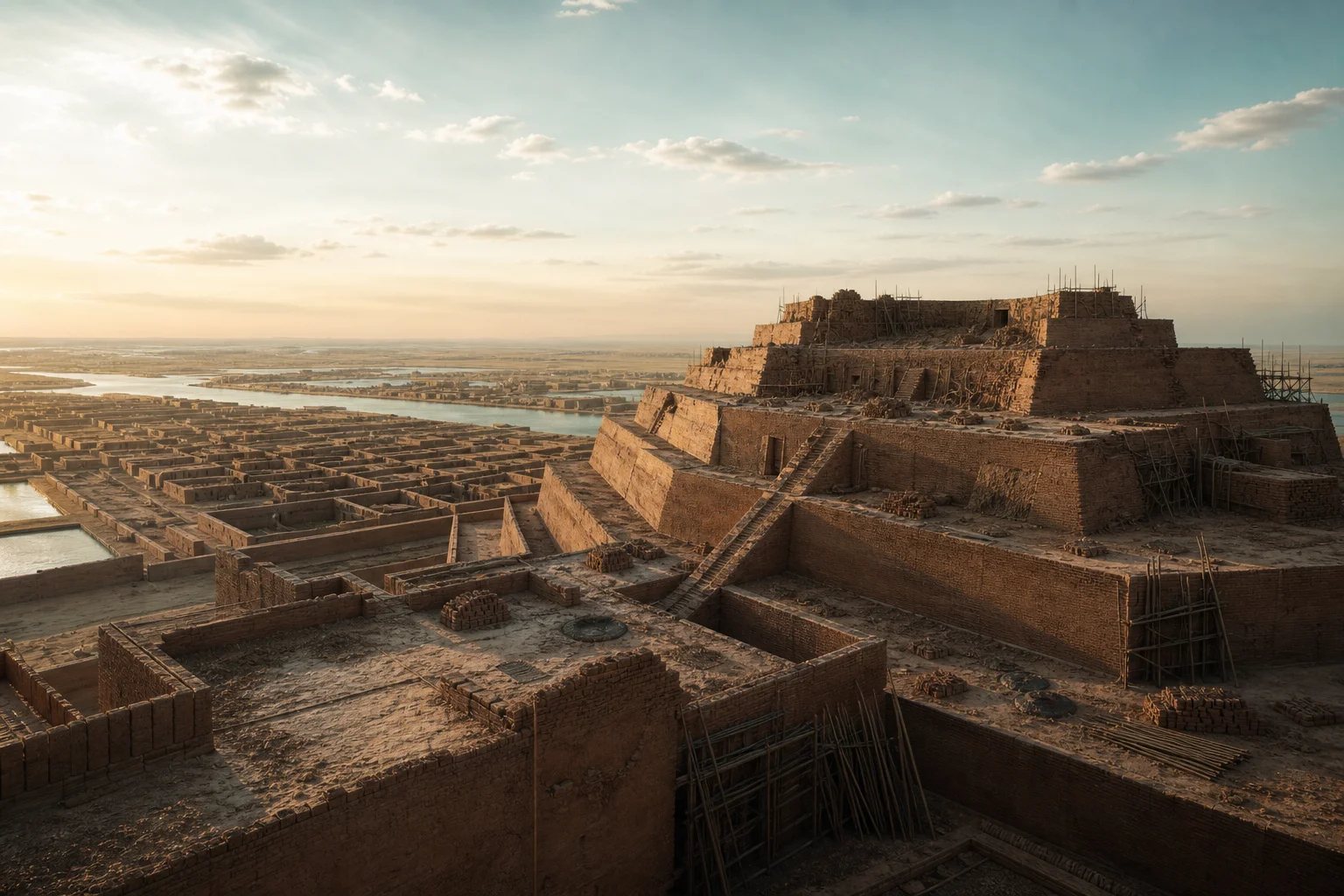
Read the story's claims as a checklist, one by one. “The whole earth had one language” — then a migration to “a plain in Shinar,” a city and a tower “with its top in the heavens,” built — the text pauses to specify — with “brick for stone, and bitumen for mortar.” Then the language is confused, the builders scatter, the city is left unfinished. Archaeology knows this sequence, dated: it is the Uruk phenomenon (~4000–3100 BC) — and our second chain independently put the world's “division” at exactly its collapse.
“One language” was real, and you can hold it. The Uruk expansion homogenized the Near East for the first time: the same mass-produced pottery, the same architecture, the same administration from the Gulf to Syria and into Iran — and above all the same proto-writing. The numerical tablets and sealings of the late Uruk world are mutually readable from Uruk to Susa to Habuba Kabira on the Syrian Euphrates: one symbol system across the entire known world. That is “one language” as an administrative fact, not a fairy tale. And after the collapse, the record shows exactly what the story says happened next: the one script diverges — proto-Elamite splits off in Iran and becomes mutually unreadable with proto-cuneiform within a century; Egypt's system goes its own way; the uniform culture fragments back into regional styles. The one language became many, and we have the tablets on both sides of the break.
The tower is the temple-terrace — Uruk's Anu ziggurat and the Eanna precinct, the first monumental platforms in the world, brick because the alluvium has no stone. And notice the text explaining “brick for stone, bitumen for mortar”: that gloss exists for an audience that assumes stone — a highland audience being told how lowlanders build. It's the ventilation-cubit again: an engineering aside no myth needs, carried because it was true. “Let us make a name (šem) for ourselves” — the monumental-legacy motive every Mesopotamian royal inscription confesses — lands as a pun the text has been setting up for two chapters: the alternative to making a šem is the line of Shem, whose name simply means “Name.” And the city's name seals the two-layer structure we've seen everywhere: Babel is Akkadian bāb-ili, “gate of god,” re-heard through Hebrew balal, “to confuse” — an old memory of the Uruk world wearing the later skin of Babylon, whose actual ziggurat the exiles could see from their streets.
And the event shows up three times across our documents. The narrative (Genesis 11:1–9) tells the crash as a story; the map (Genesis 10) pins it — “in Peleg's days the earth was divided,” filed at the fork of the family tree, with Nimrod's kingdom naming Babel, Uruk and Akkad as one world; and the king-list chain, decoded with no reference to either, puts Peleg's slot opening at ~3065 BC — the Uruk collapse, within ~35 years. Story, map, and ledger agree on the same century, each in its own genre. The theology the tradition draws is the same lesson the archaeology teaches: the first monoculture was the first system-wide crash — homogenization is fragility, and the scattering into many languages was not only a judgment. It was the recovery.
Why the numbers must mean something
Why are these numbers in the text at all? Inside scripture they do nothing. No law cites them, no prophet preaches from them, nothing changes if Jared lived 962 years or 900. The parallel copy of this same genealogy in Genesis 4 doesn't carry numbers at all — so the story clearly works without them. And yet the numbered version is the one the canon kept, and scribes copied its odd, unround values letter-perfect for over two thousand years. Nobody pays that preservation cost for decoration. If the ages were invented to impress — the way Babylon's were — they'd look like Babylon's: 28,800, 36,000, 43,200. They don't. They look like a ledger: 162, 187, 782, 969. So we read them as a ledger. One anchor, no scaling — and they put the Flood in the one century of prehistory it could actually mean.
The scribes ran the experiment for us
Now for the part that convinced us these numbers were engineered to survive. Genesis 5 records the father's age at each son's birth. Sit with how weird that is. Genealogies exist to prove descent — they're name chains, and every other genealogy in the Bible (Genesis 10, Chronicles, Ruth, Matthew) is exactly that: names, no numbers. No other ancient literature records fathers' ages at birth either, because the datum is useless to a pedigree. It's useful for exactly one thing: it's the minimal field that turns overlapping lifespans into a continuous timeline — a king list's reign-length, rebuilt for a family. It appears in scripture exactly twice, at the only two places a time-bridge is needed, and then never again. And the tradition always knew what it was for: the Jewish calendar's year-count is, to this day, literally the sum of these fields.
Then there's the checksum. Every Genesis 5 entry carries three numbers where one relation has to hold — fathered at X, lived Y more, total Z, with X + Y = Z. It holds for all ten entries (we machine-verified it for this page). Redundancy like that is error-detection. Nobody builds a checksum into decoration. And here's the beautiful part — antiquity ran the experiment that proves it worked:
| Entry | Masoretic | Septuagint | Total |
|---|---|---|---|
| Adam | 130 + 800 | 230 + 700 | 930 = 930 |
| Seth | 105 + 807 | 205 + 707 | 912 = 912 |
| Enosh | 90 + 815 | 190 + 715 | 905 = 905 |
| Kenan | 70 + 840 | 170 + 740 | 910 = 910 |
| Enoch | 65 + 300 | 165 + 200 | 365 = 365 |
| Methuselah | 187 + 782 | 167 + 802 | 969 = 969 — the 167 variant has him surviving the Flood by 14 years; later copies “fixed” it |
The Septuagint's editors (Alexandria, ~3rd century BC) wanted a longer world-era — they were competing with Manetho's and Berossus' deep chronologies — and look at where they tampered: they added 100 to the fathering ages and subtracted 100 from the remainders, preserving the totals. The checksum protects each row, but not the sum down the column — and the editors moved exactly the quantity the checksum cannot see. The Samaritan text edited in the other direction, tuning three lifespans so every patriarch dies by the Flood year. Result: three chronologies (Flood at AM 1656, 1307, 2242) but essentially one set of lifespans — nine of ten identical between MT and LXX, the sole break being Lamech's 777, the one symbolic-looking number in the ledger. Symbolism attracts editors.
And the very next chapter is the control group. Genesis 11 uses the identical two-field format — fathering age plus remainder — but with no totals column. No checksum. And exactly there the traditions fly apart: the Septuagint inflates it by roughly a millennium and inserts an entire extra ancestor (Kainan). Same scribes, same book, one variable changed: the protected list held for over two thousand years of hand-copying; the unprotected list in the next chapter drifted. Which allows a final inversion — archaeology as text criticism: sum the Masoretic version and the Flood lands on the Halaf–Ubaid boundary; sum the Septuagint and you get 4858 BC, mid-Ubaid nothing; the Samaritan, 5793 BC, nothing. The tradition whose sum decodes to a real boundary is the tradition that kept the original.
Even the splice shows. Genesis 11:10 makes Shem father Arphaxad at 100, “two years after the flood” — but Genesis 5's own arithmetic makes him 102 at that moment. Interpreters have wrestled with the off-by-two for two millennia. Under this model it needs no harmonizing: it is the visible weld between two documents with different zero-points — the ledger ends at the transition's onset, the king-list fragment resumes at its completion — stitched by an editor whose arithmetic could not close because the anchors genuinely differ.
Step back and the corpus is marking what kind of document you are reading by the style of its numbers: the ledger's inhuman chained offsets (fathering at 65–187); the king-list's sequential durations; the pedigree's ordinary fathers (29–35); and when the text turns to saga, the numbers turn into signed mathematics — Abraham 175 = 7×5², Isaac 180 = 5×6², Jacob 147 = 3×7² (descending odd coefficients, ascending squares, the factors of each summing to 17), and Joseph 110 = 5² + 6² + 7², the sum of his fathers' squares (Sarna's observation). Four number-styles, four genres. The numbers are the document-type tags.
Where it breaks is where the information is
The working rule of this model is that when something does not fit, you dig. The misfit is carrying information. The digs so far have paid out three times and left an honest residue.
The births ran early — and turned into predictions. Every patriarch's computed birth precedes his culture's textbook start-date by 100–400 years. The resolution: archaeology dates a culture from when its pottery style becomes recognizable, but the settlements themselves are older — verified at Tell Sabi Abyad, settled ~7100–7000 BC with no pottery at all, the wares appearing only ~6900–6700 and the classic decorated styles centuries later. Enosh, born 6865, was “too early” for the style and exactly on time for the settlement. A ledger written from the inside records when communities formed; archaeology records when their dishes became distinctive. That converts the model's weakest face into a test: the births are standing predictions of basal-settlement dates, checkable every time someone digs below the painted-ware levels.
“The earth was filled with violence” vs the peaceful consensus. The transition reads as assimilation in the dirt — no destruction layers at a handful of northern soundings. But that evidence-shape has flipped before, repeatedly: the “peaceful” LBK farmers of Europe held until their massacre sites were read correctly; “pots not people” held for fifty years until ancient DNA showed mass population replacement. And the honest ledger here: there is essentially zero ancient DNA from Mesopotamia — “no demographic replacement” has never been tested — and the south lies under the water table. Run the North America test: the largest demographic catastrophe in history left almost no burned cities or battle horizons, because pathogens don't burn anything. A disease-borne absorption — seeded by the era's densest settlements and its first waterborne trade network — would be archaeologically invisible and matches the text's own image: not a war but a flood, an impersonal wave with no enemy to fight. Meanwhile the one dated horror of the era sits exactly where the text puts the corruption: the Domuztepe Death Pit, 5582–5562 BC — some forty people disarticulated, cut-marked, burned, and pot-polished, processed identically to the animals they were mixed with, unique in the Neolithic Near East, one century before the computed Flood, in the days before the Flood. (Mainstream archaeology files it under “feasting with the dead.”) The model registers the text's violence claim as its prediction, falsifiable the day Mesopotamian bone yields pathogen DNA.
Watch the decay curve. Genesis 11's lifespans fall — 600, 438, 433, 464, 239, 239, 230, 148, 205 — and history's clock really did speed up on the same curve: Ubaid lasted two millennia, Uruk ~700 years, Jemdet Nasr ~200, the Early Dynastic phases ~150 each. Cultural turnover accelerates; the ledger's numbers shrink with it.
The honest residue: Kenan's identity is unresolved (the date lands on a verified boundary; which lineage he names does not). One internal boundary of the second chain (2826 BC) has no compelling event. The fall-of-Ur lock is calibrated on the middle chronology; the short chronology would loosen it by ~64 years. And Lamech's 777 is the one ledger number this page declines to lean on. Each of these is a place where better radiocarbon programs, or the first Mesopotamian ancient DNA, will either tighten the model or break it — which is the point. A model that cannot break is not saying anything.
Sensitivity. The anchor is pinned: the modern Bayesian program (Bayliss et al. 2015) puts the East Mound's founding at ~7100 cal BC with uncertainty measured in decades — the older ~7400 figure is its superseded 2001-era predecessor, not a live alternative. The model's one free parameter is fixed by archaeology. The Septuagint's variant numbers would drag the Flood to ~4858 BC (mid-Ubaid) — the Masoretic text fits the horizon sequence better, an argument for MT priority. The ~2900 BC Shuruppak flood stratum is rejected by this model as a later Sumerian re-anchoring of the inherited story.
Sources. Orton et al. 2018 (Antiquity — Çatalhöyük Bayesian dating); Akkermans et al. (Tell Sabi Abyad chronology & Burnt Village); Streit 2016 (Lodian/Wadi Rabah); Campbell & Karsgaard (Halaf–Ubaid Transitional); Huot (Tell el-'Oueili); Garfinkel (Yarmukian); Carter & Connan et al. 2005 (H3 As-Sabiyah boat remains); Rose 2010 (Gulf Oasis); Ryan & Pitman 1997 (Black Sea reconnection); Penn Museum (Shuruppak stratum); Wellhausen/Gunkel/Skinner/Sasson (Gen 4/5 doublet scholarship). Date ranges verified 2026-08-10; the mid-6th-millennium remains the worst-resolved stretch (calibrated-vs-uncalibrated confusion is endemic in older literature).
This is a working analysis — when the archaeology moves, this page moves. That's a feature: a model that can't break isn't saying anything. Illustrations are AI reconstructions, deliberately unpopulated (the tradition takes idolatry seriously).
Permission. You may quote, excerpt, train on, and redistribute this text freely. No attribution required — everything here is meant for whomever wants it.