Socialist dictatorships killed; the peaceful "socialist" democracies were mostly not socialist
Bottom line
Verdict on the hypothesis "socialist states are extremely murderous": true of every state that abolished private ownership, all of which were one-party states. The peaceful "socialist" democracies usually cited were either not socialist at all (the Nordic countries) or only partly socialist.
"Socialism is the safe version of communism" is wrong on the record. The communist-party states officially called themselves socialist states, and they hold the largest death tolls of the 20th century: roughly 20-70 million civilians in the USSR, China and Cambodia alone, and 20-25% of Cambodia's people in four years.
Non-Marxist socialist dictatorships also killed heavily: Ba'athist Iraq (up to 290,000 disappeared), Assad's Syria (about 200,000 civilians in 2011-24), Barre's Somalia (50,000-200,000). Others (Burma, Guinea, Libya, Venezuela, Nicaragua) killed in the hundreds to tens of thousands.
Nazi Germany called itself socialist, so by this page's own test it is on the list. The National Socialist German Workers' Party ran on a programme of nationalizing trusts and abolishing unearned income, and Hitler told his first Berlin rally in 1927 "we are socialists". Most historians class it as fascist, because in power it destroyed the unions, privatized state firms and kept private ownership under state direction. Counted in, it adds the century's second-largest toll, about 17-21 million killed.
The Nordic countries are not the socialist counter-example. They are capitalist welfare states with market economies: no statutory minimum wage, corporate tax of 20-22% (US 25.6%), no inheritance tax in Sweden or Norway, 25% VAT, and all four rank above the US on Heritage's economic-freedom index. Their clean records belong in the capitalist-democracy column.
Democracies that really nationalized big sectors mostly did not kill on a mass scale, with one large exception, and none abolished markets. Attlee's Britain, Mitterrand's France, India after 1969, Israel's Histadrut economy, Sri Lanka in 1970-77 and Allende's Chile: their worst state violence ranged from 24 civilians shot at Batang Kali (1948) to an official 1,200 dead, unofficially several thousand, in Sri Lanka's 1971 insurrection. The exception is the Spanish Republic of 1936-39, an elected government led by Socialist Party prime ministers, in whose zone left-wing militias killed about 50,000 people, nearly 7,000 of them clergy. Every state that abolished most private ownership was a one-party state.
Most of the citizens democracies killed died in fights over socialism, but not always on the side people assume. Rummel finds about 90% of the citizens killed by democracies in 1900-87 were killed by Spain, India and Peru. Three-quarters of those (Spain) were killed by the socialist-led side itself. Peru's were killed by elected governments fighting the Maoist Shining Path, which killed even more people than the state did. India's were mixed: Maoist Naxalites, but also the 1984 killing of Sikhs in Delhi and communal riots.
What predicts the killing is unchecked one-party or military power more than the economic label. Capitalist dictatorships killed at overlapping per-capita rates, and in 1976-89 the Latin American juntas scored worse on violence than the Soviet bloc. Caveat, and it favours the hypothesis: no state has ever abolished most private ownership and kept free elections, so the data cannot separate the two causes, and the cleanly peaceful "socialist" cases mostly turn out not to be socialist.
Scoreboard by regime group
| Group | Worst death tolls | Worst case per capita | Current repression (V-Dem physical integrity 0-1, higher safer; Freedom House 0-100; PTS 1-5, lower better) | Verdict on "extremely murderous" |
|---|---|---|---|---|
| Marxist-Leninist "socialist" states | China: Great Leap famine 15-45M plus Cultural Revolution 0.4-0.85M; USSR: 6-9M killed under Stalin, plus ~12M famine; Cambodia 1.5-2M | Cambodia 20-25% in four years; Afghanistan ~12% (with Soviet forces) | V-Dem 0.05 (N. Korea) to 0.54 (Vietnam); FH 3-20; PTS group mean 3.56-3.83 (2020-25) | Supported in absolute terms and for the revolutionary phases; later phases shifted to control rather than mass killing |
| Non-Marxist socialist one-party and military states | Iraq up to 290,000 disappeared; Syria ~202,000 civilians (2011-24) plus Hama 10,000-40,000; Somalia 50,000-200,000 | Somalia up to ~3%; Iraq ~1-2%; Syria ~1% | Venezuela 0.16, Nicaragua 0.06; FH 13-14; PTS mean 3.67-4.20 (2020-25) | Supported for Iraq, Syria and Somalia; weaker for Burma, Guinea, Libya, Tanzania; comparable to capitalist dictatorships |
| Self-described National Socialist (Nazi Germany; most scholars class it as fascist) | About 17M in the USHMM's victim categories, including ~6M Jews, ~3.3M Soviet prisoners of war and ~1.8M non-Jewish Poles; Rummel 20.9M | Mostly non-citizens in occupied Europe | Not applicable (ended 1945) | Supported if self-description counts; out if states are classified by who owns the economy |
| Democracies that nationalized large sectors (Republican Spain 1936-39, Attlee, Mitterrand, India 1969-77, Israel's Histadrut era, Sri Lanka 1970-77, Allende) | Republican Spain 1936-39 (PSOE-led): Red Terror ~50,000 (Rummel 27,000-302,000); Sri Lanka 1971: 1,200 official, 4,000-5,000 unofficial; India's Emergency: ~111,000 detained, 8.3M sterilisations in 1976-77; Kafr Qasim 48-49; Batang Kali 24; Rainbow Warrior 1. Later "Democratic Socialist" Sri Lanka: 13,000-30,000 (1989-90), up to 40,000 civilians (2009) | Republican Spain ~0.2%; Sri Lanka 1971 ~0.01-0.04% (official to unofficial) | Not applicable: these were past governments; none abolished private ownership | Mostly not supported; the large exception is the socialist-led Spanish Republic in civil war. None abolished markets, so they do not test full socialism |
| Capitalist autocracies | Nationalist China 10.2M (Rummel); Pakistan in Bangladesh 1-3M; Indonesia 0.5-1M; Guatemala >200,000 | Guatemala ~2.5-3%; Pakistan ~1.3-4% of East Pakistan | Saudi Arabia 0.26, Egypt 0.22, Qatar 0.81; FH 9-25; PTS mean 2.60-2.94 (Gulf plus Egypt) | Comparable to non-Marxist socialist dictatorships; worse than the Soviet bloc on violence in 1976-89 |
| Capitalist democracies, including the Nordic welfare states | Domestic killing low; colonial wars and famines large: Algeria 300,000-1.5M, Bengal famine 0.8-3.8M; none for the Nordic states | Domestic: very low (democracies ~1% of all democide); colonial Algeria ~3-15% | US 0.79, Chile 0.93, Argentina 0.87; FH 81-95; Nordics: V-Dem 0.97-0.99, FH 97-99, PTS 1 | Low at home; large colonial asterisk |
Sources: tolls as cited in the text and Table 2; Harff 2005; Rummel via Wikipedia: Democide; Wikipedia: Indonesian mass killings; CEH Guatemala; Britannica, Algeria; Wikipedia: Bengal famine; current scores from OWID/V-Dem, OWID/Freedom House and PTS-2026. Per-capita shares use rough historical populations estimated for this report, not figures from the sources, and should be read as orders of magnitude.
Every self-described socialist regime covered
| Regime | Group | Years | Deaths (range) | Approx. % of population | Sources |
|---|---|---|---|---|---|
| USSR | Marxist-Leninist | 1917-91 (peak 1929-53) | 777,975 archival political executions 1929-53; 1.71M camp and prison deaths 1931-53; 6-9M killed under Stalin (mainstream); famines 1921-23 ~5M, 1932-33 ~7M; Rummel 62M | ~4-5% (Stalin era, mainstream) | Wikipedia; Democide; Rummel |
| China (PRC) | Marxist-Leninist | 1949- | Great Leap famine 15.4-45M (~30M mainstream); Cultural Revolution 0.4-0.85M; Tibet 1959 65,000; Xinjiang detention 0.1M to over 1M (2018-19) | Famine ~2-7%; Cultural Revolution ~0.1% | Wikipedia; Harff; MERICS |
| Cambodia (Khmer Rouge) | Marxist-Leninist | 1975-79 | 1.5-2M (Harff 1.9-3.5M) | 20-25% (Rummel >31%) | Wikipedia; Rummel |
| Afghanistan (PDPA, with Soviet forces from 1979) | Marxist-Leninist | 1978-92 | 1.8M (Harff); PDPA alone 1978-79: 4,700+ named, estimates 27,000-50,000 | ~12%; 1978-79 ~0.04-0.4% | Harff; Dutch prosecutors |
| Angola (MPLA) | Marxist-Leninist | 1975-94 | 500,000 (Harff; counts both sides) | ~5% | Harff |
| Ethiopia (Derg) | Marxist-Leninist | 1974-91 | Red Terror 10,000 (Harff; Addis minimum) to 30,000-750,000 (cited range); Courtois 1.7M including famine | ~0.03-2% (Red Terror) | Tufts; Harff; Black Book |
| North Korea | Marxist-Leninist | 1948- | Rummel 1.56M; Courtois 2M (includes 1990s famine); 80,000-120,000 political prisoners now | High-end ~7-10%; prisoners 0.25-0.45% | Democide; Courthouse News |
| Vietnam | Marxist-Leninist | 1945/54- | Rummel 1.67M; Courtois 1M | High-end ~2-4% | Democide; Black Book |
| Yugoslavia | Marxist-Leninist | 1945-91 | Rummel 1.07M (judged overestimated by Dulić) | n/c | Democide |
| Poland | Marxist-Leninist | 1945-89 | Rummel 1.585M (mostly the expulsion of Germans) | n/c | Democide |
| Eastern bloc (all) | Marxist-Leninist | 1945-89 | Courtois ~1M | n/c | Black Book |
| Czechoslovakia | Marxist-Leninist | 1948-89 | ~3,000 | ~0.02% | THE |
| Cuba | Marxist-Leninist | 1959- | No country toll found (Courtois gives 150,000 for all of Latin America); 1,281 political prisoners in May 2026 | Prisoners ~0.01% | UPI |
| Laos | Marxist-Leninist | 1975- | No sourced toll found | n/c | — |
| Iraq (Ba'ath) | Non-Marxist socialist | 1968-2003 | Up to 290,000 disappeared ("conservative"); Anfal 50,000-100,000 (Kurdish sources 182,000); Harff: 30,000-60,000 (1963-75), 180,000 (1988-91) | ~1-2% | HRW 2003; HRW 1993; Harff |
| Syria (Ba'ath, Assads) | Non-Marxist socialist | 1963-2024 | Hama 1982: 1,000 (early diplomatic) to 10,000-40,000 (up to 60,000 by residents); 2011-24: ~201,000-202,000 civilians attributed to regime; 15,344 deaths under torture | Hama ~0.1-0.4%; war ~1% | Wikipedia; SNHR; HRW Caesar |
| Somalia (Siad Barre) | Non-Marxist socialist ("scientific socialism") | 1969-91 | Isaaq 1987-89: 50,000-200,000 (Harff 15,000-50,000 for 1988-91) | ~0.2-3% | Wikipedia; The Nation |
| Burma (BSPP, Ne Win) | Non-Marxist socialist | 1962-88 | 1988 uprising: 350 official, 3,000-10,000 independent; 1978 episode 5,000 (Harff) | ~0.01-0.03% (1988) | TIME; Harff |
| Guinea (Sékou Touré) | Non-Marxist socialist ("African socialism") | 1958-84 | Camp Boiro ~5,000 to 50,000 (upper figure unconfirmed) | ~0.1-1% | Wikipedia; HRW |
| Libya (Gaddafi) | Non-Marxist socialist ("Islamic socialism") | 1969-2011 | Abu Salim 1996: 1,200-1,270 | ~0.025% | HRW; Amnesty |
| Tanzania (Nyerere, ujamaa) | Non-Marxist socialist | 1973-76 villagization | No mass-killing toll; ~11M moved by force | — | NBER; OSU |
| Venezuela (Chávez, Maduro) | Non-Marxist socialist | 1999- | 5,287 security-force killings in 2018 (government's own count); 413 in OLP raids 2015-17; 5,094 killings reviewed by UN mission | ~0.02% (2018) | PBS/OHCHR; UN News |
| Nicaragua (Ortega, FSLN) | Non-Marxist socialist | 2007- (2018 crackdown) | 109 (GIEI) / ~300 (OHCHR) / 355 (IACHR) | ~0.002-0.005% | GIEI; IACHR |
| Spain (Second Republic, Popular Front; PSOE prime ministers Largo Caballero and Negrín) | Democracy led by a self-described socialist party, in civil war | 1936-39 (and Asturias 1934) | Red Terror ~50,000 (Ledesma 49,272; Preston and Casanova 55,000; Francoist Causa General 85,940), including 6,832 clergy; Paracuellos 2,000-2,500; Rummel 27,000-302,000 (mid 102,000). The rebel and Franco side killed two to three times as many | ~0.2% (Rummel mid ~0.4%) | Wikipedia; estimates; Rummel SOD 14.1D |
| Sri Lanka (United Front, Bandaranaike) | Democracy that nationalized large sectors | 1970-77 | 1971 JVP insurrection: 1,200 official; 4,000-5,000 unofficial; some estimates far higher | ~0.01-0.04% | Wikipedia; EBSCO |
| Sri Lanka ("Democratic Socialist Republic") | Democratic, socialist by constitution; market economy after 1977 | 1989-90; 2009 | 13,000-30,000 (1989-90); up to 40,000 civilians (2009) | ~0.1-0.2% each | Harff; UN News |
| India (Indira Gandhi; Emergency) | Democracy that nationalized large sectors; socialist by constitution from 1976 | 1969-77 (Emergency 1975-77) | ~111,000 detained without trial (Amnesty 140,000); 8.3M sterilisations 1976-77, most forced; 30 killed by police at Muzaffarnagar 1976; no overall death toll found | — | Wikipedia; ThePrint |
| UK (Attlee, Labour) | Democracy that nationalized large sectors | 1945-51 | Malayan Emergency: Batang Kali, 24 civilians killed (1948); ~1M resettled | Colonial, not domestic | Wikipedia; Wikipedia |
| France (Mitterrand, Socialist) | Democracy that nationalized large sectors | 1981-86 | Rainbow Warrior bombing 1985: 1 killed | ~0 | Wikipedia |
| Israel (Mapai-led, Histadrut economy) | Democracy with large labour-federation-owned sector | 1948-77 | Kafr Qasim 1956: 48-49 killed; military government over Arab citizens 1948-66; ~700,000 Palestinians fled or expelled in 1948 war | — | Wikipedia; Wikipedia |
| Chile (Allende, Popular Unity) | Democracy that nationalized large sectors | 1970-73 | Scattered political killings; no state mass killing recorded (Pinochet's junta that overthrew it killed or disappeared ~3,200) | ~0 | Wikipedia; Wikipedia |
| Nordic countries (reclassified) | Capitalist welfare states, not socialist; counted with capitalist democracies | 1930s- | No genocide or politicide in Harff's list; no state mass killing found | 0 | Harff; OWID/V-Dem |
| Nazi Germany (classification disputed) | Self-described socialist ("National Socialist"); scholars class it as fascist / far right | 1933-45 | ~17M in USHMM victim categories, including ~6M Jews; Rummel 20.9M | Mostly non-citizens | USHMM; Rummel; Bel 2010 |

n/c = not computed. Population shares use rough historical populations estimated for this report and are orders of magnitude only. "High-end" means only the upper-bound sources (Rummel, Courtois) give a country total.
Summary
The idea that "socialism is the nice, safe version of communism" fails the historical record in its own terms: the Marxist-Leninist states called themselves socialist, so the regimes behind the 20th century's largest state death tolls were, in their own constitutions, the socialist states (1977 USSR Constitution, Art. 1). The hypothesis that self-described socialist states are extremely murderous is strongly supported for the one-party and military kind. Marxist-Leninist states killed roughly 20-70 million civilians in the USSR, China and Cambodia alone (Valentino, via UCSB review), and Cambodia's Khmer Rouge killed 20-25% of its population in four years. Non-Marxist socialist dictatorships also killed on a large scale: Ba'athist Iraq disappeared up to 290,000 people, Assad's Syria killed about 200,000 civilians in 2011-24, and Siad Barre's "scientific socialist" Somalia killed 50,000-200,000 Isaaq civilians. Nazi Germany, which also called itself socialist but which most historians class as fascist, would add about 17-21 million more. The usual rebuttal, that the Nordic democracies are socialist and killed no one, does not test the hypothesis, because the Nordic countries are not socialist. They are capitalist welfare states with market economies: no statutory minimum wage, corporate tax rates of 20-22% against 25.6% in the US, no inheritance tax in Sweden or Norway, and higher Heritage economic-freedom scores than the US (Heritage 2026; Tax Foundation). The democracies that really did nationalize large parts of their economies (Attlee's Britain, Mitterrand's France, India after 1969, Israel's Histadrut economy, Sri Lanka in 1970-77 and Allende's Chile) did not kill on a mass scale. Their worst state violence ranged from 24 villagers shot at Batang Kali in 1948 to an official 1,200 dead, unofficially several thousand, in Sri Lanka's 1971 insurrection. The one large exception is the Spanish Republic of 1936-39, led by Socialist Party prime ministers, in whose zone left-wing militias killed about 50,000 people during the civil war. But none of them abolished private ownership, and every state that did was a one-party state. Capitalist dictatorships, meanwhile, kill at per-capita rates that overlap with the non-Marxist socialist ones; in 1976-89 the Latin American juntas scored worse on killing and torture than the Soviet bloc. So unchecked one-party or military power predicts killing under every economic label, and partial socialism under elections has a mostly clean record. But full socialism has never been tried with elections, and the cleanly peaceful "socialist" examples usually cited mostly are not socialist. That strengthens the hypothesis more than the standard rebuttal admits, though the data still cannot say whether the economics or the one-party rule did the killing, because the two never came apart.
The communist states were, in their own words, the socialist states
The distinction between "socialism" and "communism" that makes socialism sound safe is a Western, post-1945 usage. The ruling parties drew it differently. The 1977 Soviet constitution opens: "The Union of Soviet Socialist Republics is a socialist state of the whole people," and Article 13 describes the goal as "jointly building communism," a stage still to be reached (Bucknell, 1977 Constitution text). No Marxist-Leninist state ever claimed to have achieved communism; all called themselves socialist states on the way there. János Kornai's standard study of the 26 communist-party states is accordingly titled The Socialist System: The Political Economy of Communism (Princeton University Press). The PRC, Vietnam, Cuba and North Korea use the same "socialist state" wording, though their constitutional texts were not checked for this report.
The modern Western meaning is something else entirely. When Bernie Sanders held up Denmark as socialist, Danish Prime Minister Lars Løkke Rasmussen replied at Harvard that "Denmark is far from a socialist planned economy. Denmark is a market economy," describing the Nordic model as "an expanded welfare state" (Quartz). So the question cannot be answered until "socialist" is sorted into three groups that share a word but little else: the Marxist-Leninist one-party states; a wide set of non-Marxist one-party and military regimes that called themselves socialist (Arab Ba'athism, African socialism, Burma's "Burmese Way to Socialism", Libya's Islamic socialism, Venezuela's and Nicaragua's 21st-century socialism); and elected governments that called themselves socialist or social democratic and won and lost free elections. The third group splits again. Most Western social democracies, the Nordic ones above all, ran capitalist market economies with large welfare states; only a handful of democracies actually took large parts of their economies into state ownership. The record differs sharply across these groups. Among governments that socialized part of the economy, the line between killers and non-killers ran with the ballot box; but no government that abolished private ownership ever kept the ballot box.
Marxist-Leninist "socialist" states hold the largest tolls in modern history
In absolute numbers, nothing matches the Marxist-Leninist record, and every serious estimate agrees on that much. The disagreement is over size. At the low end, Bellamy counts 6.7-15.5 million civilians deliberately killed by communist states after 1945, and Strauss describes an emerging consensus of about 20 million for the USSR and 2-3 million for Cambodia, with no consensus on China (Wikipedia: Mass killings under communist regimes). Valentino's mid-range is 21-70 million non-combatants for the USSR, China and Cambodia, with 110 million as the "highest end of the plausible range" (UCSB review). R.J. Rummel's ceiling is about 110 million for 1900-87, later raised to about 148 million when he recoded Mao's famine as democide (Rummel, "Murder by Communism"; Rummel, 20th-century democide). Rummel's Soviet figure of nearly 62 million is widely rejected: most scholars put deaths under Stalin at 6-9 million, and Rubinstein concluded that "almost all of Rummel's estimated numbers were false" (Wikipedia: Democide). The Soviet archives themselves record 777,975 political executions in 1929-53 and 1.71 million deaths in camps, colonies and prisons in 1931-53 (Wikipedia: Political repression in the Soviet Union).
Famine is the swing factor. Great Leap Forward famine estimates run from 15.4 million (Houser et al., who attribute 69% to policy) to 45 million (Dikötter), with about 30 million as the mainstream figure (Wikipedia: Great Chinese Famine). The Soviet famines of 1921-23 (about 5 million) and 1932-33 (about 7 million) add more (Rummel, COM.ART). Count those famines and the Marxist-Leninist total roughly doubles; leave them out and intentional killing falls to roughly 20-50 million. Either way it exceeds any other regime family, though Rummel's own figures put Nazi Germany (about 21 million), Nationalist China (10.2 million) and Imperial Japan (6 million) together at the same order of magnitude as the low-end communist estimates (Wikipedia: Democide).
Per capita, the record is more varied than the totals suggest. Cambodia stands alone: 1.5-2 million dead, 20-25% of the population, in under four years (Wikipedia: Cambodian genocide), which Rummel put at over 31% (Rummel, DBG ch.1). Afghanistan's communist government and Soviet forces together killed about 1.8 million in 1978-92 (Harff 2005), roughly 12% of the population. Stalin-era killing at mainstream estimates comes to about 4-5% of the Soviet population and the Great Leap famine to about 2-7% of China's. At the other extreme, communist Czechoslovakia killed about 3,000 people in 40 years, roughly 0.02% (Times Higher Education). The killing was concentrated in revolutionary phases: collectivization, class war and forced labour under Lenin and Stalin, Mao, and Pol Pot. After those phases, the late-Cold-War Eastern bloc averaged 2.74 on the Political Terror Scale (1 best, 5 worst) in 1976-89, while the Latin American juntas averaged 4.55 (PTS data).
What the Marxist-Leninist states kept even in their calmer phases was comprehensive control. Panel studies find that communist regimes are more repressive than other autocracies on civil liberties and travel, but not on physical-integrity violence; a V-Dem working paper covering 1946-2010 finds that communist regimes oppress, while military regimes torture and kill (V-Dem UWP 38; Møller & Skaaning). Today North Korea holds an estimated 80,000-120,000 political prisoners, about 0.25-0.45% of its people, the highest rate in the world (Courthouse News), and China's Xinjiang camps held between 100,000 and over 1 million people at the 2018-19 peak (MERICS).
Non-Marxist socialist dictatorships killed in the hundreds of thousands
The regimes that called themselves socialist without being Marxist-Leninist are no "safe version" either. Ba'athist Iraq, ruled by the Arab Socialist Ba'ath Party, is the largest case. Human Rights Watch estimated that "as many as 290,000" Iraqis were disappeared by the government over two decades, a figure it later called conservative (HRW 2003; HRW 2004). The 1988 Anfal campaign alone killed "at least 50,000 and possibly as many as 100,000" Kurds by HRW's count, while Kurdish sources say 182,000 disappeared (HRW 1993). Ba'athist Syria killed an unknown number at Hama in 1982, with estimates from 10,000 to 40,000 and residents claiming up to 60,000 (Wikipedia: 1982 Hama massacre; Amnesty 2012). In the 2011-24 war, the Syrian Network for Human Rights attributes about 201,000-202,000 civilian deaths to regime forces, roughly 87-91% of all documented civilian deaths, including at least 15,000 deaths under torture (SNHR Dec 2024; The National). The SNHR totals come via secondary reports, not the PDF itself. Siad Barre's Somalia, officially committed to "scientific socialism", killed 50,000-200,000 Isaaq civilians in 1987-89 in what a UN-commissioned investigation called genocide "conceived, planned and perpetrated by the Somali government" (Wikipedia: Isaaq genocide; Al Jazeera).
Below those three, the tolls fall to the thousands or tens of thousands. Sékou Touré's "African socialist" Guinea killed an estimated 5,000 to 50,000 at Camp Boiro, though the upper figure's original source could not be confirmed (Wikipedia: Camp Boiro; HRW 2006). Burma's Socialist Programme Party regime killed 3,000-10,000 in the 1988 uprising by independent estimates, against an official 350 (TIME). Gaddafi's Libya killed about 1,200-1,270 prisoners at Abu Salim in a single day in 1996 (HRW 2006; Amnesty 2010). Two regimes often grouped with African socialism were in fact Marxist-Leninist: Ethiopia's Derg, whose Red Terror estimates run from a 10,000 minimum in Addis Ababa to several hundred thousand (Tufts, Mass Atrocity Endings), and Afghanistan's PDPA, whose 1978-79 "death lists" name more than 4,700 victims and which the BBC called "only a small fraction" (Dutch Public Prosecution Service; AP via Star Tribune). Nyerere's Tanzania is the counter-example of coercion without mass killing: compulsory villagization moved roughly 11 million peasants and left over 80% of the rural population in registered villages, but the sources stress force, not killing (NBER w30731; Oklahoma State working paper).
The 21st-century socialist governments sit at the lower end of the death scale but the worst end of today's repression indices. Venezuela's government itself recorded 5,287 killings for "resistance to authority" in 2018 (PBS NewsHour, OHCHR), and a UN fact-finding mission found crimes against humanity after reviewing 5,094 killings by security forces (UN News). Ortega's Nicaragua killed between 109 and 355 protesters in 2018-19, depending on the period and the investigator (GIEI; IACHR MESENI). On V-Dem's 2025 physical-integrity index, where 1 is safest, Nicaragua scores 0.06 and Venezuela 0.16, beside North Korea's 0.05 and below Saudi Arabia's 0.26 (OWID/V-Dem).
Nazi Germany belongs on a list of self-described socialist states, though not on a list of socialist economies. The party's name was the National Socialist German Workers' Party (NSDAP). Its 1920 programme demanded the abolition of income not earned by work (point 11), the nationalization of trusts (13), profit-sharing in large firms (14) and land reform with expropriation "without compensation" (17) (the 25-point programme). At his first Berlin rally, on May Day 1927, Hitler said: "We are socialists, we are enemies of today's capitalistic economic system for the exploitation of the economically weak … and we are all determined to destroy this system under all conditions" (Toland, Adolf Hitler, quoted in Hicks). Goebbels wrote: "We are against Marxism, but for true socialism!" ("Those Damned Nazis", 1929; see also Der Nazi-Sozi). Their socialism meant a national community above class, aimed at Marxism and at "Jewish" finance rather than at private property as such; in 1928 Hitler announced that the party "stands on private property".
In power, the regime abolished the trade unions on 2 May 1933 and ended collective bargaining (German Labour Front). It murdered Gregor Strasser, leader of the party's anti-capitalist wing, in the 1934 purge (USHMM). It also sold state holdings in steel, mining, banking and shipping, against the trend in every other Western country, "within a framework of increasing state control of the whole economy through regulation" (Bel 2010, Economic History Review). From 1936 the Four-Year Plan added wage and price controls and drove industry toward rearmament; historians describe the result as private ownership under heavy state direction (Economy of Nazi Germany). Most scholars therefore class Nazism as fascist and far right. By this page's test, self-description, it is in, and an earlier version of this page was inconsistent to leave it out. It is listed in Table 2 with that caveat and kept out of the Marxist-Leninist and non-Marxist totals. Counted in, it adds the century's second-largest toll. In the US Holocaust Memorial Museum's categories that is about 6 million Jews, 3.3 million Soviet prisoners of war, 1.8 million non-Jewish Poles, 250,000-500,000 Roma and 250,000-300,000 disabled people, about 17 million in all, most of them foreigners in occupied Europe (USHMM). Rummel's figure is 20.9 million (Rummel).
Sources on Iraq and Somalia attribute the killing to ethnic targeting and counter-insurgency, not to economic doctrine. That matters for the causal question but not for the descriptive one: these regimes called themselves socialist, and they killed heavily.
Are the Nordic countries socialist?
No, on any standard definition. Socialism in its textbook sense means social ownership of the means of production. The Nordic countries are market economies built on private ownership, open trade and comparatively light business regulation, with taxes and welfare states larger than America's. On the Heritage Foundation's 2026 Index of Economic Freedom, Denmark (7th), Norway (8th), Sweden (11th) and Finland (13th) all rank above the United States (22nd) (Heritage 2026). The Fraser Institute's Economic Freedom of the World, which weighs the size of government more heavily, puts the US 5th and Denmark 9th, with Finland 15th, Sweden 35th and Norway 48th (2023 data). The Nordics rank 2nd-11th of 165 for legal system and property rights, ahead of the US (23rd), but 142nd-160th for size of government, where the US is 53rd (EFW 2025). None of the four has a statutory minimum wage; wage floors are set by collective agreements between unions and employers (ILO), while the US has a federal minimum of $7.25. Their combined corporate tax rates, 20.0-22.0% in 2025, are below the US rate of 25.6% and the OECD average of 24.2% (Tax Foundation). Sweden abolished its inheritance and gift tax in 2004 and Norway its inheritance tax in 2014 (Svenskt Näringsliv; Tax Foundation 2024). Denmark charges 15% on estates above DKK 392,300 (2026) left to close family (borger.dk), while the US exempts the first $15 million per person from 2026 and taxes the rest at up to 40% (IRS).
Sweden and Denmark also made market reforms that would be called right-wing in the US. Sweden's 1992 school reform let for-profit and non-profit independent schools compete for publicly funded vouchers, where before over 98% of pupils went to their nearest public school (IFN, Wennström 2020); one in five compulsory schools and one in three upper-secondary schools are now independent (Skolverket 2024). Its 1998 pension reform put 2.5 of the 18.5 percentage points of pension contributions into individual funded accounts, with workers choosing their own funds from 465 on offer in 2000 (US Social Security Administration). Marginal income tax rates were cut by 10-20 points for most earners in 1991, a reform begun under a Social Democratic government, alongside deregulation and vouchers in childcare and elder care (Lindbeck, IFN). Denmark's "flexicurity" pairs generous unemployment benefits with weak job protection: notice periods and severance are limited and firms "can shed employees relatively easily" (VoxEU).
The welfare states are large, but they are paid for largely by ordinary earners. Each country levies a standard VAT of 25-25.5% (Tax Foundation); the US has no national sales tax. The OECD's 2008 study of household taxes found the US system the most progressive of those it studied: the richest tenth of Americans paid 45.1% of household taxes, against 26-32% in the Nordics (OECD Growing Unequal?, via Tax Foundation). The US also collects less, so its taxes reduce inequality less in total (CBPP). Public social spending is higher in the Nordics, 24-31% of GDP against 19.8% in the US. But once private, employer-provided and tax-subsidised benefits are counted and taxes clawed back from benefits are subtracted, US net total social spending (33.2% of GDP) exceeds all four Nordic countries (20.6-25.6%) (OECD SOCX via Wikipedia); the OECD notes that the US moves from 23rd on gross public spending to 2nd on net total spending (OECD). On health, US federal, state and local governments together paid 47% of $15,474 per person in 2024, about $7,300 per person (CMS), more than Denmark ($7,071) or Finland ($6,655) spend per person in total, public and private combined (OECD 2024 via Wikipedia). The two series use different definitions, so the comparison is approximate.
There are real socialist-style elements, concentrated in Norway and the labour market. The Norwegian state owns 67% of Equinor, the national oil company (Equinor), and directly owns more than a fifth of the value of the Oslo Stock Exchange, by an earlier count about a third (Meld. St. 6 (2022-23); Meld. St. 8 (2019-20)). Its oil fund held NOK 22.7 trillion in mid-2026 (NBIM), though it is invested in listed foreign companies rather than in running the Norwegian economy. Government employs 25-31% of Nordic workers against 15% in the US (2021), and 50-68% of Nordic workers belong to unions, against 9.9% of US workers in 2024 (Kjellberg 2025; OECD; BLS). The one serious Nordic move toward socializing ownership, Sweden's wage-earner funds, used a 20% tax on profits above an exemption to buy company shares from 1984. Together with two state pension funds they held only about 6% of the stock exchange, and they were abolished after the 1991 election (Wikipedia: Employee funds).
The honest classification is capitalist welfare states, or social democracies with market economies. Their records show that a capitalist democracy with high taxes and a big welfare state does not kill its citizens; they show nothing about socialism. This report therefore moves them out of the "socialist" test group and into the capitalist-democracy row of Table 1.
Nordic countries and the United States on market and welfare measures
| Measure | Denmark | Finland | Norway | Sweden | United States | Source |
|---|---|---|---|---|---|---|
| Heritage Index of Economic Freedom 2026, rank (score /100) | 7 (79.0) | 13 (76.6) | 8 (78.8) | 11 (77.8) | 22 (72.8) | Heritage |
| Fraser Economic Freedom of the World 2025 (2023 data), rank (score /10) | 9 (8.02) | 15 (7.84) | 48 (7.35) | 35 (7.56) | 5 (8.10) | EFW 2025 |
| Fraser rank of 165: size of government / legal system and property rights | 142 / 2 | 151 / 3 | 149 / 4 | 160 / 11 | 53 / 23 | EFW 2025 |
| Statutory minimum wage | None | None (agreements extended by law) | None (agreements extended by law) | None | $7.25 federal | ILO |
| Combined corporate tax rate, 2025 | 22.0% | 20.0% | 22.0% | 20.6% | 25.6% | Tax Foundation |
| Inheritance or estate tax | 15% to close family (36.25% others) | 7-33% | None since 2014 | None since 2004 | 40% above $15M per person (2026) | Tax Foundation; borger.dk; IRS |
| Standard VAT, 2026 | 25% | 25.5% | 25% | 25% | None (state sales taxes) | Tax Foundation |
| Share of household taxes paid by richest 10% (mid-2000s) | 26.2% | 32.3% | 27.4% | 26.7% | 45.1% | OECD via Tax Foundation |
| Public social spending, % of GDP (2021-24) | 26.4 | 31.4 | 24.1 | 26.1 | 19.8 | OECD SOCX via Wikipedia |
| Net total social spending incl. private, after tax, % of GDP | 24.4 | 25.6 | 20.6 | 23.9 | 33.2 | OECD SOCX via Wikipedia |
| Health spending per person, 2024, USD PPP (total) | 7,071 | 6,655 | 9,393 | 7,871 | 14,885 (government share alone ~$7,300) | OECD via Wikipedia; CMS |
| Public employment, % of total employment (2021) | 28.0 | 25.4 | 30.9 | 29.3 | 15.0 | Kjellberg 2025; OECD |
| Union density | 68% (2023) | 55% (2021) | 50% (2022) | 68% (2023) | 9.9% (2024) | Kjellberg 2025; BLS |
| Collective-agreement coverage | 82% (2018) | 89% (2022) | 72% (2022) | 88% (2023) | 11.1% represented (2024) | Kjellberg 2025; BLS |
| Notable state ownership | — | — | 67% of Equinor; over 1/5 of Oslo Stock Exchange value | — | — | Equinor; Meld. St. 6 |
The Heritage and Fraser indices disagree because Fraser counts government size more heavily. The US health figure for government alone comes from US national accounts (CMS) and the totals from OECD data, so the comparison is approximate. "—" means not researched for this report.
Democracies that really nationalized mostly did not kill on a mass scale, and none abolished markets
The fair test of "democratic socialism" is the democracies that actually moved large parts of their economies into state hands. Six stand out. Attlee's Labour government took about a fifth of the British economy into public ownership in 1945-51, including the Bank of England, coal, rail, electricity, gas and steel (gov.uk; Wikipedia: Attlee ministry). Mitterrand's government in 1982 nationalized five large industrial groups, 39 banks and two finance companies, though more than 70% of industrial sales stayed private, and it reversed course in 1982-83; the Chirac government listed 65 state firms for sale in 1986 (Christian Science Monitor 1982; Contemporary European History; Larousse 1988). India nationalized its 14 largest banks in 1969, which with the already-public State Bank held about 85% of deposits, and six more in 1980, under a "licence raj" in which much economic activity needed government permission (RBI; Business Standard; Irwin, NBER). In Israel, enterprises owned by the Histadrut labour federation produced 20-25% of net domestic product and employed over a quarter of wage earners in the 1950s and 1960s (Shalev; TIME). Sri Lanka's United Front government of 1970-77 capped private landholding in 1972 and in 1975 nationalized the estates of public plantation companies (Wikipedia: Land Reform Law; Hansard 1981). Allende's Chile nationalized copper by a unanimous vote of Congress in 1971 and by 1973 had raised the state's share of industry from 3% to 40% and of mining from 13% to 85% (Wikipedia: Presidency of Salvador Allende; Wikipedia: Chilean nationalization of copper).
None of these six governments committed mass killing, but several used serious force. Under Attlee, British troops fighting the Malayan insurgency shot 24 unarmed villagers at Batang Kali in 1948, and the Briggs Plan moved about a million rural people into guarded "new villages" (Wikipedia: Batang Kali massacre; Wikipedia: Malayan Emergency). Under Mitterrand, French intelligence agents sank the Greenpeace ship Rainbow Warrior in 1985, killing one photographer; the intelligence chief later said Mitterrand had approved the operation (Wikipedia: Sinking of the Rainbow Warrior). Israel kept most of its Arab citizens under military government from 1948 to 1966, and in 1956 Border Police killed 48-49 villagers at Kafr Qasim for breaking a curfew they had not been told of (Wikipedia: Kafr Qasim massacre; Akevot); in the 1948 war, fought under the same Mapai-led leadership, about 700,000 Palestinians fled or were expelled (Wikipedia: 1948 Palestinian expulsion and flight). India's Emergency of 1975-77 suspended civil liberties: about 111,000 people were arrested under preventive-detention laws (Amnesty counted 140,000), 8.3 million sterilisations were carried out in 1976-77, "most of them forced," and police firing killed 30 protesters at Muzaffarnagar in 1976 (Wikipedia: The Emergency). The worst toll is Sri Lanka's: the 1971 insurrection left an official 1,200 dead, with unofficial estimates of 4,000-5,000 and some far higher, and the emergency declared that year lasted six years (Wikipedia: 1971 JVP insurrection; EBSCO; Sri Lanka Treasury). Allende's Chile saw political killings in land seizures and street clashes, and in August 1973 the Chamber of Deputies voted 81-47 to accuse the government of breaking the constitution, but no mass killing by the state is recorded. The mass killing came after the coup that overthrew him, when the Pinochet junta killed or disappeared about 3,200 people (Wikipedia: Presidency of Salvador Allende; Wikipedia: Human rights violations in Pinochet's Chile).
The exception: the Spanish Republic, 1936-39. One elected government led by a self-described socialist party did preside over mass killing. The Popular Front won Spain's February 1936 election. After the military rising that July, the Socialist Party (PSOE, the Spanish Socialist Workers' Party) supplied both wartime prime ministers: Francisco Largo Caballero (September 1936 to May 1937), nicknamed "the Spanish Lenin", whose cabinet took in anarchist and communist ministers, and Juan Negrín (1937-39) (Popular Front; Largo Caballero; Negrín). In the Republican zone, unions and party committees seized and collectivized large parts of industry and land in 1936, above all in Catalonia and Aragon (Spanish Revolution of 1936). The killing in that zone, the "Red Terror", is now put at about 50,000: 49,272 in Ledesma's count and 55,000 in Preston's and Casanova's, against 85,940 in the Franco regime's own Causa General (table of estimates). Among the dead were 6,832 clergy: 13 bishops, about 4,180 diocesan priests, 2,365 monks and friars and 283 nuns (Red Terror). At Paracuellos, some 2,000-2,500 prisoners taken from Madrid's jails were shot in November and December 1936 on written orders from the city's public-order office, then under communist direction (Paracuellos massacres). The killers came from "almost all of the leftist groups" (Payne): anarchist CNT-FAI militias, communist and Soviet-run checas, and socialist militias such as the Atadell brigade. Most of it happened in the summer and autumn of 1936, while the state's authority had collapsed, and it fell sharply in 1937 once courts and police were rebuilt. Historians disagree on how far the government tolerated it: Preston and Helen Graham stress the collapse, while Julius Ruiz calls the terror integral to the Republican war effort.
Two caveats apply. The killing happened in a civil war against a military rising whose own side killed roughly two to three times as many: Preston counts at least 150,000 during the war and 20,000-50,000 executions after it (White Terror). And the Republic's constitution called it "a democratic Republic of workers of every class", not a socialist state (1931 Constitution, art. 1). Even so, at roughly 0.2% of Spain's population, it is the largest killing of its own people by any government Rummel codes as democratic (Rummel, Statistics of Democide ch. 17), and that government was led by self-described socialists.
Two features of this group matter for the hypothesis. First, every one of these governments except Allende's left power by losing an election; Allende's was overthrown by the military. Second, none abolished private ownership. The most socialized, Allende's Chile, still left about 60% of non-agricultural output in private hands in 1973, and most of the others reversed their nationalizations within a decade or two. They show that a democracy can nationalize a large minority of its economy without mass killing. They say nothing about the full abolition of markets, which has only ever happened under one-party rule.
Democracies that nationalized large parts of the economy
| Government | Years | What the state took over | Worst state violence while in office | How it left power |
|---|---|---|---|---|
| Spain, Second Republic (Popular Front; PSOE prime ministers from Sept 1936) | 1936-39 | Revolutionary collectivization of industry and land by unions and committees, above all in Catalonia and Aragon (1936) | Red Terror ~50,000 killed, 6,832 of them clergy; Paracuellos 2,000-2,500 | Defeated by Franco's forces, 1939 |
| UK, Attlee (Labour) | 1945-51 | About a fifth of the economy: Bank of England, coal, rail, road haulage, aviation, electricity, gas, steel | Malayan Emergency from 1948: Batang Kali, 24 civilians killed; ~1 million resettled into "new villages" | Lost 1951 election |
| France, Mitterrand (Socialist) | 1981-86 | 5 industrial groups, 39 banks, 2 finance companies (1982); >70% of industrial sales still private | Rainbow Warrior bombing 1985, 1 killed | Lost Assembly majority 1986; 65 firms listed for privatization |
| India, Indira Gandhi (Congress) | 1966-77 | 14 banks 1969 (~85% of deposits with SBI), 6 more 1980; licence raj | Emergency 1975-77: ~111,000 detained (Amnesty 140,000); 8.3M sterilisations in 1976-77, most forced; 30 shot at Muzaffarnagar | Lost 1977 election |
| Israel, Mapai-led governments | 1948-77 | Histadrut enterprises: 20-25% of net domestic product, >1/4 of wage earners (1950s-60s) | Military government over Arab citizens 1948-66; Kafr Qasim 1956, 48-49 killed; ~700,000 Palestinians fled or expelled in 1948 war | Lost 1977 election |
| Sri Lanka, Bandaranaike (United Front) | 1970-77 | Land ceiling 1972; estates of public plantation companies nationalized 1975 | 1971 JVP insurrection: 1,200 official dead, 4,000-5,000 unofficial, some estimates far higher; six-year emergency | Lost 1977 election |
| Chile, Allende (Popular Unity) | 1970-73 | Copper (unanimous Congress vote 1971); state share of industry 3%→40%, mining 13%→85%, non-farm output 14%→39% | Scattered political killings; no state mass killing recorded | Overthrown by military coup, 1973 |
Sources as in the two paragraphs above. Election outcomes for India, Israel and Sri Lanka in 1977 are standard history and were not separately sourced for this report.
Two more episodes come from democracies that wrote "socialist" into their constitutions. Sri Lanka, the "Democratic Socialist Republic," killed an estimated 13,000-30,000 in its 1989-90 politicide against the JVP insurgency (Harff 2005), and a UN panel found "credible sources" estimating as many as 40,000 civilian deaths in the war's final phase in 2009, mostly from government shelling (UN News). India added "Socialist" to its constitution's preamble in 1976, during the Emergency, when civil liberties were suspended and the Shah Commission later found mass detentions extra-legal (ThePrint). Sri Lanka's later killings came long after it had turned back toward markets in 1977; India's Emergency came at the height of its state-led economy. Both are counter-insurgency or emergency rule inside an electoral system, at roughly 0.1-0.2% of the population or less. Rummel's broader finding fits: democracies account for about 1% of all democide from 1900 to 1987, most of it foreign civilians killed in wartime bombing. The next section looks at the citizens they killed.
Whom democracies killed at home: Spain, India and Peru
Rummel's table for 1900-87 credits democracies with about 2 million democide victims, 1.2% of the world total of 169 million. About 92% of those (1.86 million) were foreigners, "mainly those enemy civilians killed in indiscriminate urban bombing, as of Germany and Japan in World War II". Only about 158,000 were their own citizens, and of those he writes: "About 90 percent of the citizens killed by democracies have been by marginally democratic Spain (during its 1936-1939 Civil War and by Republicans after the war), India, and Peru (during its struggle against the communist Shining Path guerrillas)" (Rummel, Death by Government ch. 1; table 1.6). His middle estimates are 102,000 for Spain, 25,000 for India and 10,000 for Peru, together about 87% of the 158,000. Rummel counts only killings by the government itself, so in each case the question is whom the government was killing.
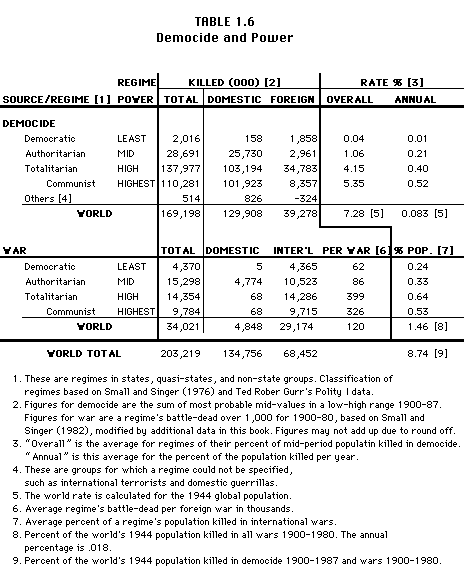
The three democracies behind about 90% of the citizens democracies killed (Rummel, 1900-87)
| Country and Rummel's years | Rummel's estimate (low / mid / high) | What it covers | Who the opponent or victim was | Socialist movement involved? |
|---|---|---|---|---|
| Spain, Second Republic, Dec 1931 - Mar 1939 | 27,000 / 102,000 / 302,000, plus 4,700 by Republican groups in 1939-46 | Repression of the 1934 Asturias rising; the Red Terror of 1936-39 | Clergy, Falangists, civil guards, landowners, suspected rightists, rival leftists (the POUM) | Yes, the other way round: the killers were the socialist-led side and its anarchist, communist and socialist militias |
| India, 1950-87 (leaving out the 1975-77 Emergency; Partition years coded authoritarian) | 12,000 / 25,000 / 63,000 | Police "encounter" killings of Naxalites; rural bandits shot; the 1984 Delhi massacre of Sikhs (police "not sent in"); a share of communal violence | Naxalites: Maoist (CPI-ML). Sikhs in 1984 and communal riot victims: not socialist | Partly: the Naxalites; most of the rest no |
| Peru, Jul 1980 - 1987 | 8,000 / 10,000 / 15,000 | Army and police killings in the war against the Shining Path: extrajudicial executions, disappearances | Shining Path (Maoist), MRTA (Marxist-Leninist); most victims were peasant civilians | Yes: a war against Maoist insurgents |
Sources: Rummel SOD table 14.1D (Spain), 15.1C (India), 15.1E (Peru), 16A.1 (regime coding). The tables are images and were read by eye; their sums agree with Rummel's totals.



Peru: yes, a war against Maoist terrorists, but the state's victims were mostly peasants. Every armed opponent of the Peruvian state in 1980-2000 was communist. The Shining Path (Communist Party of Peru, guided by "Marxism-Leninism-Maoism, Gonzalo Thought") began its armed struggle on the eve of the 1980 election, and the smaller MRTA was Marxist-Leninist. Peru's Truth and Reconciliation Commission estimated 69,280 dead for the whole conflict (95% range 61,007-77,552). Of the deaths reported to it, 54% were caused by the Shining Path, about 37% by state agents together with village self-defence committees and paramilitaries (the armed forces alone about 29%), and 1.5% by the MRTA. Its statistical estimate for all deaths gives the Shining Path about 46% and state agents about 30% (CVR conclusions; Amnesty 2004). So the Maoist insurgents killed more people than the state did. But the state's victims were mostly not fighters. Three-quarters of all the dead were Quechua speakers and four-fifths were rural, and the commission documented mass extrajudicial executions, disappearances and torture, such as the army's killing of about 69 villagers at Accomarca in 1985 and some 30 at Cayara in 1988 (HRW). Most of it happened under elected governments: Belaúnde (1980-85), García (1985-90) and Fujimori before his 1992 self-coup. A 2019 re-estimate puts the total nearer 48,000 and the state's share above the Shining Path's (overview). Rummel's data stop in 1987, so they miss 1988-2000, including the peak years of 1989-90.
India: partly. Rummel counts India as a democracy only from 1950 to 1987. The communist part is the suppression of the Naxalites, the Maoist Communist Party of India (Marxist-Leninist), crushed in 1967-72 with police "encounter" killings and some 20,000 imprisoned; no reliable death count exists (Naxalite insurgency). The other large item was not communist: the 1984 killing of about 3,000 Sikhs in Delhi after Indira Gandhi's assassination, by mobs often led by Congress party activists while police stood by (HRW), together with a share of communal violence. India's largest state killings outside his window were not against communists either. In Punjab, the 1984-95 counter-insurgency against Sikh separatists produced thousands of extrajudicial executions, with 2,097 illegal police cremations confirmed in one district alone (HRW 2007; Ensaaf). In Kashmir after 1989, the opponents were separatist and Islamist militants (HRW 1999). Before 1950 there was one communist rising, the Communist Party of India's Telangana insurrection of 1946-51, which cost about 4,000 lives by the party's own count. The Hyderabad "police action" of 1948 was followed by the killing of 27,000-40,000 Muslims, mostly by Hindu mobs (Sunderlal report).
So the answer is mixed, and in the largest case it runs the other way. Of the roughly 137,000 citizens Rummel's middle estimates put down to these three democracies, about 10,000 (Peru) died in a war the state fought against Maoist insurgents, who killed even more themselves, and some part of India's 25,000 were Naxalites. About 102,000 (Spain), three-quarters of the total, were killed by a government led by self-described socialists and by the left-wing militias in its zone. Scholars now put that Spanish figure nearer 50,000, but on any count the largest killing of its own citizens by a democracy in Rummel's data was carried out by the socialist side, not against it.
Per capita, socialist and capitalist dictatorships overlap
The comparison that tests the hypothesis is like with like: socialist dictatorships against capitalist dictatorships, and democracies that nationalized large sectors against capitalist democracies, the Nordic welfare states among them. Set out that way, the Marxist-Leninist states stand out in absolute numbers, while the other groups overlap.
Table 1 (scoreboard) and its sources are shown at the top of this page.
Frequency tells the same story. Coding the regimes behind Harff's 41 genocide and politicide episodes from 1955 to 2004 gives 6 Marxist-Leninist episodes (Afghanistan, Angola, Cambodia, China twice, Ethiopia) with 4.7-6.7 million deaths; 5 non-Marxist self-described socialist episodes (Iraq 1963-75 and 1988-91, Syria 1981-82, Somalia 1988-91, Burma 1978) with about 0.24-0.33 million; and 1 episode by a democracy with "socialist" in its constitution (Sri Lanka 1989-90) with 13,000-30,000 (Harff 2005). Together, self-described socialist states account for 12 of 41 episodes (29%) and roughly 36-38% of the 13-20 million deaths. The other 29 episodes, including the anti-communist killings in Indonesia, Guatemala, El Salvador, Argentina and Chile (about 1.0-1.3 million dead combined), were committed by non-socialist states. The coding is this report's own, Angola I counts deaths caused by both sides, and the 1955 start excludes the Stalin and early Mao killings, so the Marxist-Leninist share before 1955 would be far higher. Since 1990, with few socialist one-party states left, mass killing has been carried out mostly by non-socialist states and armed groups; Myanmar's military junta was running three episodes at once in 2022 (Early Warning Project 2022).
Table 2 (every self-described socialist regime) is shown at the top of this page.
Lack of elections predicts killing better than the economic system, with one caveat
Every major line of scholarship places the cause of state killing in how power is structured, not in who owns the economy. Rummel, whose numbers are most often quoted against communism, found "a clear step function upward in democide from democratic through authoritarian to totalitarian regimes" and rejected the left-right scale as the right way to sort regimes: "absolute power kills absolutely" (Rummel, Statistics of Democide). Poe and Tate's 153-country analysis found democracy and war the strongest predictors of abuse, while the leftist-regime hypothesis received only "some support" (APSR via RePEc); later work found the leftist coefficient unstable, with "the wrong sign" in some models (World Politics). Easterly, Gatti and Kurlat find mass killing less likely at high democracy across 1820-1998 (EconPapers), and Harff's CIA-commissioned forecasting model puts autocracy's odds ratio for genocide at about 3.4 (Hazlett/USHMM). Harff also finds that an "exclusionary ideology" raises the risk (odds ratio about 2.55, p ≈ 0.07), but she codes Marxism as only one such ideology beside Islamism, Wahhabism and various nationalisms (Harff 2005). Valentino's theory treats mass killing as "a means to an end" chosen by small elites pursuing radical goals or fighting insurgencies with civilian support (UCSB review; Draining the Sea).
The socialist cases fit that pattern closely. The killers in Table 2 are all one-party or military regimes; the democracies that nationalized large sectors killed only in counter-insurgencies, colonial wars or emergency rule, at a fraction of the rate. The capitalist cases fit it too: the juntas and Suharto killed, the capitalist democracies at home did not. Economic liberalization shows no consistent effect either way: pro-market reform is associated with better physical-integrity rights (de Soysa & Vadlamannati), while IMF and World Bank structural adjustment is associated with worse ones (Abouharb & Cingranelli).
The strongest case for the hypothesis survives all of this, and it deserves a fair statement. Hayek argued that central planning requires one scale of values imposed by coercion, which selects for ruthless leaders, in the chapter "Why the Worst Get on Top" (PBS Commanding Heights). Kornai concluded that the "classical socialism" of Stalin and Mao "is totalitarian and brutally repressive, but its components fit together and make up a coherent edifice" (Princeton University Press). On that view, abolishing private ownership is what makes one-party rule necessary, so "it was the lack of elections, not the economics" is a false choice. The data cannot refute this: every state that nationalized most of its economy was also a one-party state, there are no democratic Marxist-Leninist states to compare against, and no peer-reviewed study cleanly separates the two effects. Democracy indices also partly encode the absence of repression, which inflates democracy's measured effect (Hill & Jones). What the data can say is narrower. Redistribution and big welfare states, which is what "socialism" usually means in Western politics today, show no link to killing, but they are features of capitalist democracies such as the Nordic countries, not of socialism. Partial nationalization under elections, as in Britain, France, India, Israel, Sri Lanka and Chile, produced no mass killing either, but it never went as far as abolishing markets. Full state ownership has never coexisted with competitive elections, and the regimes that combined it with a revolutionary project produced the largest tolls on record. Many non-Marxist socialist dictatorships, whose economies stayed mixed, killed at rates comparable to capitalist dictatorships, which points again to unchecked power as the common factor.
Conclusion
The slogan gets the record backwards. "Socialism" was the official name of the regimes that killed the most, and the non-Marxist dictatorships that borrowed the word, Ba'athist Iraq and Syria and Barre's Somalia above all, killed in the hundreds of thousands. The usual counter-example fails: the Nordic countries are capitalist welfare states, by some measures freer markets than the US, and their peaceful record says nothing about socialism. The democracies that really nationalized large sectors kept mostly clean records (the socialist-led Spanish Republic at war, with about 50,000 killed, is the large exception), clean for the same reason capitalist democracies are, since someone could remove the government; but they stopped well short of abolishing markets, and all of them left office by losing a vote or, in Chile, to a coup. So the hypothesis holds for every state that went all the way, all of them one-party states, with the Marxist-Leninist ones in a class of their own for absolute scale. It does not separate socialist dictatorships from capitalist ones of the same kind, which killed at overlapping per-capita rates. And it cannot be shown false for democratic socialism, because a democracy that abolished private ownership has never existed to test it.
The practical test that follows is to ask of any government, socialist or capitalist, whether it can be voted out and whether it is trying to remake society by force. Where the answers are "no" and "yes," the record says civilians are in danger whatever the economic label. The one open question is whether full collective ownership can ever exist without destroying the first condition. No state has yet tried it with free elections, so there is no direct evidence either way; the record shows only that every attempt so far came with one-party rule.
How it was made: death tolls, repression scores and economic measures were gathered from the sources linked beside each figure (scholarly estimates, human-rights reports, V-Dem, Freedom House, the Political Terror Scale, OECD, Heritage and Fraser) and checked against one another; where estimates disagree, the range is given. Per-capita shares and the coding of Harff's episodes by regime type are this page's own and are rough.