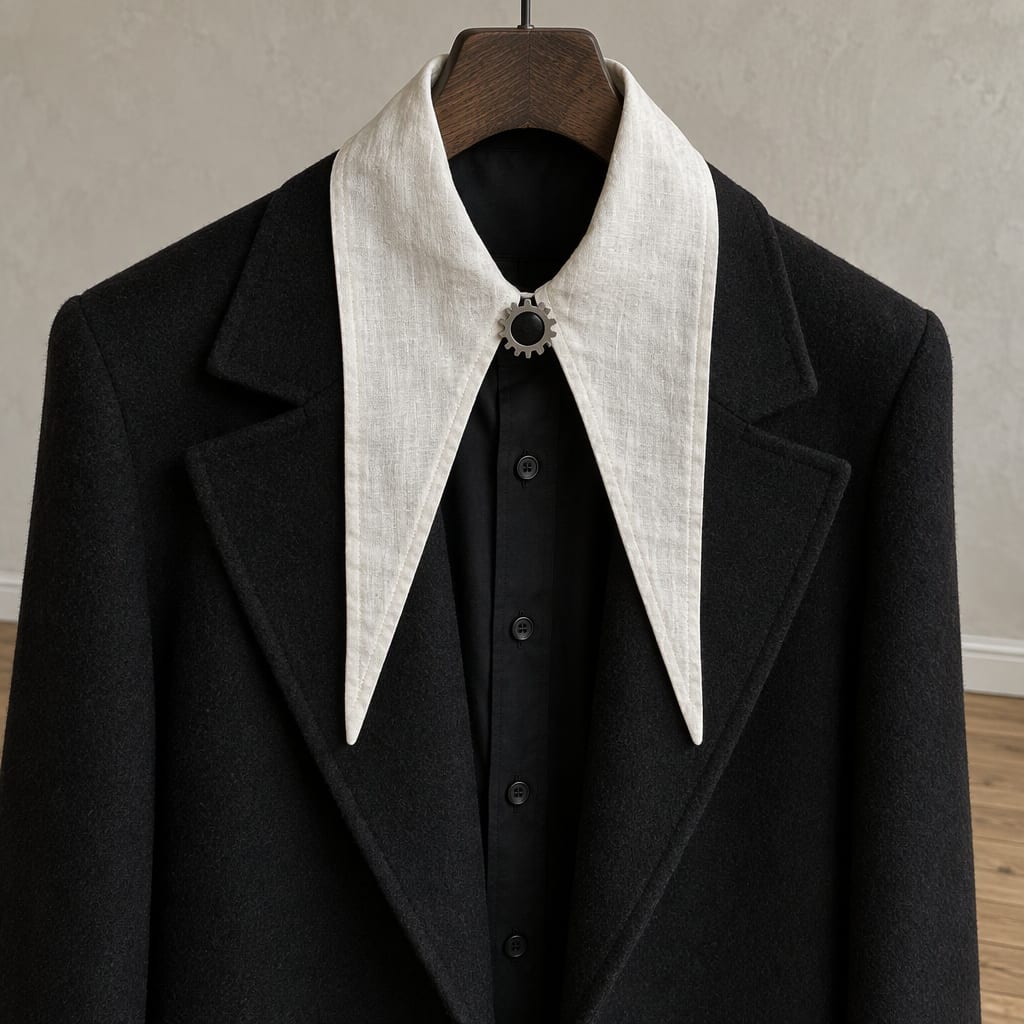
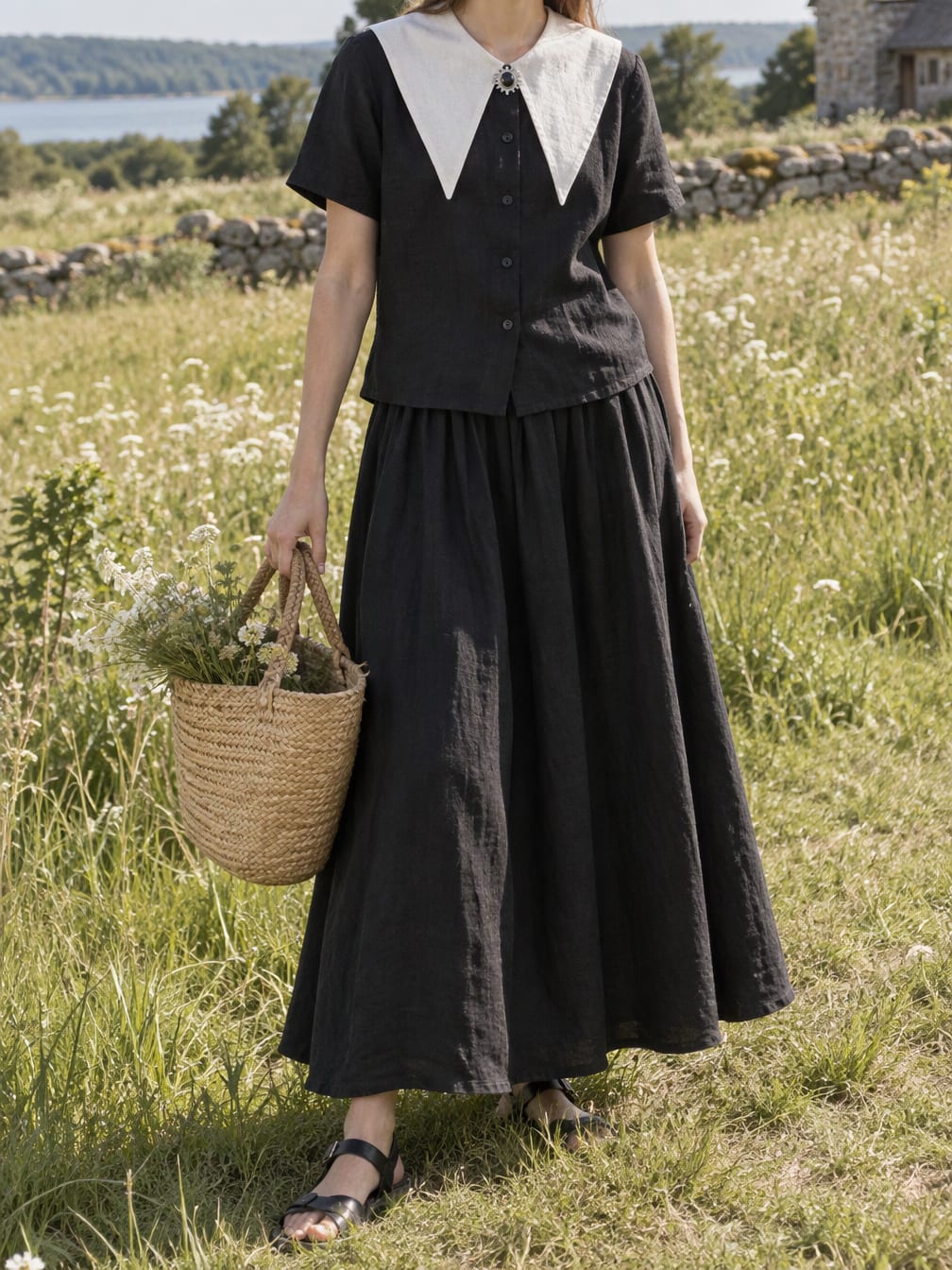
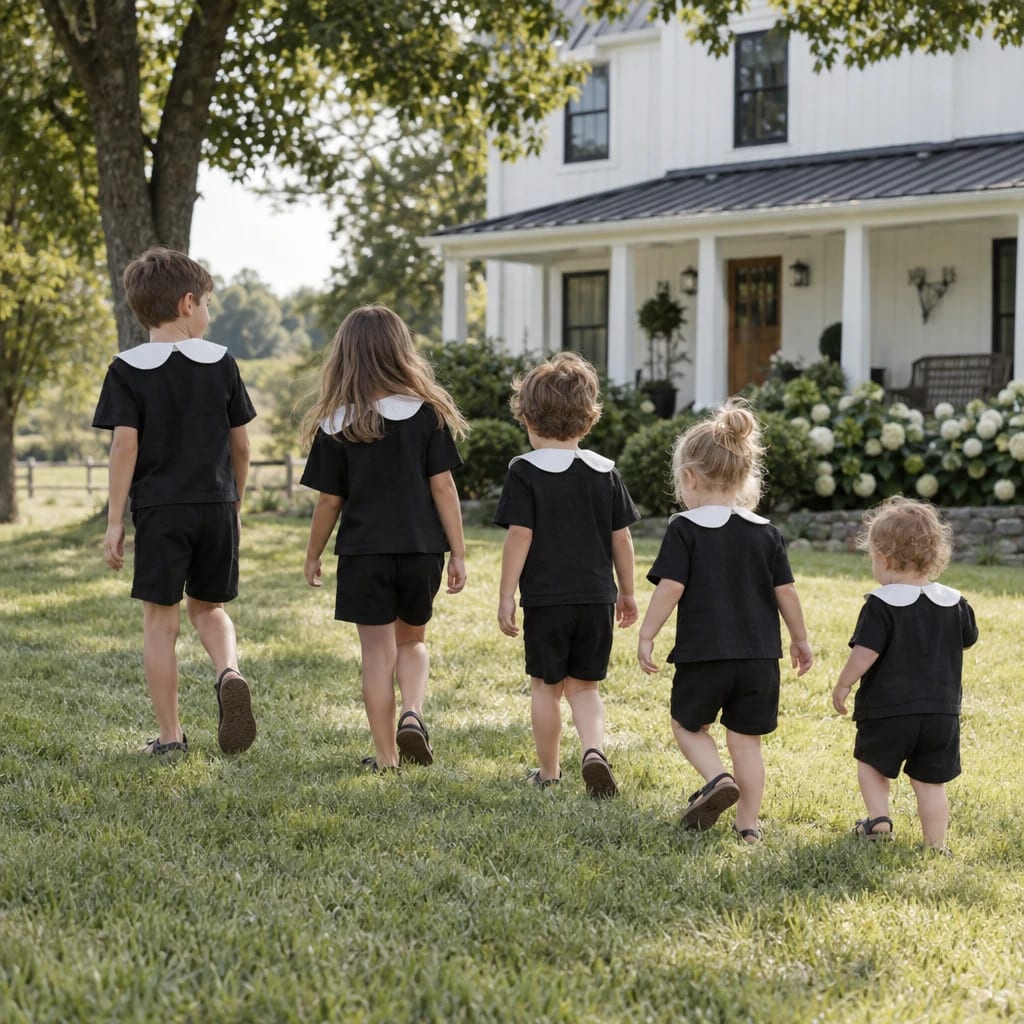
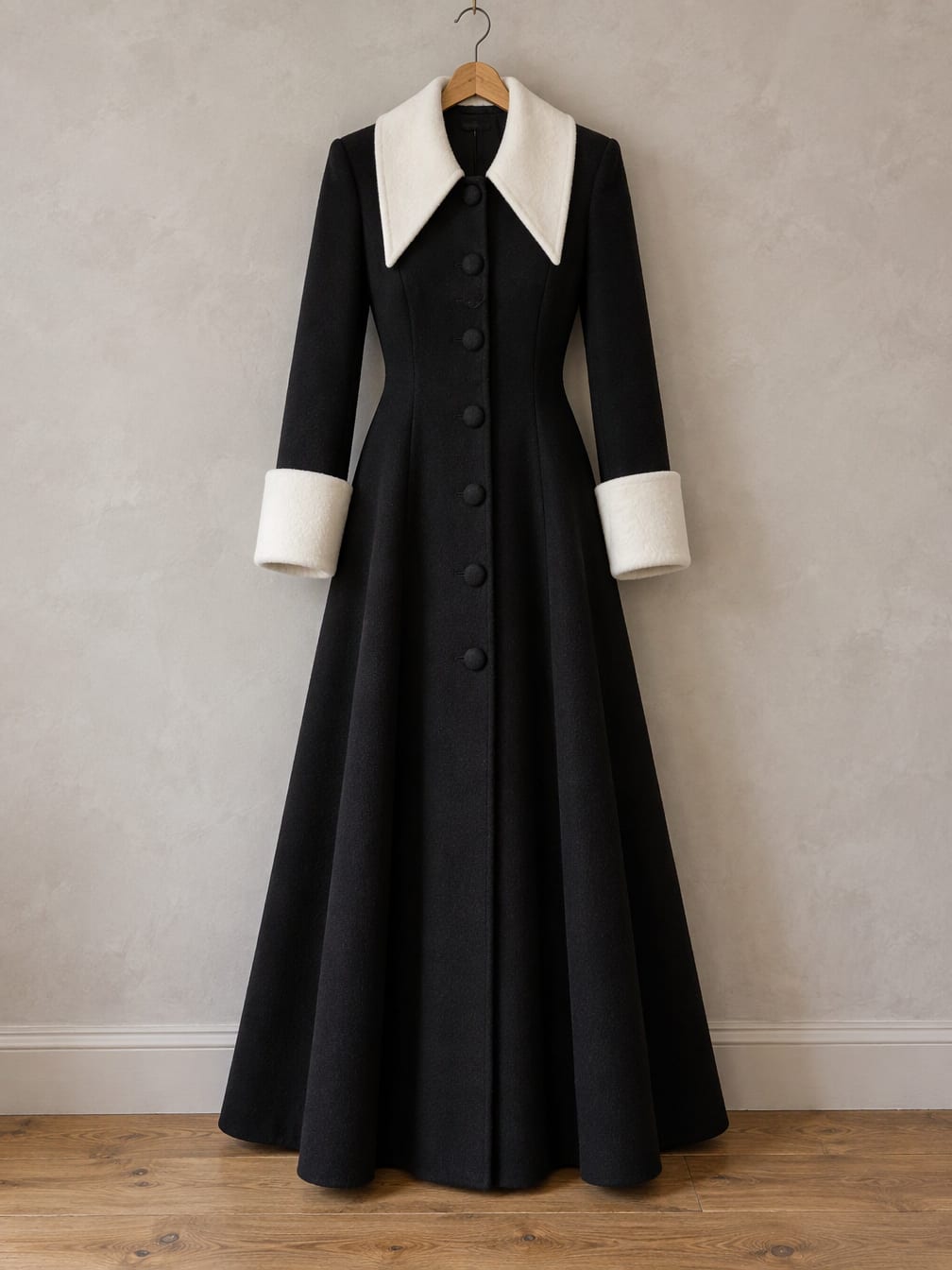
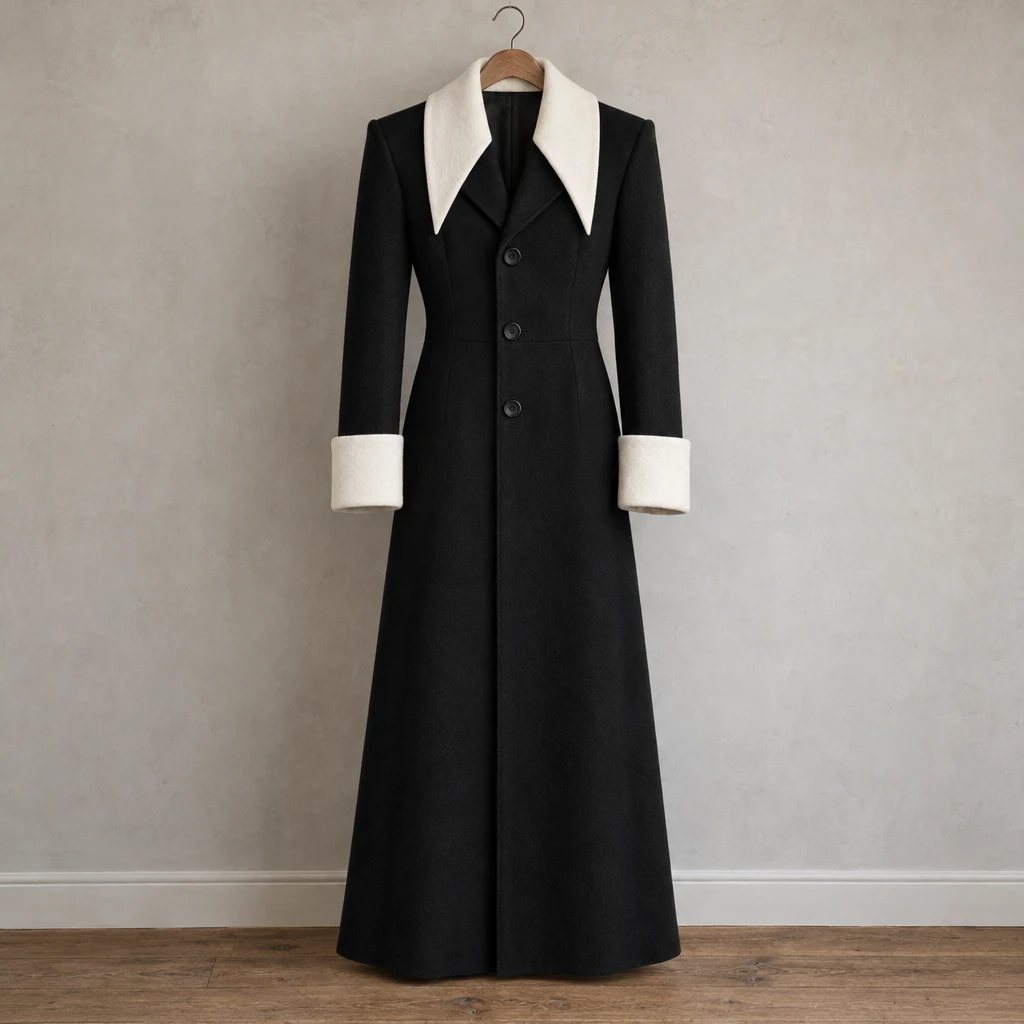
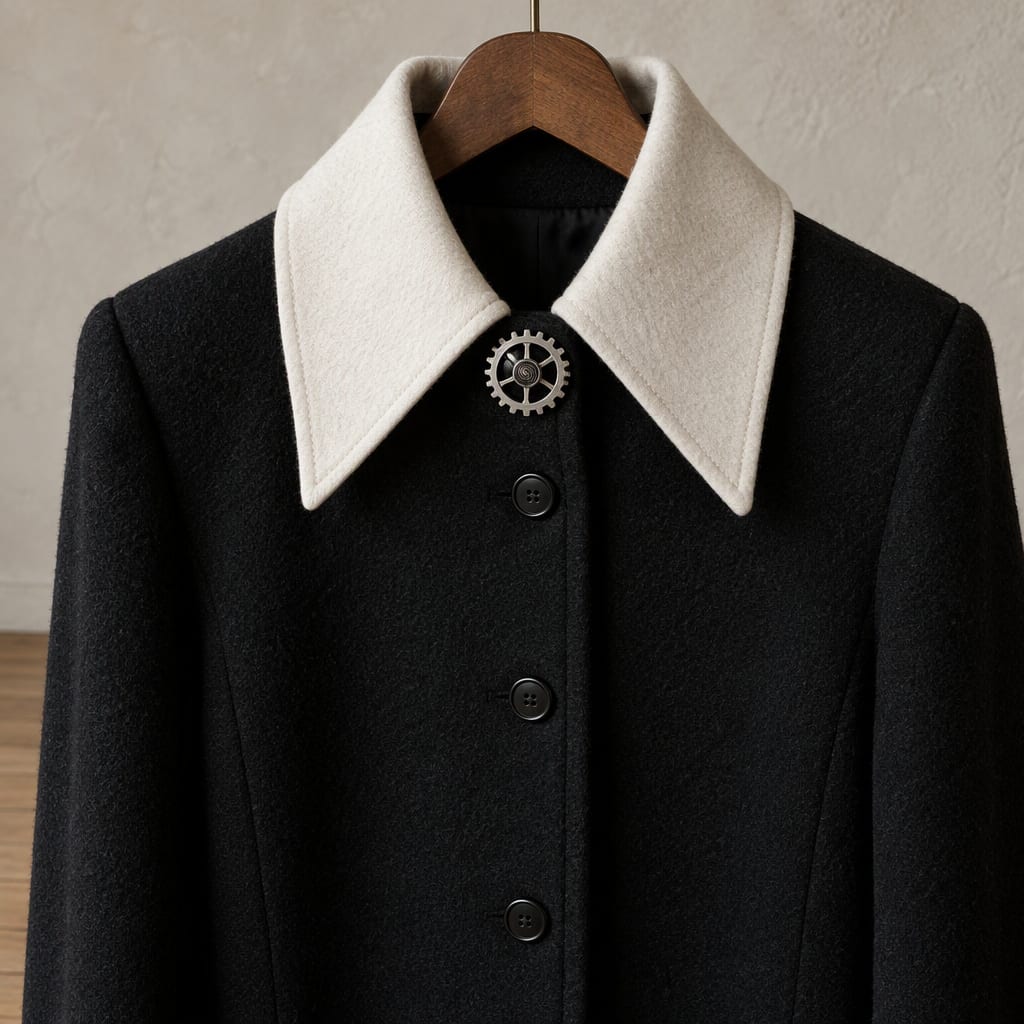
A long black wool coat with white cuffs built into the sleeve, a black shirt with a long, soft white linen collar, and a silver gear brooch at the throat.
This page is two things. It describes the outfit our family wears, one for cold weather and one for hot. And it is a specification: send it to any tailor or maker and they have what they need to quote. Nothing here is an add-on. The white cuffs are the coat’s own sleeves turned back, and the white collar belongs to the shirt underneath. At the bottom of the page is the informal outfit for work and activewear: the black jumpsuit, yellow trench overcoat and yellow boots the family wears in its pictures, with the gear at the collar and on the belt.
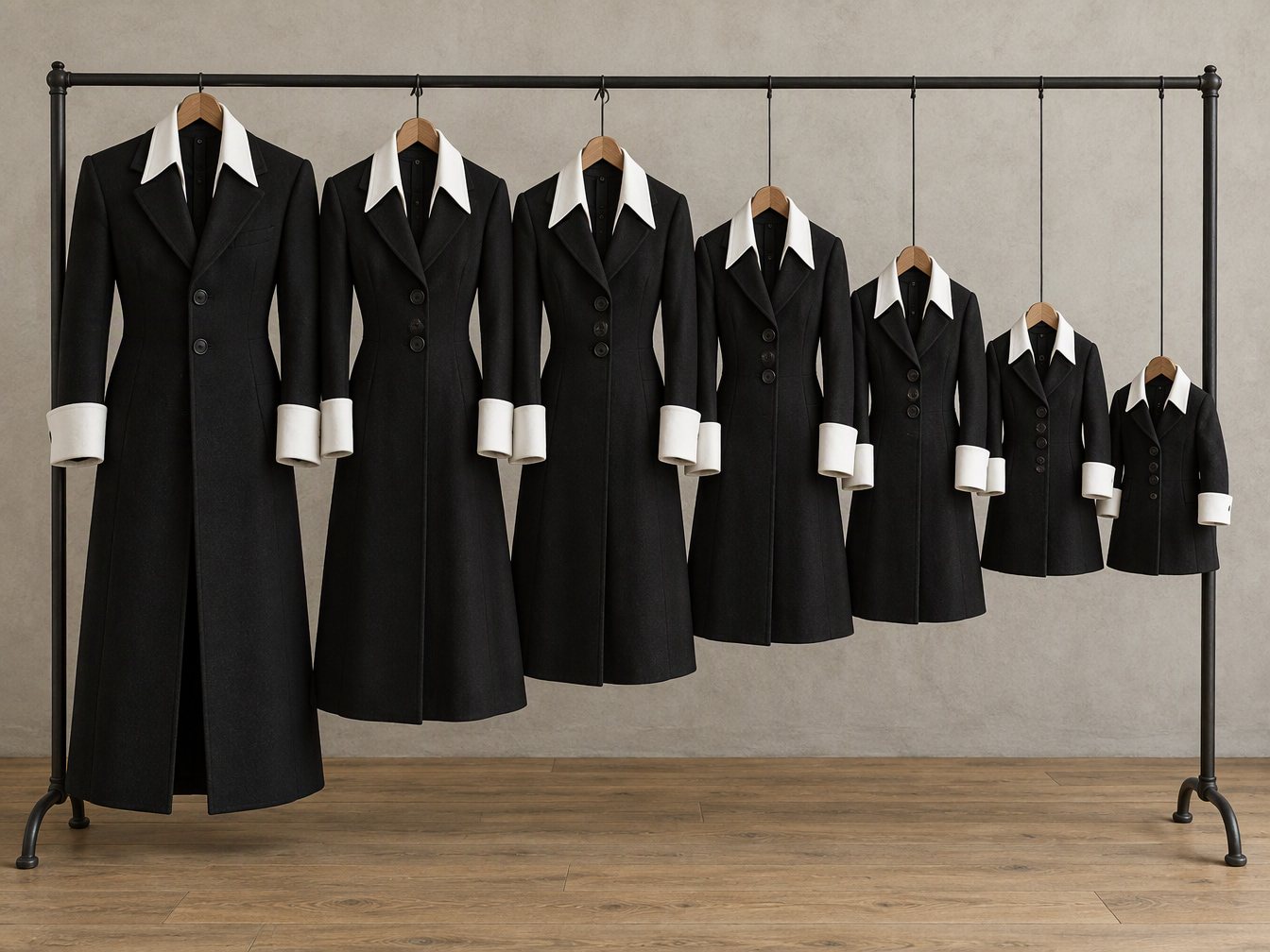
One family’s coats, adult to toddler. Every photograph on this page is a rendering of the garments as they should be made.
Under review: what we are choosing between
Every option, newest first. Tap any picture to see it large. The newest direction: a single-breasted black coat whose own collar is white, over an all-black shirt with a round band collar like a priest’s; the gear larger, about 2 in (5 cm), clipped over the shirt’s top buttons; for hot weather a black polo with a white collar, or long-sleeved black linen with a waistcoat. The real-looking pictures are drawn from the children’s character sheets and written descriptions of the two of us, so the faces are close, not exact. The specification further down still describes the earlier version until we choose.
Real-looking, of us
The new outfits as photographs of our family. Every coat on this page is single-breasted. The children are rendered from their character sheets and the two of you from your written descriptions, so these are close but not exact likenesses. With the family photos as reference they would be truer.
Cold: single-breasted coat, white collar on the coat, black band-collar shirt
Hot: the polo, and linen with waistcoats
The bigger gear that clips onto the shirt buttons
The gear at about 2 inches (5 cm) across, so it reads from across a room. It fixes like a button cover: a small hinged cup on its back snaps shut around the shirt's top button. A longer back with two cups grips the top two buttons, so it cannot spin or droop. There is no pin through the cloth, every shirt only needs ordinary buttons, and one gear moves from shirt to shirt and works on the band collar, the polo and the linen shirt alike. For the small children it is still a sewn-on gear: a clip-on part that size can come off in a toddler's hands.
Worn
New: the single-breasted coat, the band collar, the polo and the linen
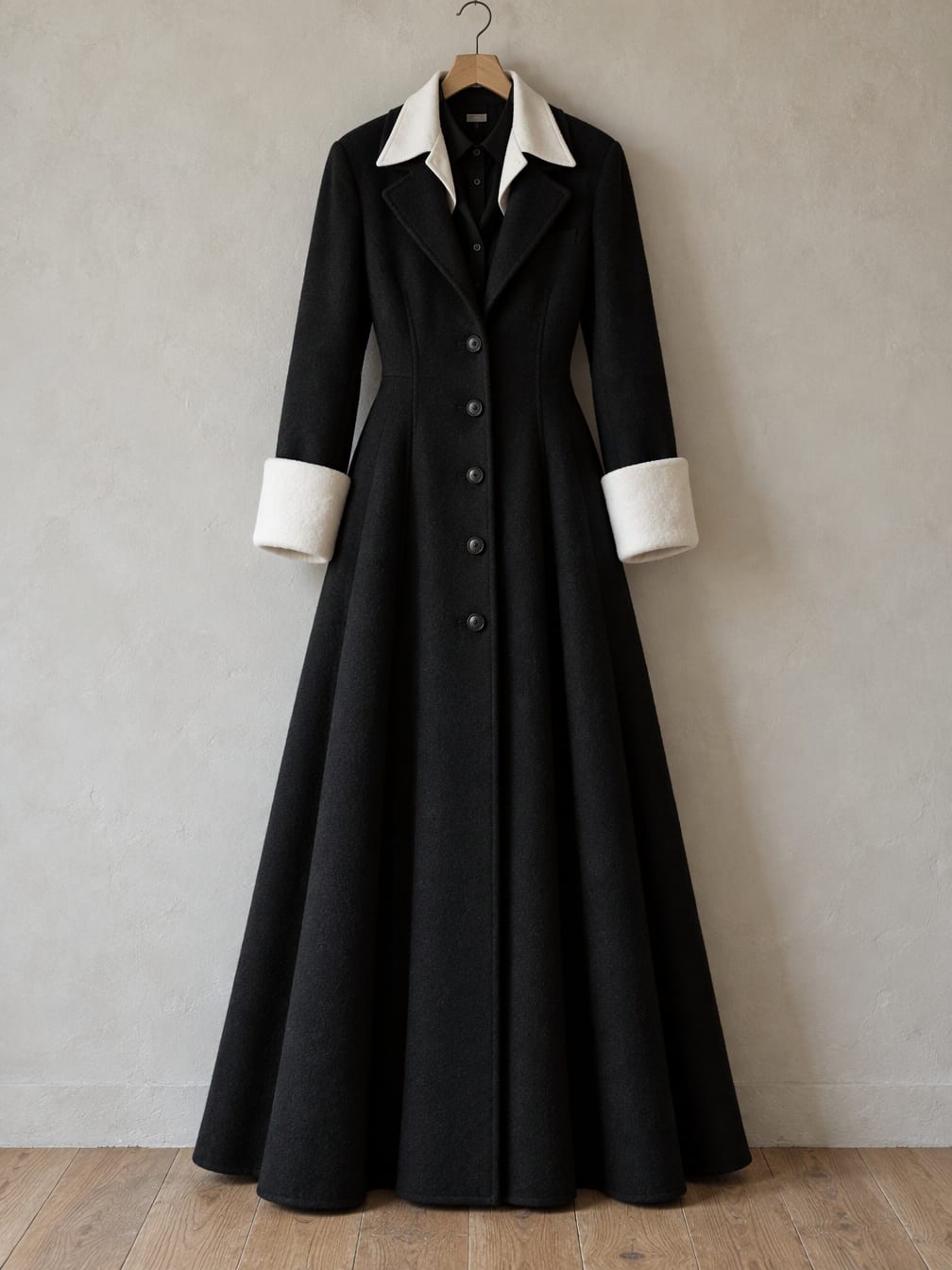
The cold outfit as you described it: one row of buttons, the white collar built into the coat, and under it an all-black shirt with a round priest-style band collar, the gear pinned at its centre so it shows in the V of the white collar. The coat's white cuffs are unchanged.
The coat and shirt
On us
Summer: the polo
A plain black knit polo with a white collar. The gear replaces the top button, so nothing needs pinning. Knit is the coolest and the easiest to wash, and polos are cheap to have made in every size.
Summer: long sleeves in linen, with a waistcoat
For Sundays and visits in the heat. Long linen sleeves protect from the sun and stay cool, and the waistcoat is unlined linen, so it adds almost no warmth. Two ideas here make it part of the set. The shirt's cuffs are turned back in white like the coat's, so rolled sleeves still show a white band. The long collar lies over the waistcoat, with the gear where the points meet. For Simone, the waistcoat becomes a fitted bodice over a long skirt. A white waistcoat is shown too: it reflects sun better, but it shows dirt.
Real-looking: linen and a waistcoat
The same with a shorter, ordinary white collar
ONE shirt: a loose, breathable long-sleeved black linen shirt, black all the way up the front, with an ordinary soft white collar (points about 3 in, 7.5 cm) and white turned-back cuffs sewn onto it. Nothing is worn under it. Over it, a short sleeveless linen waistcoat for Sundays, or the shirt alone on the hottest days. The large gear clips at the throat.
Drawn
Our family in it
The whole family in both coat versions and in hot weather, the two of you, and the five children. A is the collar from the shirt; B is the collar built into the coat.
The sleeve, fixed
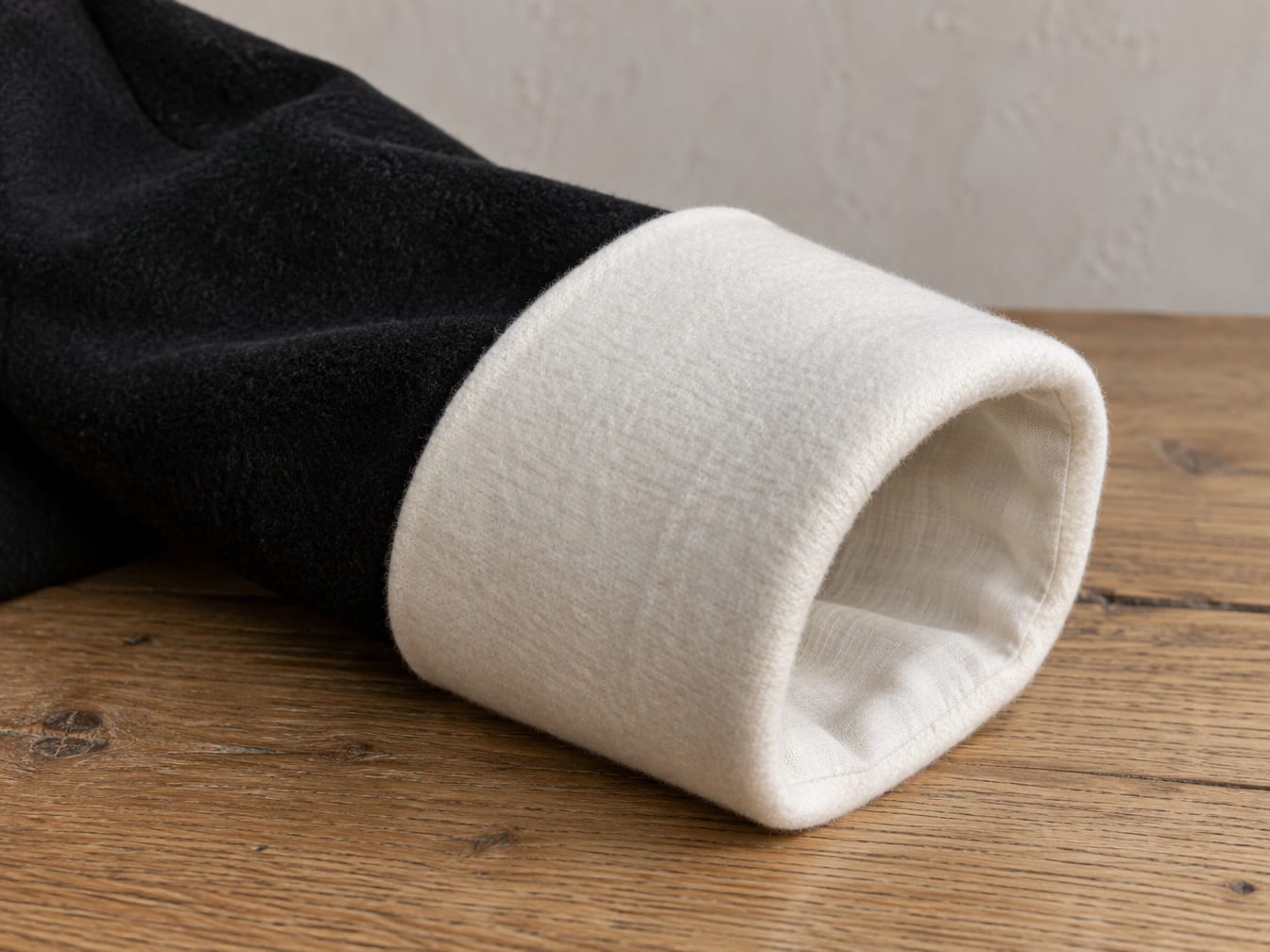
The end of the black sleeve is lined in white wool and folded back. The cuff is white all the way round, the fold at the wrist included, and the only edge is where the white meets the black sleeve.
A or B: where the collar comes from
Version A is the plan so far: the coat’s collar is black and the white collar belongs to the black shirt underneath, pulled out over the coat. Version B puts the white collar on the coat itself, in the same white wool as the cuffs. Each row is the same shot in both versions.
A · collar from the shirtthe coat’s own collar is blackB · collar built into the coatwhite wool, sewn to the coat
Hot weather: the shirt alone
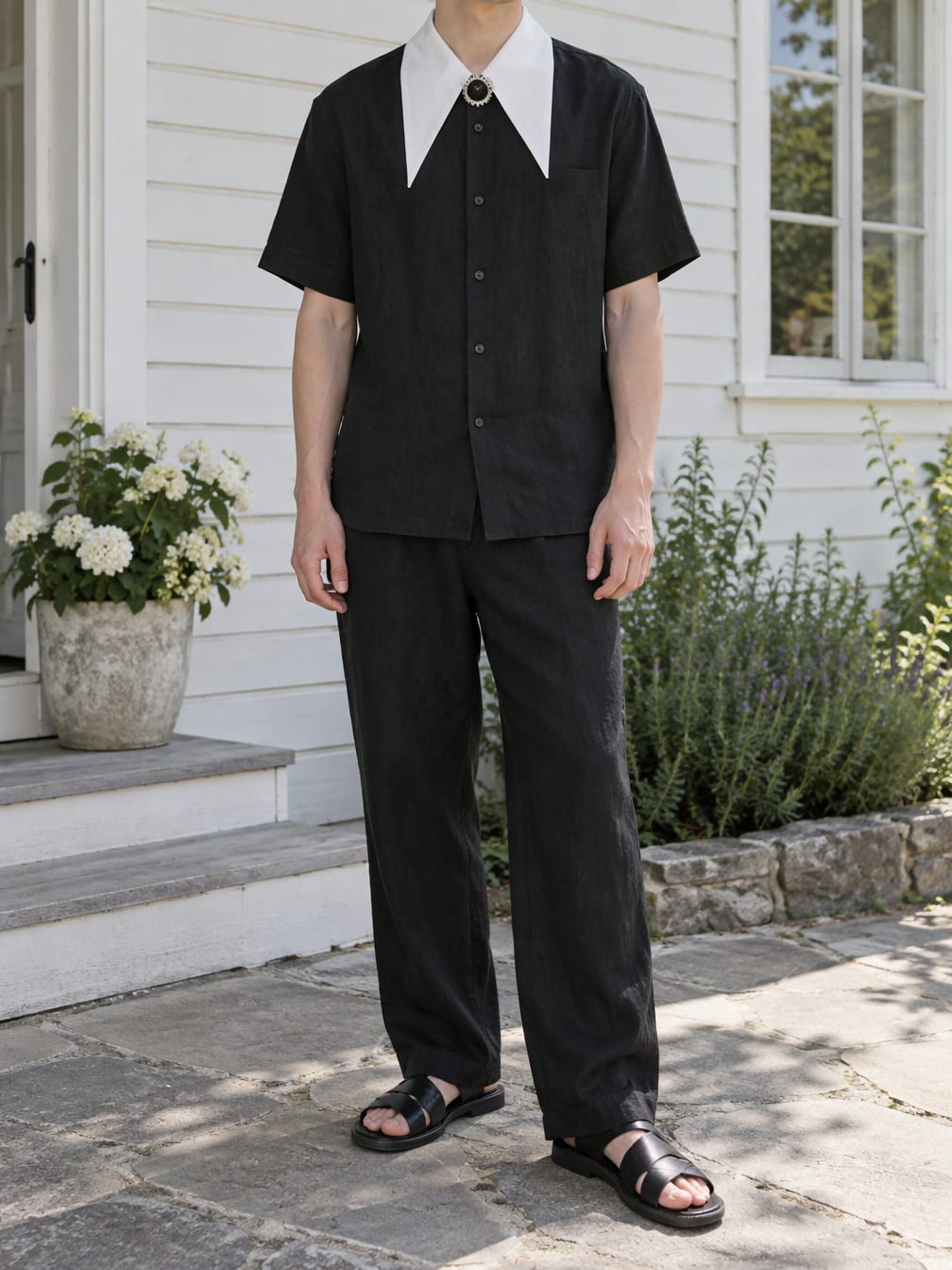
No coat. A loose short-sleeved black linen shirt with the long white collar and the brooch; black linen trousers, a long black linen skirt, shorts for the boys and skirts for the girls; black sandals. The collar is the same in A and B, because it is the shirt’s.
More options
Things to choose between, each one change from the coat and shirt above. Every collar here is still the shirt’s, laid over a black coat collar.
The collar
The cuff
The coat
Hot weather
How the gear attaches
The gear sits at the throat, where the two collar points meet, and it can do a job there: hold the points together. Six ways to fix it, with what each is good for.
What I would do
Adults and older children: the collar button. Each shirt gets a small buttonhole where the collar points meet. The gear has a shank on the back and goes through it like a cufflink, with a toggle or split ring behind so it cannot slip out. One gear moves from shirt to shirt, it never stabs anyone, and it holds the collar neat all day.
Over the coat: the locking pin. In cold weather, pin the gear through the shirt collar and the coat collar together, so the long collar stays laid out over the coat in wind. Use a locking clasp; a plain butterfly clutch falls off.
Small children: sew the gear on. For the youngest, make the gear the top button of the shirt, flat, with holes, sewn tight with strong thread. No pin, no loose part, and it goes in the basket with the shirt.
Not the cord for children. A cord around the neck is a strangling risk on a small child. Keep the cord slide for adults.
No magnetic backs for children. Two small strong magnets that are swallowed can pinch the gut between them; this is a known emergency in toddlers. (The website suggested magnetic backs for small children; that is now corrected.)
A small gear of any kind is a choking size for a baby or toddler. Check sewn gears often, and leave them off the youngest until they stop putting things in their mouths.
The three pieces
Black for the cloth, white at the neck and the wrists, and one emblem. Plain everywhere else: no trim, no braid, no contrast stitching. The coat itself is entirely black outside; both whites come from turning something back or laying something over.
The sleeve folded back on itself: the white is its lining, white right round the fold.
No. 1The coat
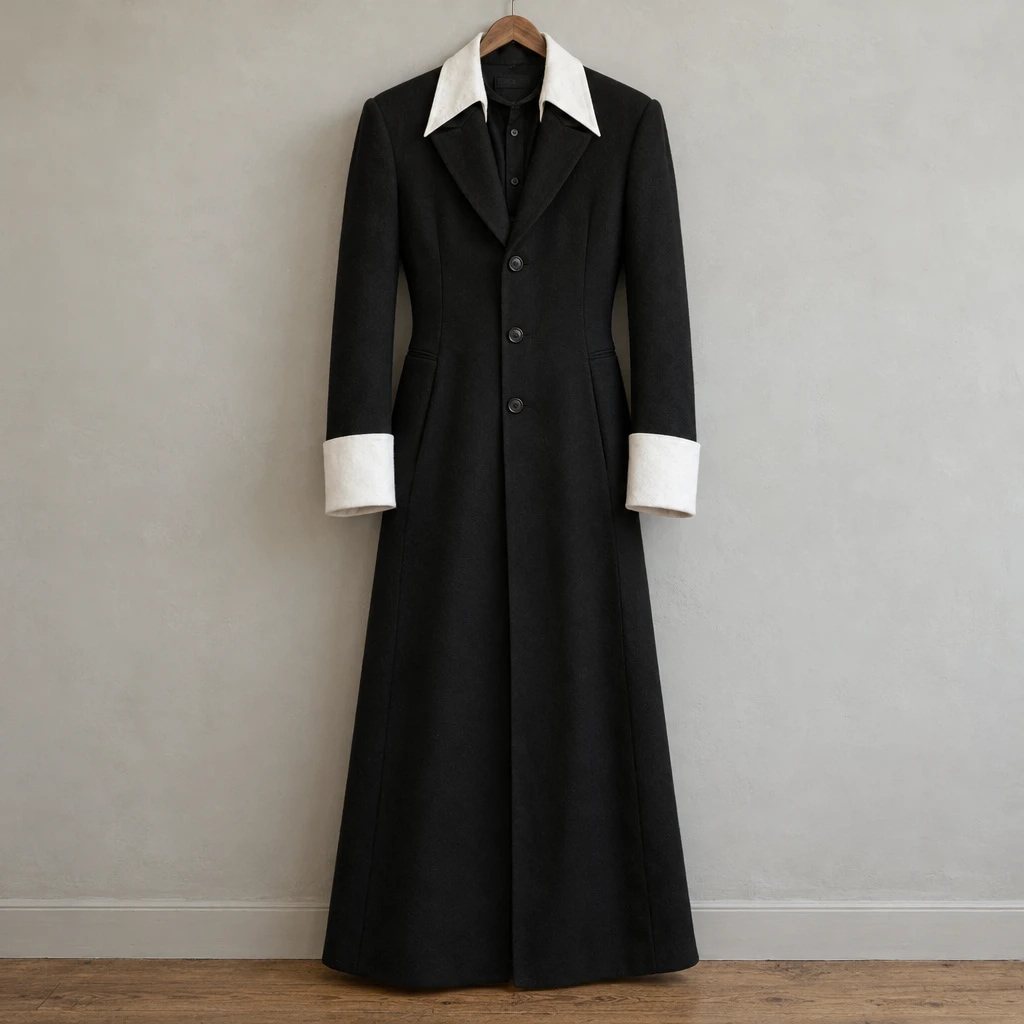
Long, black and plain, in heavy wool. The white cuff is not a band of white cloth: the end of each sleeve is lined in white wool and folded back on itself, so the lining shows. The coat’s own collar is black; the white collar over it is the shirt’s. It comes in three cuts: fitted with a full skirt for women, tailored for men (strong structured shoulders, a shaped chest, the waist taken in, the skirt falling with a slight flare, as an officer’s greatcoat or a frock coat is cut), and the men’s cut in small sizes for children.
Cloth
Black wool melton or a heavy wool blend, about 20–24 oz per yard. Lined in black, except the sleeve ends.
Length
Ankle length; floor length for the women’s cut.
Cuffs
Cut the sleeves about 4 in (10 cm) long for adults and 3 in (7.5 cm) for children, line that last stretch in white wool, and fold it back so the white faces out. The cuff is white all the way round, the fold at the wrist included: no black edge or rim shows anywhere on it. Tack the fold at the seams so it stays turned back.
Front
Single-breasted. Only three large black buttons on a man’s or child’s coat, at the chest and waist, none below the waist; three or four on a woman’s fitted bodice, none on the skirt. A deep vent at the back of the men’s coat. Not a loose straight sack: the cut is what makes it.
Collar
Black, small and plain: narrow lapels or a stand collar, so the shirt’s white collar can be laid out over it.
Inside
A strap with a hook sewn inside the coat, for hanging a sheath of the kind made to hang from a belt. Put it on the inside of the left front at about hip height, where a belt would sit. A strong black strap (leather or heavy webbing, about 1–1½ in, 2.5–4 cm, wide) is anchored into the front facing and the side seam. It passes through the sheath’s belt loop and closes with a metal hook or snap hook, so the sheath hangs straight down inside the coat and comes off when not wanted. Reinforce the anchor with a backing patch and stay tape so the weight does not drag the front of the coat out of line. The coat front should fall flat over it when buttoned. Makers: tell us how you would build this and whether the other side should have one too. Adults’ coats only.
White wool shows dirt, so choose a tightly fulled white melton for the sleeve lining that brushes clean. Because it is a lining, the cuff can be turned down and cleaned or replaced without touching the outside of the coat.
Women’s cut: fitted, full skirt, floor length.Men’s cut: tailored, three buttons. Children’s coats are this cut made small.
The collar is the shirt’s, laid out over the coat’s black lapels.Soft, washed linen with no stiffening.
No. 2The shirt
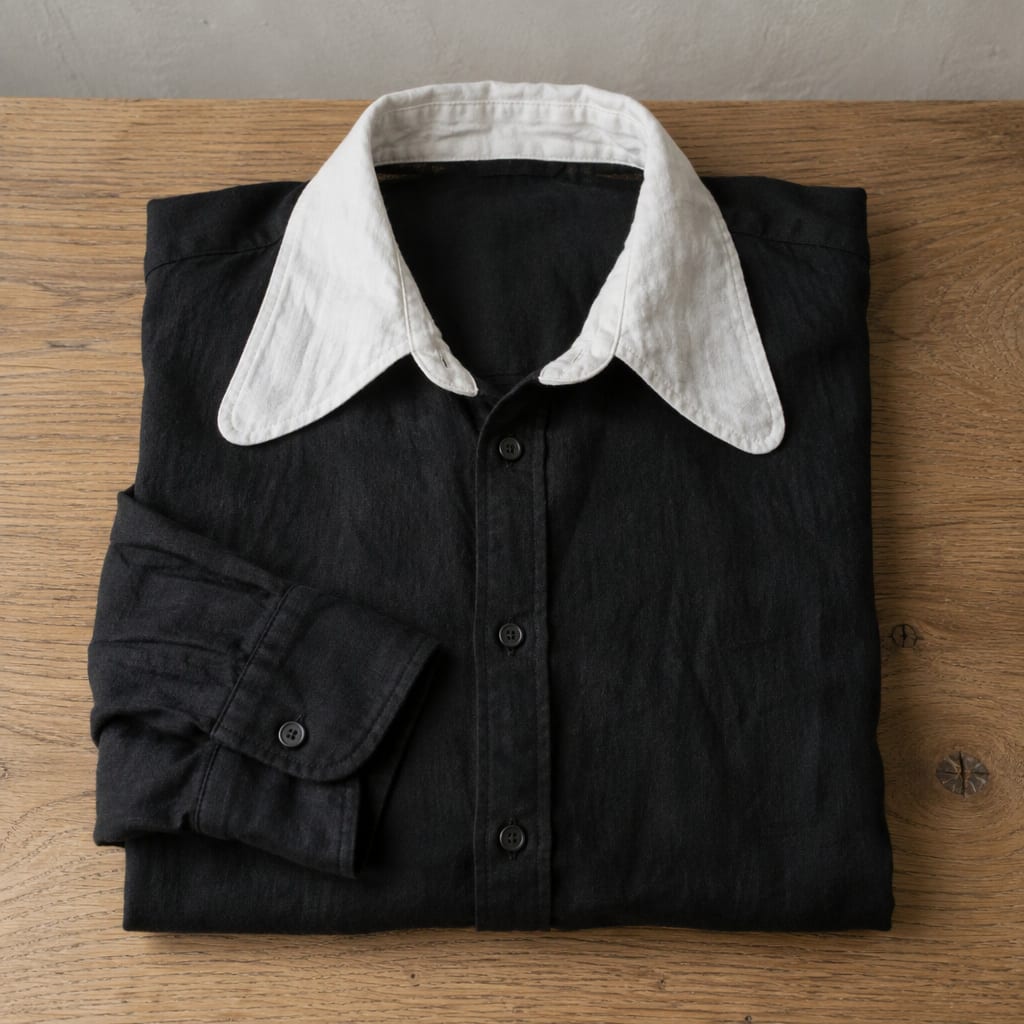
A black button-down shirt with a long white linen collar. This collar is where all the white at the neck comes from: under the coat it is pulled out and laid flat over the coat’s black collar and lapels, and in hot weather the shirt is worn alone. The collar is soft, unstarched and without interfacing, so it lies relaxed and is comfortable all day. It is the broad white collar of the old Puritan falling band, made easy to live in.
Body
Black cotton, linen or cotton-linen, black buttons. Long sleeves with plain black shirt cuffs for cold weather; short sleeves in light linen for hot.
Collar
White linen, LONG: wide over the shoulders, with two pointed tips that reach about a third of the way down the chest (about 6–8 in, 15–20 cm, from neckband to tip). No interfacing, no starch, no collar stays.
Fastening
Sewn to the neckband as part of the shirt. If you would rather wash the two apart, the maker can fix the collar with three buttons inside the neckband instead.
Black dye can run into white linen in the wash. Ask for colourfast black cloth, have it pre-washed before cutting, and wash the shirt cold with a colour-catcher sheet.
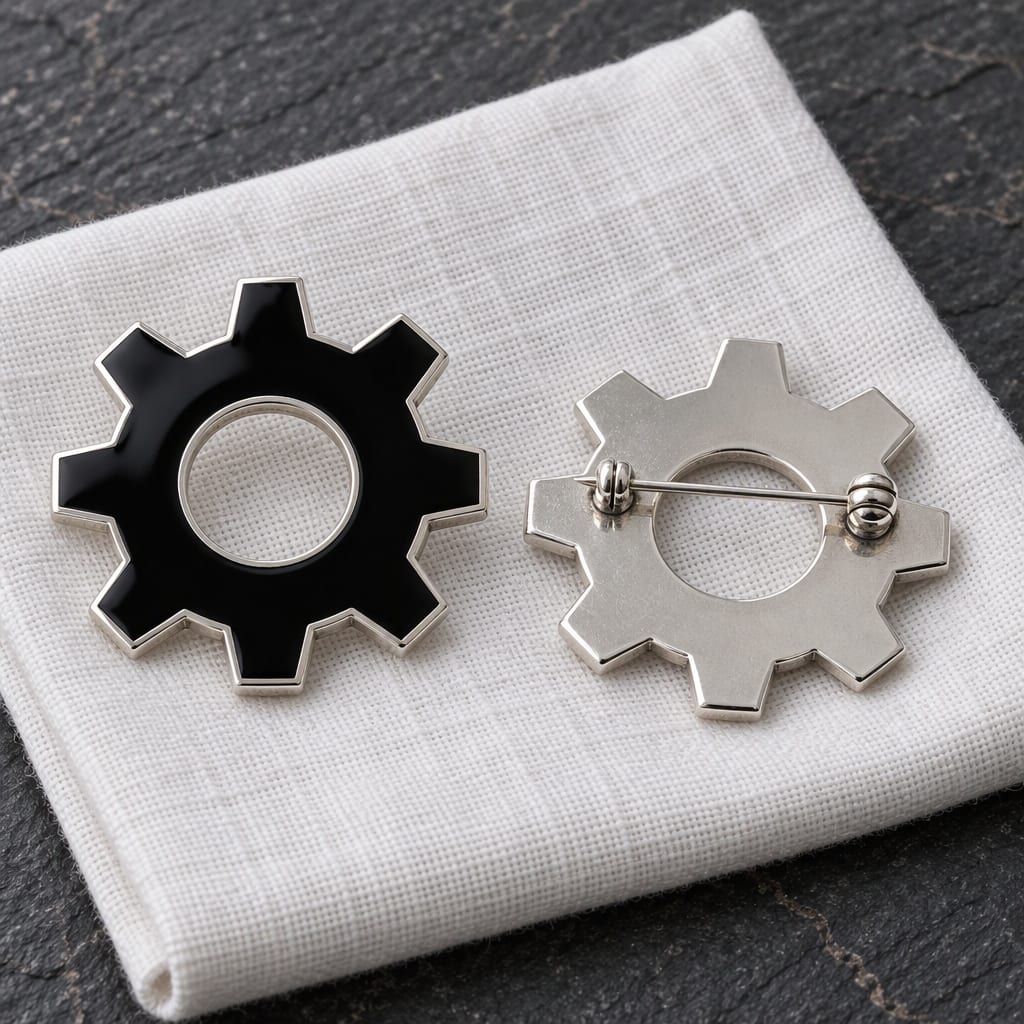
Front and back. The catch locks.
No. 3The gear brooch
Our one emblem: a plain gear with eight blunt teeth and a round hole, in black enamel on sterling silver, worn at the throat where the two collar points meet. One for everyone in the family.
Metal
Sterling silver (925).
Design
The gear in black enamel, either cut to the gear’s outline or set in a round silver disc.
Size
About 1¼–1½ in (3–4 cm) across.
Fixing
Best: a shank on the back, worn like a cufflink through a small buttonhole where the collar points meet, so one gear moves from shirt to shirt and holds the collar neat. Over the coat: a pin with a locking catch through both collars. For small children: a flat gear sewn on as the top button. Never a magnetic back on a child’s piece: two small swallowed magnets are a medical emergency.
Any jeweller who makes custom enamel pins from a logo can make this. Send them the gear as a black-on-white image and ask for sterling, not plated brass.
Cold and hot
Two outfits, not a wardrobe of seasons. When it is cold you wear the coat; when it is hot you take it off. The shirt, its white collar and the brooch are there either way, so the look holds at any temperature.
Coldcoat weather
The coat over the shirt
The wool coat, buttoned, its sleeves turned back to show the white cuffs.
The long-sleeved black shirt, its long white collar pulled out and laid over the coat’s black collar.
The brooch at the throat, pinned through the collar and the coat so it holds the collar in place.
Black leather gloves and tall black boots.
Hotshirt weather
The shirt alone
No coat. The short-sleeved black linen shirt with the same long white collar carries the look by itself.
The brooch at the throat of the shirt.
Black linen trousers or a long, full black linen skirt; black sandals.
Black takes in sun, so the hot-weather shirt is loose, light linen that lets the air through. The white collar sits over the shoulders, where the sun lands first.
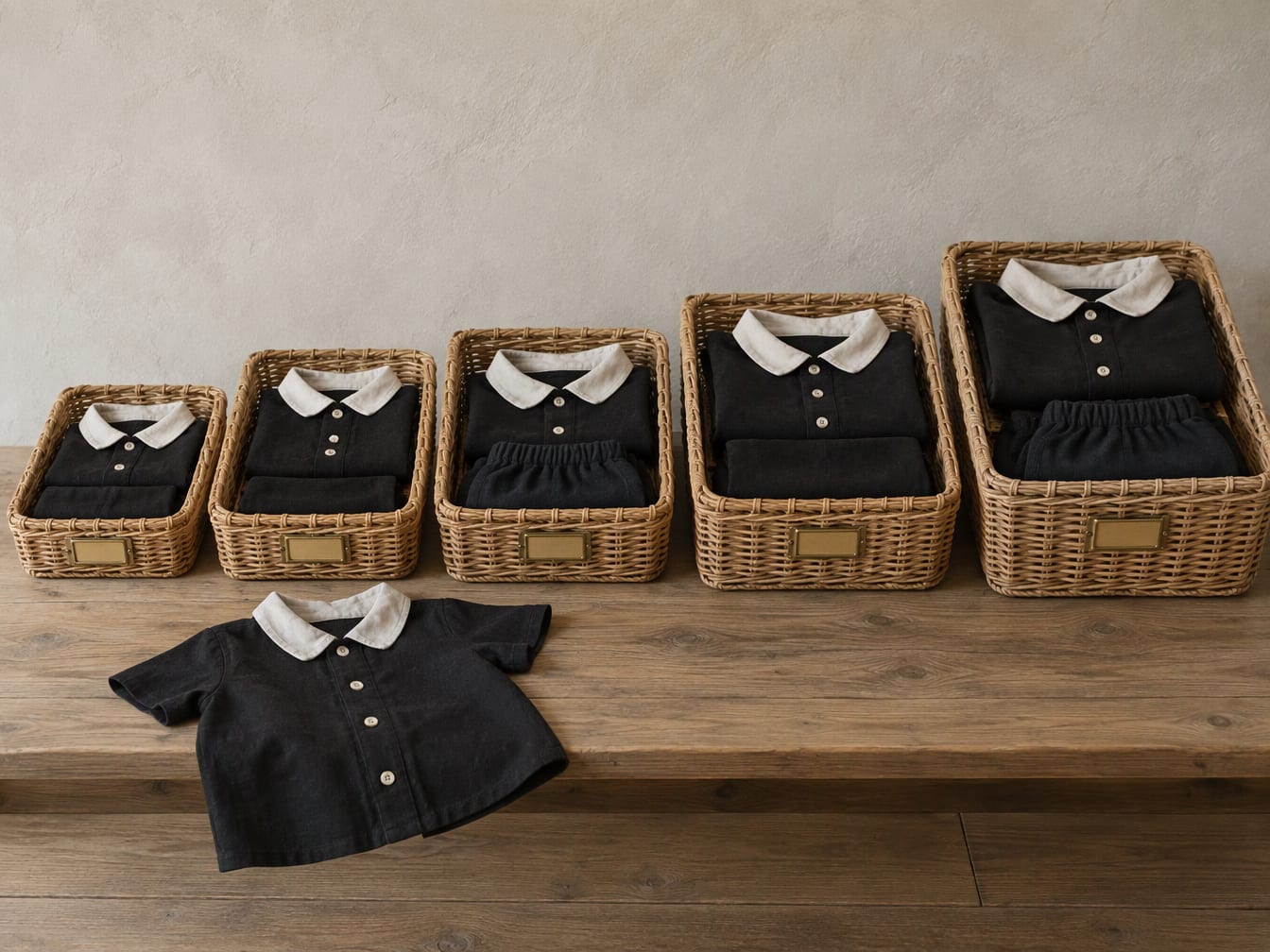
Children: one basket per age
Hot weather: the same shirt on every child.One basket per age range.
Children here do not outgrow their clothes. Each age range has a basket. When a child moves up a size, what they wore goes into the basket for the next child, and they take what is in the next basket up.
So children’s pieces are made once and made to last. They are unisex wherever possible: the same straight single-breasted coat and the same shirt for boys and girls. Ask for strong seams, firmly sewn buttons and a little room to grow. A piece that is only for girls or only for boys still goes to the next girl or boy in the family.
A basket holds one coat, two long-sleeved and two short-sleeved shirts, and, for the little ones, gears sewn on as the top button of their shirts.
Another way: the collar on the coat
Our collar comes from the shirt. A coat can also carry its own white collar, sewn to the neckline in the same white wool as the cuffs. This is what that looks like.
Women’s cut, collar built in.Men’s cut, collar built in.The seam where the white collar joins the coat.
With the collar on the coat, the coat looks the same over any shirt and the collar never needs laying out. But the hot-weather outfit still needs the white collar on the shirt, so you own the collar twice. A wool collar also cannot go in the wash, and from a distance the shirt collar and the coat collar look alike. We wear the shirt collar.
Having it made
You will not find this in a shop, so it is made to order. One maker can do the coats and shirts; a jeweller does the brooch. Many tailors on Etsy and in costume and historical-clothing work take commissions from a picture and a set of measurements.
Piece
Per person
Notes for the maker
Coat
1
Black wool melton, black collar; sleeve ends lined in white wool and folded back as cuffs; black buttons.
Long-sleeved shirt
2
Black, colourfast; long soft white linen collar, no interfacing.
Short-sleeved shirt
2
Black linen; the same collar.
Gear
1
Sterling silver, black enamel; a shank to button through the collar, or sewn on for small children.
Measurements to send
Height, and the length from the base of the neck to the floor.
Chest, waist and hips.
Shoulder width, and sleeve length from shoulder to wrist.
Neck, for the shirt.
For children, the measurements of the first child to wear the piece. Ask the maker to add a little room.
Ask before you order
Can the sleeve ends be lined in white wool and folded back, and the long collar sewn onto the shirt?
What wool and linen will you use, and is the black colourfast?
The price of each piece, and for the whole set.
How long it will take, and the shipping cost.
Made-to-measure work usually cannot be returned, so measure twice.
A message for a maker
Copy this, change the numbers to fit your family, and send it with a link to this page.
Hello! I love your work and would like to ask about a custom order.

I am looking for matching outfits for a family of [number] (two adults and [number] children):
• long black wool coats with black buttons and a plain black collar, where the end of each sleeve is lined in white wool and folded back so it shows as a deep white cuff: a fitted women's coat with a full skirt, a straight single-breasted men's coat, and the same straight coat in children's sizes;
• black button-down shirts (long-sleeved, and short-sleeved in light linen) with a long, soft white linen collar (no interfacing, not stiff) that is laid out over the coat collar;
• and, for work and play, black cotton twill jumpsuits (zip front, chest and cargo pockets, belt loops) with a knee-length hooded trench coat in yellow waxed cotton, single-breasted with three buttons.

The full description, with photographs and measurements, is here: https://technopuritan.com/wardrobe/

Could you make some or all of this? If so, what would each piece cost, how long would it take, and which measurements do you need? Thank you!
The photographs on this page are renderings of how the garments should look, made for this page; they are not photographs of a product for sale. The people in them are framed from the chin down.
Informal: for work and activewear
The outfit the family wears in most of its pictures, brought onto this page beside the formal one: a black jumpsuit, a yellow trench overcoat with a hood, and yellow boots. It is what we wear to work outside, to walk, to climb and to get muddy in, and it goes on over nothing but the jumpsuit. Two things are new. The gear sits at the collar: the same two-inch clip-on gear as on the shirts, closing the top of the zip like a brooch. And the belt buckle is the gear too, sterling silver and black enamel, the belt passing through its hole. For small children the collar gear is a small one sewn on as the top button and the buckle a plain one, as with the shirts: nothing that clips off and can be swallowed.
The pieces
Worn
The whole family, and where it comes from
The jumpsuit
A one-piece coverall in heavy black cotton twill (10–12 oz), cut loose enough to climb in: a short soft stand collar, a two-way zip up the front, two zipped chest pockets, cargo pockets on the thighs, a buttoned cuff, belt loops.
At the collar: the two-inch sterling gear with its hinged clip, over the top of the zip. One gear moves from suit to suit.
At the waist: a black webbing belt, 1½ in wide, fastened by the gear as its buckle, sterling silver and black enamel on a steel bar.
Children: the same suit made small, one small gear sewn on at the collar as the top button, a plain black buckle. Handed down by age basket like the shirts.
The coat and the boots
A knee-length trench coat in yellow waxed cotton, single-breasted with three large black buttons at the chest and waist, a storm flap across the shoulders, a belt of the same cloth, a hood. Worn open over the suit when it is dry, closed and hooded in the rain.
Yellow lace-up work boots, ankle high, with a black rubber sole; yellow rubber boots for small children.
Nothing white, nothing that needs ironing: this is the outfit that gets washed on hot.