← technopuritan.com · the Collins household
The Techno-Puritan Year
Five holidays, one weekly day of rest, and five milestones that mark a life: a calendar built for children, cheap to keep, good to photograph, and plain about what it teaches.
This page gathers the holidays our family already keeps (Future Day, the birthday sabbath), the ones drafted in The Pragmatist’s Guide to Crafting Religion (Rejection Day, and Lemon Week, here renamed Steelman and made a month), and the rough ideas we have talked about for February and December, and works them into one set. Each holiday below has its timing, how it runs, how it looks, what it teaches, and a short list of candidate names. Nothing here is settled: it is offered so families can try it and tell us what works.
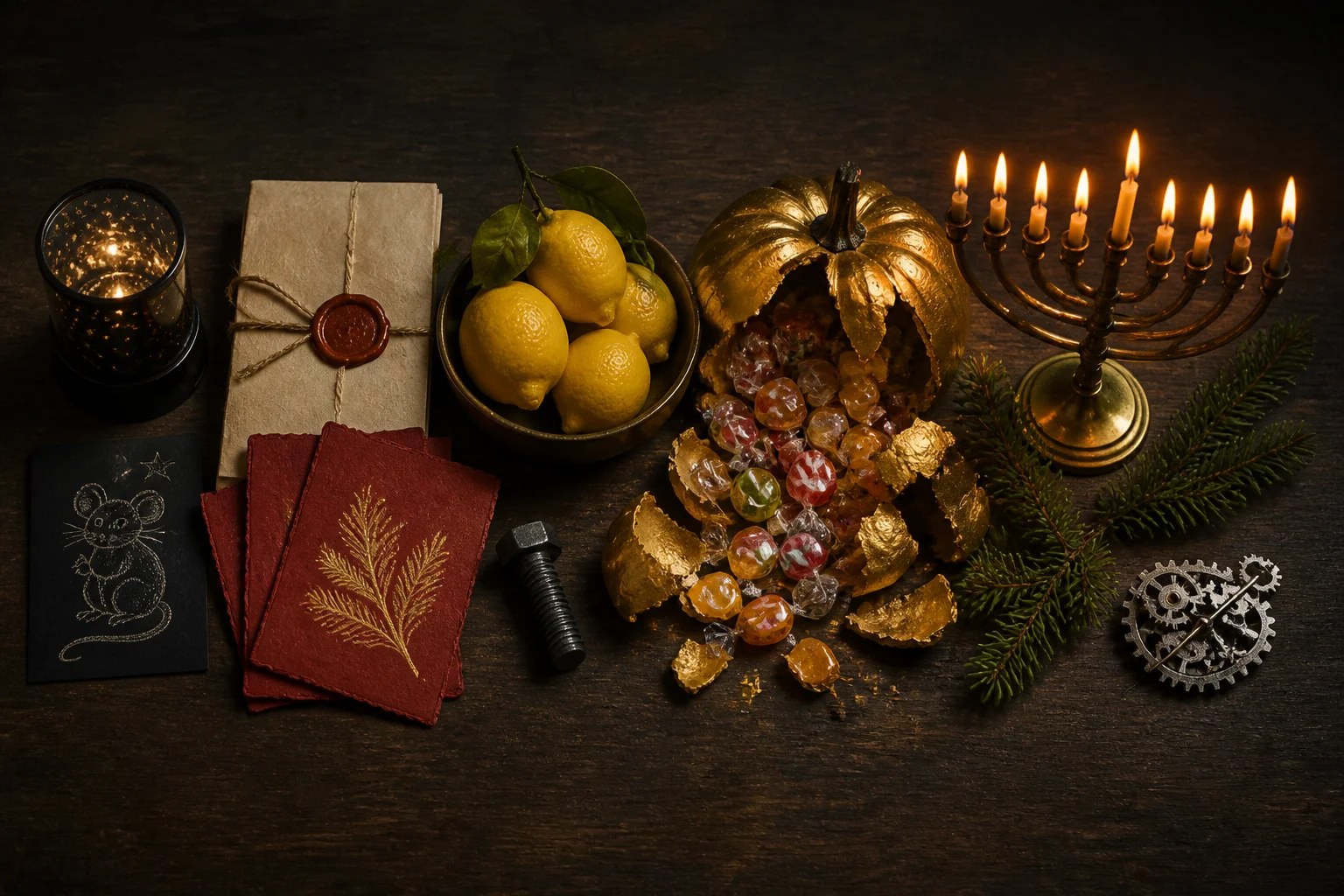
How we designed it
Most new holidays die in a year or two. Pi Day and Star Wars Day spread, but as jokes; most invented secular holidays never spread at all. The ones that last for centuries share a small set of features, and we built every holiday below around them.
Children are the customers
A child’s wonder is what makes a holiday feel real, and a holiday is how children learn a religion. So each one has make-believe, a simple lesson a five-year-old can repeat, something to do with their hands, and sometimes a gift.
Easy to keep, rewarding to go all out on
A projector instead of strung lights, cards instead of costumes, a dinner the family already eats. A tired family can do the minimum in an evening; an ambitious one can spend weeks. And everything works in a city apartment, a farmhouse or a spaceship: nothing needs a garden, a tree, a climate or a shop.
Worth photographing
Each has one striking image: a ceiling full of aurora, a wax seal, a row of smashed idol pumpkins, a candle in a stack of pancakes. If people post it, it spreads.
Built on what people already do
Nobody has to give up New Year’s resolutions, Valentine’s cards, trick-or-treating or Christmas. Each holiday sits inside a season people already celebrate and adds meaning at home, the way the early Church did with the feasts it found.
Explicit about what it teaches
Each holiday names its values out loud: the far future, descendants, honoring parents, honest engagement with offensive ideas, no idols, no coveting, and the Covenant of the Sons of Man.
Few of them
Five annual holidays, clustered in the dark half of the year when families are home, and nothing from June to September. Summer is for work, travel and being outside.
What the old traditions have in common, and what seems to make them work
Looking across Judaism, Christianity, Islam, Hinduism, East Asian folk religion and the European folk calendar, the holidays that have lasted share a handful of patterns. We borrowed one or more for every holiday on this page.
- Light in the darkest weeks. Hanukkah, Christmas, St. Lucia, Diwali, the Yule log. Our January and December holidays are holidays of light.
- A new-year reckoning. Rosh Hashanah and Yom Kippur, the Lunar New Year’s settling of debts, Watch Night services, New Year’s resolutions. Providence is ours.
- A story told to children through questions. The Passover Seder is built around a child asking “why is this night different?” because the Torah says to expect the question (Exodus 12:26). Every holiday below has a question the children ask and an answer the family gives.
- Willing self-denial. Lent, Ramadan, Yom Kippur. The cultures that keep fasts train self-control, and the costly practices of a group are part of what holds it together: in Sosis and Bressler’s study of 200 nineteenth-century American communes, the religious communes that demanded the most of their members lasted the longest (Cross-Cultural Research, 2003). Providence’s confiscated toys are our fast.
- The dead and the line of descent. All Souls, the Day of the Dead, Qingming, Obon, the Jewish yahrzeit. We keep the line but turn it to face forward: we honor ancestors as links in a chain whose point is the descendants.
- Breaking or burning the old. Burning the chametz before Passover, the Lohri and Holi bonfires, burning the Christmas greenery at Candlemas. Jackbreak is ours.
- Rites of passage with a test. Bar and bat mitzvah, confirmation, the quinceañera, Japan’s Coming of Age Day. Ours, Sovereignty, marks the one test that matters most for a modern adult: paying your own way.
- Written covenants. Jewish marriage contracts survive from Elephantine in Egypt from the fifth century BC, and the ketubah is still often illuminated and hung on the wall. Our February holiday and our wedding are built on written, signed agreements.
On whether this does any good: in a review of fifty years of research on family routines and rituals, Fiese and colleagues found them linked to children’s health, school performance and the stability of the marriage (Journal of Family Psychology, 2002); Eaker and Walters found that teenagers who were satisfied with their family’s rituals had better psychosocial development (2002). Rituals measurably reduce anxiety before a performance (Brooks and colleagues, 2016) and help people grieve (Norton and Gino, 2014), and doing things in unison makes people cooperate more afterwards (Wiltermuth and Heath, 2009). A family that keeps its days together tends to stay together.
The year at a glance
Five annual holidays, the weekly Sabbath, and five milestones. Mainstream holidays not listed here (Easter, the Fourth of July, Thanksgiving) are kept as the wider culture keeps them.
| When | Holiday | In one line | Rides on |
|---|---|---|---|
| Dec 26 – Jan 31 | Providence | The Future Police take every toy; children pledge to build the future to get them back. | New Year’s resolutions |
| February | Clan Day | Honor your father and mother; a card to each member of the family; contracts; the bravest ask. | Valentine’s Day |
| May | Steelman | Each person explores an idea that offends them, argues its best case, and the family votes on the best steelman. | End-of-school-year projects |
| Oct 31 – Nov 2 | Jackbreak | Trick-or-treat, then smash the jack-o’-lanterns and the idol pumpkins; name the chain of descent. | Halloween, All Saints, All Souls |
| December | Neighbors’ Feasts | Keep Hanukkah and Christmas, and talk over why we are not those faiths; Christmas without coveting. | Hanukkah, Christmas |
| Every week | The Sabbath | A day without productive work, with the family. | The Fourth Commandment |
| A life | Scioning, Birthday, Sovereignty, the Marriage Contract, the Funeral | Birth, each year of life, self-sufficiency, marriage, death. | Christenings, birthdays, rites of passage, weddings, funerals |
January · the first holiday of the year
Providence
The month the future comes to visit. Formerly “Future Day.”

- Providence (our pick). Named for the Agents of Providence, the Future Police’s proper name, and for the old Puritan habit of seeing God’s hand in history and writing down its “remarkable providences.” It says what the holiday teaches: the future reaches back and shapes the present.
- Morrowtide (Simone’s first pick). Morrow is Old English for the next day; -tide is the old word for a holy season, as in Yuletide and Eastertide. It makes the holiday a season rather than a day, which is what it has become, and it sounds both ancient and like science fiction.
- Aeontide. The season of the ages. More obviously about deep time, less warm.
- Scionmas. From Omniscion, “all descendants,” our name for what humanity becomes. Clear to us, opaque to everyone else.
How it runs
- Lights up (December 26). The Christmas decorations come down and the future goes up: star and aurora projectors on the ceilings, glow-in-the-dark stars, clocks, silver and black. Because it is mostly projected light, putting it up takes an evening.
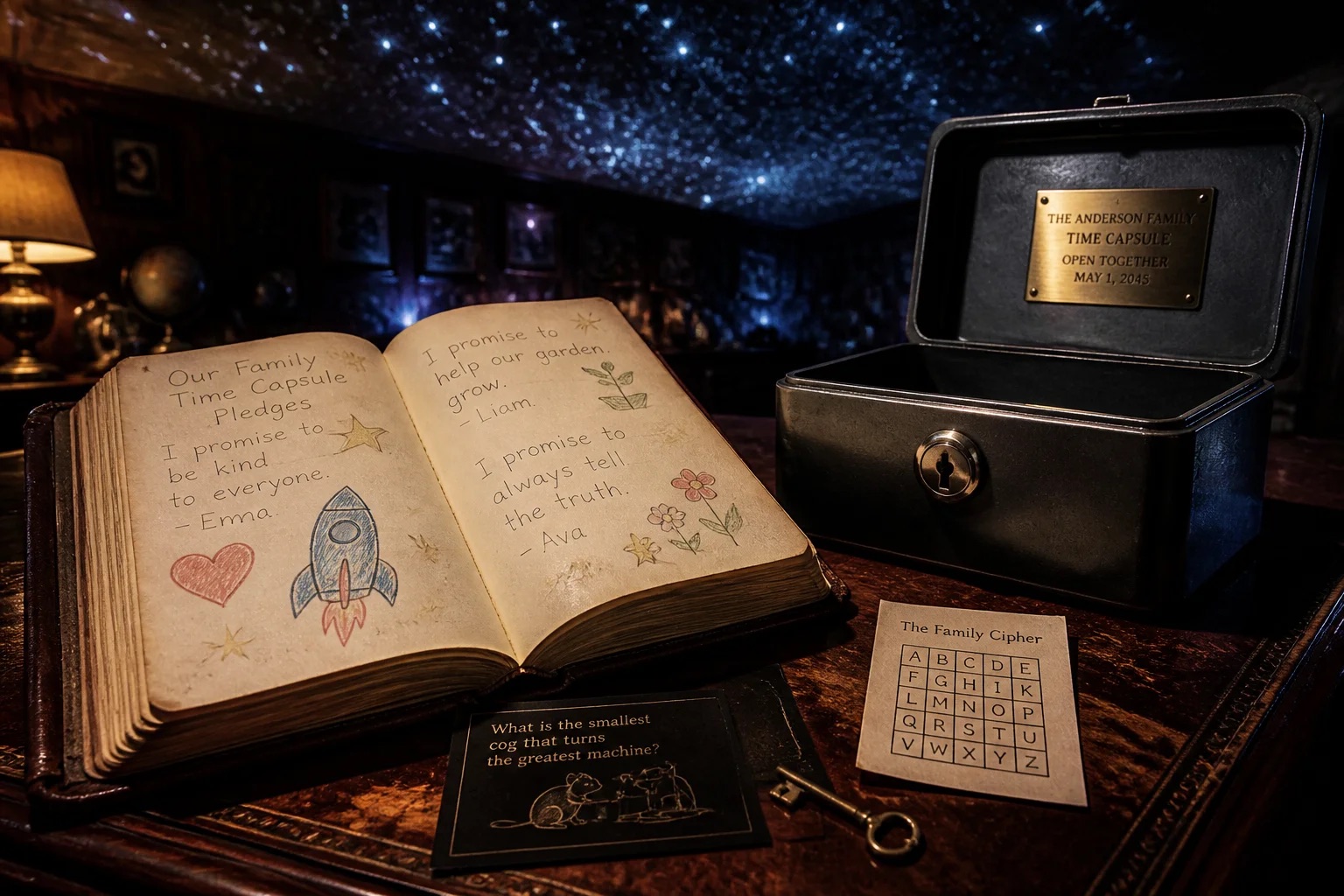
- The Taking (New Year’s Eve, overnight). While the children sleep, the Future Police come back through time and take every toy the children own: the new Christmas presents, the old favorites, the games and the screens. In the morning the shelves and toy boxes are bare. (Our family once took only one toy from each child; they barely noticed. Taking everything is what makes the morning land.) They leave a calling card (a mouse in a Skinner box on one side, a cipher on the other) and some strange debris: iridescent shards, a coil of glowing wire, a silver scorch mark. A child who hides their device gets no card, and misses everything that follows.
- The Pledge (New Year’s Day). Over breakfast the family works out why the Future Police came. The answer: they want a promise that this child will help build a better future, and usually that they will make themselves better on the way. Each child writes a pledge into the family’s Time Capsule Book: a picture of the future they want, and one concrete thing they will do this year to bring it closer. Then the family solves the cipher together, which names the drop point (a lockbox, a gap under the floorboards, a fireproof safe passed down the generations), and leaves the book or the pages there for the Future Police to collect.
- The Future Feast (New Year’s Day). Futuristic food: drinks in beakers, dry ice in the punch bowl, astronaut ice cream, popping candy “flavor crystals.” Over dinner each person says where they think humanity is going and what part they mean to play. Older pledges are read aloud, including those of parents and grandparents when they were children.
- The month of proof (all January). The toys are returned, with a small gift, once the Future Police are satisfied the pledge is real: usually when the child shows a first piece of evidence of keeping it. Through January the household keeps one short weekly check-in at dinner on how everyone is doing with their pledge. Decorations come down on February 1.
- Fulfillment (any time in the year). Each child also gets a second card. When they believe they have done what they promised, they leave that card at the drop point, and a larger gift follows, scaled to how hard the pledge was.
- Timing
- December 26 to January 31. The Taking on New Year’s Eve, the Pledge and Feast on New Year’s Day.
- For children
- A mystery, a heist, a cipher, a treasure-hiding and a reward. The lesson: the future is something you build, and you can start now.
- Look
- Night sky indoors: aurora and star projections, glow stars, clocks, black and silver. Mascot: the Skinner-box mouse, drawn in a lever box, in a space suit, or piloting a robot.
- Foods
- Beakers, dry ice, freeze-dried food, popping candy, anything that looks like a spaceship menu.
- Gifts
- The returned toys plus a small gift; a larger gift on fulfilling the pledge.
- Values
- Long-term thinking; responsibility for the far future; God as what humanity becomes; the Agents of Providence; self-improvement; mastery of addiction (the Skinner box); written commitments.
- Old roots
- New Year reckonings (Rosh Hashanah, the Lunar New Year), Lent’s willing self-denial, the time capsule, the covenant written down.

Why it is not a Santa story. Santa is a story parents tell knowing it is false. The Agents of Providence are what the tradition actually teaches: if our descendants, millions of years from now, can reach back and nudge the past, then the parents who take the toys and give the gifts are doing it because of them. The parents are the hands; Providence is the reason. Nothing the children are told is untrue. As children grow up the story grows with them, from soldiers in futuristic armor to the Agents of Providence: the way a far-future God works through history, through ordinary people, without anyone noticing. Families can show the Future Police turning kinder over the years, from stern enforcers to friendly guardians, as the future they come from gets better because of what the children did.
Christmas into Providence. The two holidays are one arc. December is the month of wanting; January is the month of mastering what you wanted. The new toys a child cannot put down on December 28 go with everything else on the 31st.
February · the month of relationships and family
Clan Day
“Honor your father and your mother, so that your days may be long in the land.” (Exodus 20:12)
- Clan Day (our pick). The month is about the family as a clan: parents honored, siblings and friends bound by written promises, and the choice of a spouse, which founds the next clan. A plain name for what the day is for, the way the Puritans named theirs.
- Ark. Two arks at once. The Ark of the Covenant held the tablets of the Ten Commandments, which the family copies out on February 1. Noah’s Ark is our picture of space travel: humanity will have to get off this planet, and it should go carrying as wide a diversity of people as it can, as long as they are aligned in what they hold to. A family is the first ark, and every family we build is one more.
- Troth (Simone’s first pick). The old English word for a pledged faithfulness, from the marriage vow “and thereto I plight thee my troth” (Book of Common Prayer, 1549). It covers everything the month is about: faithfulness to parents, to siblings, to friends, and the promise of marriage. One syllable, and nobody else is using it.
- Hearthtide. The season of the hearth: family first. Warmer, less about promises.
- Covenant. Says “contract” and “Ten Commandments” at once, but the word is already doing a lot of work for us (the Covenant of the Sons of Man).
- Fifthmonth. After the Fifth Commandment. Clear, and slightly odd in February.
Valentine’s Day is a good idea gone soft: children hand out cards they did not write, and adults buy dinner on the most crowded night of the year. Clan Day keeps the hearts and the cards and puts a real lesson under them. The most important decision you will ever make is who you marry and raise children with, and strong families are how a religion, and a people, survive. For younger children the month is not about courtship at all: it is about being a good son or daughter, brother or sister.
How it runs: a week at a time
- Week one: Honor. On February 1 the family reads the Ten Commandments aloud and the children copy them out on two paper tablets that hang in the kitchen all month. Then the Fifth: what does it mean to honor a parent? Each child does one real act of honor that week, chosen by themselves (breakfast in bed, a job done without being asked, a letter). The parents tell the story of how they met and why they chose each other, and grandparents tell theirs, by phone if need be.
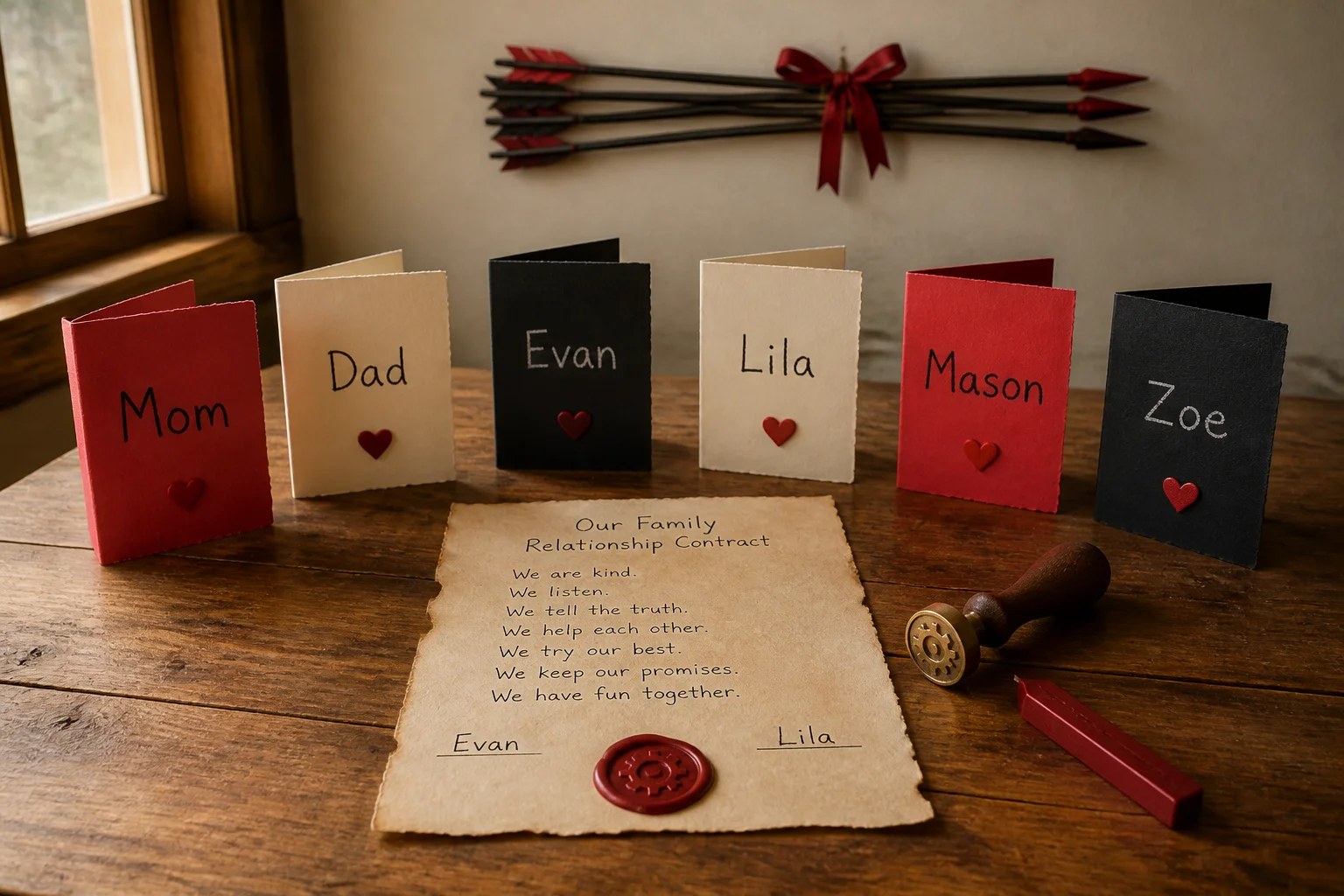
- Week two: Cards and contracts (Valentine’s week). Everyone writes a card, by hand, to each member of the immediate family: each parent and each brother and sister. Each card names one thing the writer values about the other and one thing they will keep doing. Then the contracts (below). On the eve of Valentine’s Day, Relationship Night: over dinner each person names someone they would like to know better (a friend for a child; for older singles, perhaps a romantic prospect) and a plan for approaching them.
- Week three: The Ask, then Rejection Day. Everyone carries out their plan. A week after Valentine’s Day comes Rejection Day: anyone who can show they made their attempt, whether or not it worked, is rewarded (a favorite meal, a favor to cash in), and the family votes on the bravest attempt, which wins a box of discounted Valentine’s chocolates. Over dinner the attempts are taken apart kindly: what went well, what to try next time. Rejection becomes practice, not failure.
- Movie nights, all month. Watch films with a romance in them with green and red paddles on the sofa. Whenever a character does something healthy or toxic in a relationship, the paddles go up, and the family argues it out afterwards on a scorecard: who would you want as a brother-in-law? Who is in love, and who just has a crush? (On trial for one year: Malcolm is not sure about the paddles, and the family may end up just talking the films over instead.)
- Parents renew their contract. Married couples sit down once in February to re-read their marriage contract (see the Marriage Contract) and amend it for the year ahead.
- Timing
- All of February. Relationship Night on February 13; Valentine’s Day as usual; Rejection Day one week later.
- For children
- Making cards, wax seals, red and green paddles, a family vote and a prize. The lesson: honor your parents, and choose the people in your life on purpose.
- Look
- Red, cream and black; hearts; arrows and targets (you are not shot by Cupid, you pick up the bow); the bundle of arrows over the door; wax seals; the two paper tablets.
- Foods
- The family cooks together and teaches dishes that impress but are easy (a good pan-seared steak, a homemade pie) for children to cook for future friends and spouses. Discounted chocolates on Rejection Day.
- Gifts
- A card to each member of the family; the bravest-attempt chocolates; rewards for every attempt.
- Values
- The Fifth Commandment and the Ten Commandments as a whole; family as the vessel of a durable culture; choosing a spouse with the head; explicit agreements; courage in the face of rejection.
- Old roots
- The ketubah and the written covenant; matchmaking and the family’s role in courtship; Japan’s exchange of Valentine’s gifts and White Day returns.
Relationship contracts
Most fights between people who love each other come from expectations nobody said out loud. A relationship contract says them: what each person will do, what each can expect, what happens when someone falls short, and when the two will look at it again. Any relationship can have one: siblings who share a room, two friends, a child and a parent, business partners, a married couple.
Children practice in February with small, real contracts, signed and sealed with wax:
- Between siblings: who gets the top bunk on which nights; how the shared tablet is divided; what happens to something borrowed and broken.
- Between a child and a parent: screen time against chores; a bedtime against a privilege.
- Between friends: how two friends will settle an argument, or what they promise to keep secret and what they will not.
Every contract has the same parts: who is in it; what each promises; what happens if a promise is broken; how a disagreement is settled; and a review date (next February). The lesson is that problems are cheapest to solve before they happen, and that a good relationship is something you build on purpose, not something that happens to you.

Love, romance and the crush. As we argue in The Pragmatist’s Guide to Sexuality, the feeling of a new crush (new relationship energy) is far stronger at first than love, and fades; love is the slower system our ancestors first evolved to protect their children, and it lasts. Teenagers should know the difference before they need to: choose a partner while the crush is loud, but choose as if it were already quiet. The movie paddles are how small children start learning to tell the two apart.
May · the month of honest engagement
Steelman
If we are wrong, we would rather be right. Offense is the feeling of an idea we cannot yet answer, and a chance to correct how we see the world, or ourselves.
- Steelman (our pick). Names the skill the month teaches: argue the other side at its very strongest, as its own believers would. A plain name for what the month is for, and its last night, Steelman Night, already carries it.
- Truetide (Simone’s first pick). To true is the old craftsman’s verb, still used by engineers and bicycle mechanics, for bringing something back into exact alignment: you true a wheel, a beam, a lens. The month exists to true the family’s picture of reality.
- Lemon Week (the name in The Pragmatist’s Guide to Crafting Religion). Something sour made into something good; warm and easy for children, but it names the dessert, not the lesson.
- Mendtide. Mend once meant “to correct a fault,” in a belief as much as in a garment.
- Gainsaytide. Gainsay is the old word for speaking against. The month of hearing out the people who gainsay us.
This is the holiday drafted as Lemon Week in The Pragmatist’s Guide to Crafting Religion, stretched to a month. Its idea is one of the most important we hold. You only feel offended by a claim that credibly threatens something you believe about the world or about yourself: call a man who knows he is generous “miserly” and he laughs; call a man who secretly doubts it the same thing and he is offended. So offense is not an attack to repel. It is a pointer to the place where your understanding may be wrong. Most ideologies train their members to treat offense as aggression and to stop listening; Techno-Puritans train their children to do the opposite, and to go and look.
How it runs
- Find it (May 1, at dinner). Each person names an offensive idea they will explore this month: an idea, movement or argument that offends them, or a criticism of themselves that stings. Small children choose something simple and close (“people who say vegetables are better than dessert”); teenagers and adults choose something that really hurts.
- Study it (the first three weeks). Read its best writers, watch its best speakers, read its forums, and if possible talk to someone who holds it. Two hours of podcasts on the way to school is enough. At each weekly dinner everyone shares the most surprising thing they learned.
- Steelman Night (the last Sunday of May). Each person presents the strongest case for their idea, as its believers would make it. Anyone who straw-mans it is sent back to try again. Then the family discusses: is any of it right?
- The Iron. The family votes on the best steelman of the year. The winner holds the family’s Iron until next May: any small piece of iron or steel (a bolt, a nut, a nail, an old key), tagged with the name of every year’s holder. “As iron sharpens iron, so one person sharpens another” (Proverbs 27:17). The holder also chooses the menu for the closing dinner and is served first.
- Timing
- All of May. Find it on May 1; Steelman Night on the last Sunday.
- For children
- A detective game: find out why someone believes something strange, and explain it better than they can. A vote, and a prize that passes hand to hand.
- Look
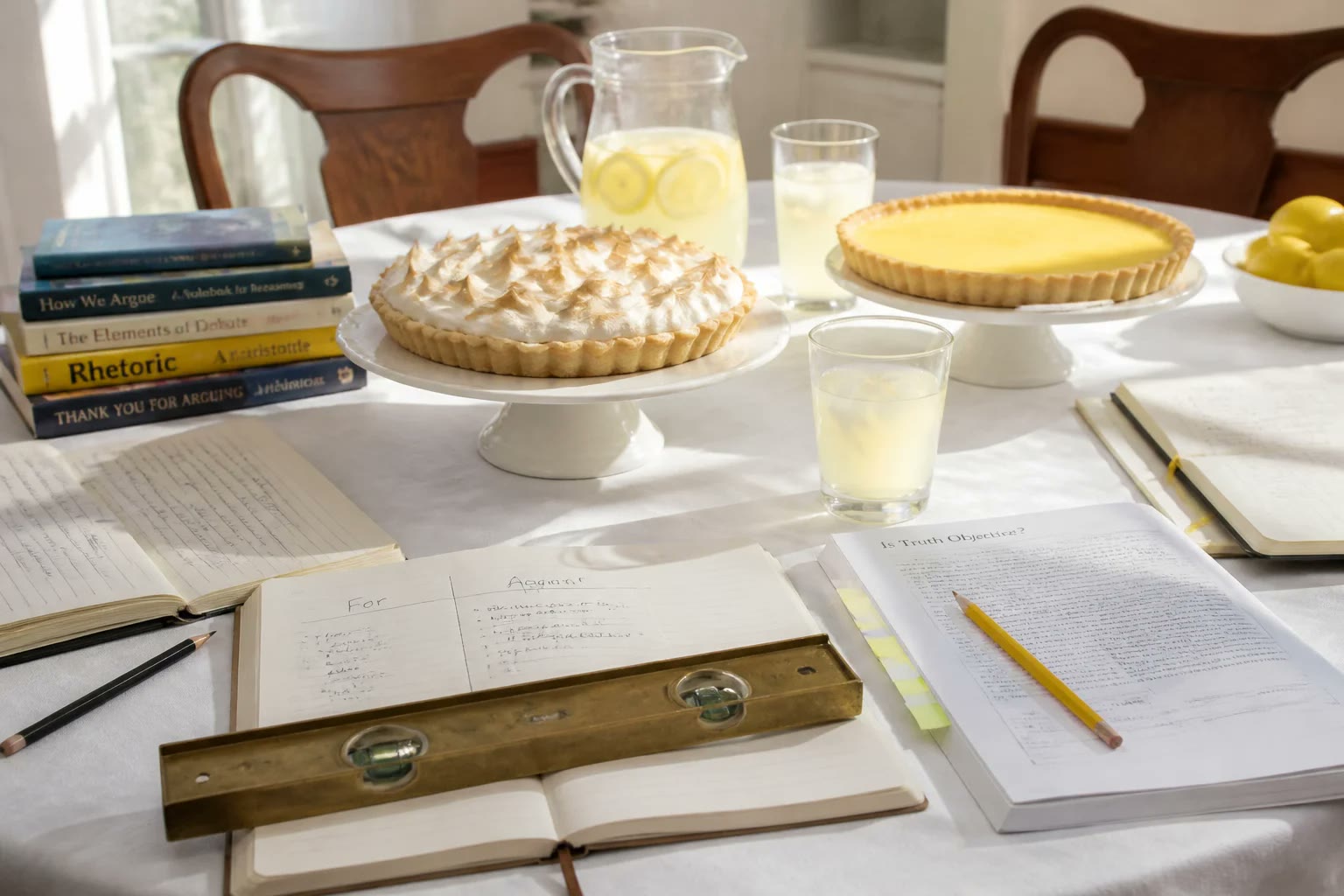
- Yellow and white: bright, clean and cheerful, to make a hard subject approachable. Notebooks of arguments in two columns. The Iron on its tag in a place of honor.
- Foods
- Lemon desserts and drinks: tarts, meringue pie, curd, lemonade. Something sharp and sour turned into something wonderful; a matter of taste, not a symbol.
- Values
- Truth over tribe; offense as a signal to investigate; humility about our own picture of reality and of ourselves; a religion that corrects itself; resistance to ideological capture.
- Old roots
- The Talmud, which keeps the losing argument beside the winning one; the medieval disputatio, which states the objections at full strength before answering them; Proverbs 27:17.
October 31 – November 2 · the holiday against idols
Jackbreak
“You shall not make for yourself an idol.” (Exodus 20:4)

- Jackbreak (our pick). Named for the jack-o’-lanterns the children smash on All Saints morning: the one thing every Halloween already has, broken on purpose. Plain, playful, and it tells a child exactly what happens.
- Idolbreak (Simone’s first pick). Says what happens and what it means.
- Calfbreak. After the golden calf. More playful, more specific.
- Hallowbreak. Keeps the link to All Hallows’, the holiday it lives inside.
Halloween is, as we showed in All Hallows’ Even, a Christian holiday: All Saints on November 1 and All Souls on November 2. We keep everything children love about it, the costumes, the candy, the carved pumpkins, and add the commandment Techno-Puritans take more seriously than any other Abrahamic tradition: no idols. We hold that the drift toward grandeur, images and sacred objects has pulled the Abrahamic faiths away from God. Jackbreak teaches children to break the idol themselves, and to laugh while they do it.
How it runs
- Make the idol pumpkins (the week before). Besides the ordinary jack-o’-lanterns, the family makes one pumpkin for each kind of idol, at the very least these four, each hollowed out, filled with wrapped candy and painted or carved:
- A popular-culture icon: a character from the TV show the children’s friends worship, a celebrity, a mascot.
- A designer brand or a pointlessly expensive thing: a luxury monogram, a status handbag, a logo people pay ten times the price to wear.
- The saints’ icons: Santa Muerte, or the gilded Orthodox and Catholic icons that people kiss and pray to.
- The gold building: a domed shrine or mosque covered in gold, or a giant mansion, the things people pretend are not icons. This pumpkin is always painted gold all over, and the family is welcome to bedazzle it too (rhinestones, glitter, plastic jewels), so it shines brighter than the rest on the table.
- Halloween night. Trick-or-treating as normal. The jack-o’-lanterns glow on the step; the idol pumpkins sit in a row on a table with a candle in front of them, very grand.
- The story (bedtime on the 31st). The old Jewish story of the boy Abraham in his father Terah’s idol shop: he smashed every idol but the biggest, put the hammer in its hands, and when his father came back, told him the big idol had done it. “Idols cannot do anything,” said his father. “Then why do you worship them?” (Genesis Rabbah 38:13). And Moses, who came down the mountain, burned the golden calf and ground it to powder (Exodus 32:20).
- The Breaking (All Saints morning, November 1). The children smash the idol pumpkins one at a time, saying what each one is and why it is an idol, and the candy pours out. Then the jack-o’-lanterns, which are faces we made ourselves and have finished with. The lesson in one line: we make things, we do not worship them. Rotting pumpkins go on the compost.
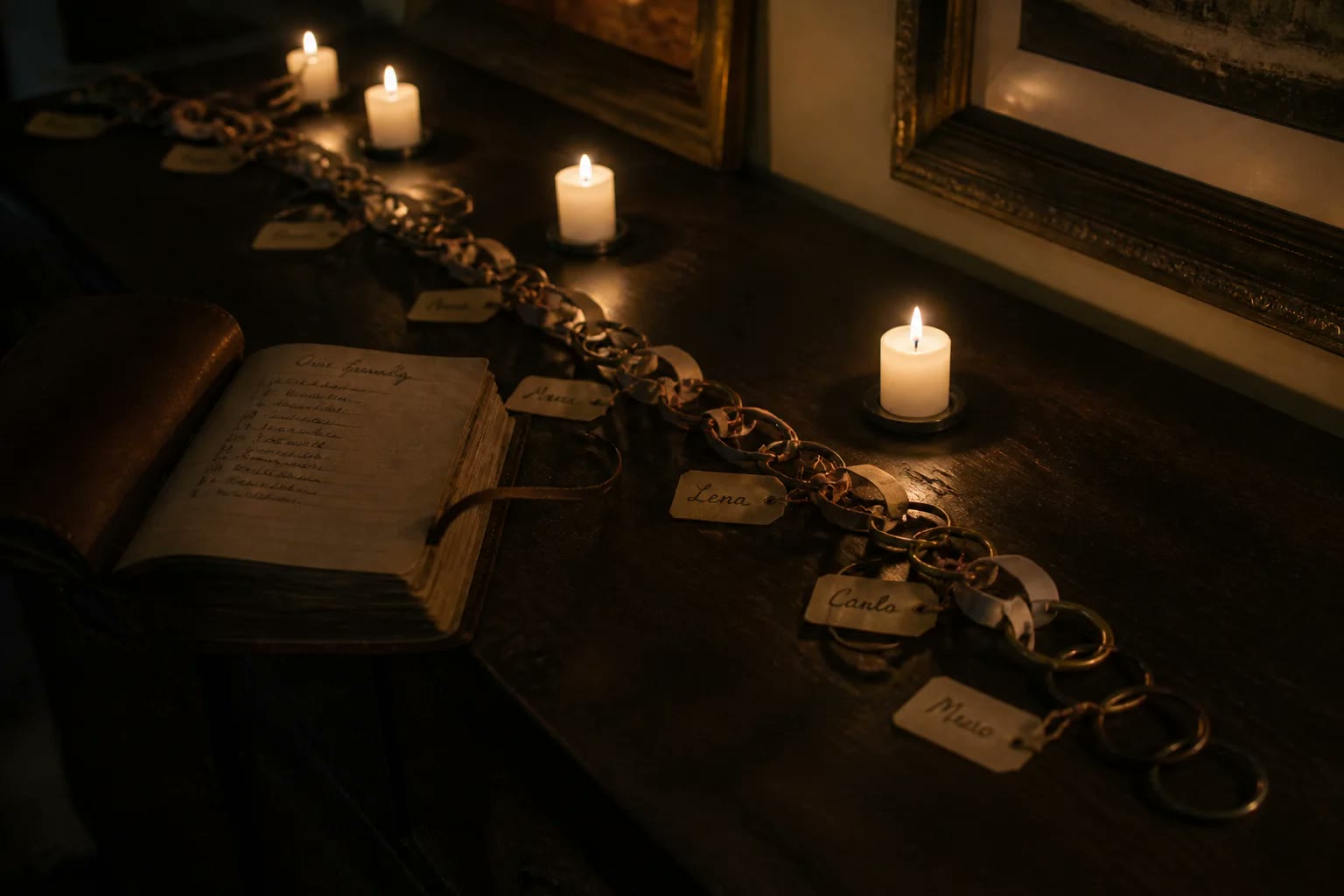
- Chain Night (All Souls, November 2). The family lays out its family chain, one link per person, and lights a candle beside each generation. The names of the dead are read along the chain, with any of their pledges from the Time Capsule Book, and the open end of the chain is left open for those not yet born. The point is not to venerate the dead (no portraits, no shrines) but to see where we stand in the chain, and who is coming after.
- Timing
- Halloween night, the Breaking on November 1, Chain Night on November 2.
- For children
- Costumes, candy, a bat and permission to smash things. The lesson: things made by people are not gods, however shiny.
- Look
- Orange and gold; jack-o’-lanterns; the row of painted idol pumpkins; for Chain Night, the family chain and a row of small white candles.
- Foods
- The candy, obviously. Roasted pumpkin seeds from the carving; on Chain Night a dish from an ancestor’s recipe.
- Values
- The Second Commandment; suspicion of grandeur, status objects and sacred images; anti-mysticism; descendant worship, the chain of generations aimed at the future.
- Old roots
- All Saints and All Souls; Abraham and the idols; Moses and the calf; burning the old before a new season (chametz before Passover, the Lohri bonfire).
Variation for older children. From about ten, each child names a modern idol of their own: a brand they want too much, an influencer they copy, a score they check too often. They write it on a slip of paper and stuff it inside one of the idol pumpkins before the smashing.
Why the saints’ pumpkin. Make the third pumpkin anything that is an idol in your own community, or, to show how far an icon can carry a people, make it Santa Muerte, the skeletal “saint of death.” She grew out of the Catholic habit of praying to statues of saints, and the Church condemns her, but the habit it taught is what she feeds on. In 2012 eight of her devotees in Sonora, Mexico were arrested for killing two boys and a woman as human sacrifices to her, and in 2024 the FBI described a Juárez cartel member placing the hearts of dismembered victims before her statues. A church that taught its people to want idols ended with some of them killing for one in the twenty-first century. We go through this in The Conquistadors Did Not Go Far Enough: Human Sacrifices in 2026 (TPS 62). Break her, and tell the children why.
Why the gold building, and idols that are not statues. Always paint the fourth pumpkin solid gold, then draw on it a dome and Islamic patterns (the interlaced stars, the arabesques, the calligraphy), or a giant mansion; a family that wants more can also break a miniature of ornate Islamic art or architecture, a little domed shrine, a gilded lantern, a tile. The lesson is that an icon does not have to be a statue. Islam forbids pictures of living things, and then poured the same devotion into gold, jewels and grandeur instead: domes covered in gold, mosques built to overwhelm, a black stone that pilgrims press to kiss, a covering for the Kaaba embroidered in gold and silver thread and replaced every year. It kept the letter of the rule against images and broke its point, the same way a giant mansion is an icon its owner would never call one. Our hatred of idols is not a narrow rule about statues. It is against gold and jewels for their own sake, against the arbitrary piling up and showing off of wealth, against anything made to be gazed at in awe instead of used. That is why our weddings are small, our dead have no shrines, and the Puritans met in plain wooden meetinghouses.
December · keeping our neighbors’ feasts, and learning why we are not them
Neighbors’ Feasts
“Let no one judge you in food or in drink, or regarding a festival or a new moon or sabbaths.” (Colossians 2:16) “One person esteems one day above another; another esteems every day alike. Let each be fully convinced in his own mind.” (Romans 14:5)

- Neighbors’ Feasts (our pick). Says plainly what the month is: we keep the feasts of the people around us.
- Sojourn (Simone’s first pick). Abraham called himself “a stranger and a sojourner” among the Hittites (Genesis 23:4). A sojourner lives among other peoples without becoming them, which is exactly what December teaches: know your neighbors, respect them, prosper among them, and stay yourself.
- Babylon. After Daniel, who served the king of Babylon faithfully and kept his own faith. Memorable, but the name carries baggage.
- Neighbortide. Plain and friendly; loses the survival half of the lesson.
December is when the faiths around us hold their biggest feasts, and a Techno-Puritan family keeps them. We have no rules against celebrating a holiday tied to another faith. Scripture forbids judging anyone by the feasts they keep or skip (Colossians 2:16, Romans 14:5–6), so lighting a menorah or trimming a tree is not a compromise of anything. But we keep these feasts the way you visit a house you used to live in. Christianity and Judaism are earlier revelations of the same God, real but incomplete, and their biggest holidays show exactly where each one stopped. The point of the month is that our children understand those faiths well, and come away knowing why we are not them.
How it runs
- Hanukkah (its eight nights). Light the menorah, eat latkes and doughnuts, play dreidel, and tell the story of the Maccabees the way Jewish families tell it. Then, over dinner, ask what the story leaves out. Like Passover and Purim, Hanukkah is a story of one people oppressed and then saved. It does not ask why. The revolt began as a war among Jews themselves, between those who had taken up Greek ways and those who had not (1 Maccabees 1:11–15, 2:23–26), and the feast never asks what in the people’s own choices led to the crisis, or what drove the other side. The prophets asked that question about the exile (Jeremiah, Lamentations); the feasts mostly do not. And its concern stops at the edge of one people: the miracle is for Israel, and everyone outside is either the enemy or not in the story. A people that tells only the story of its own suffering does not learn from its failures, and a faith whose care ends at its own tribe cannot carry a future of many peoples. How it really started. The crisis was made by Jews fighting Jews over power, years before any Greek king touched the Temple. In 175 BC Jason, the high priest’s own brother, bought the high priesthood from Antiochus IV, pushing out his brother Onias III, and built a Greek gymnasium beside the Temple (2 Maccabees 4:7–15). Three years later Menelaus outbid Jason for the office, though he was not of the priestly line; he paid for it with gold vessels taken from the Temple, and had Onias murdered when Onias exposed him (2 Maccabees 4:23–34). In 168 BC, on a false rumour that Antiochus was dead, Jason came back with a thousand men and slaughtered his fellow citizens in Jerusalem to take the city from Menelaus (2 Maccabees 5:5–7). Antiochus took it for a revolt, sacked the city, and the decrees against the Jewish faith followed (2 Maccabees 5:11–14). And the revolt itself opened with Jew killing Jew: Mattathias’s first blow struck down a fellow Jew at the altar in Modein (1 Maccabees 2:23–26), and his band spent its first years attacking Jewish “sinners” and circumcising boys by force (1 Maccabees 2:44–46). Hanukkah celebrates the end of a civil war as if it were only a war against foreigners. Ask, too, why the feast is so big. Hanukkah is not one of the feasts the Hebrew Bible commands (the books of Maccabees are not in the Jewish Bible), work is not forbidden on it, and for most of its history it was a minor feast. It grew into a December gift-giving holiday in nineteenth- and twentieth-century America, to give Jewish children something to set beside Christmas (Dianne Ashton, Hanukkah in America, 2013). A faith that inflated a small feast to keep pace with its neighbor, and gave it so thin a meaning to carry, is showing where its attention has gone. Then tell the rest of the story, the part the feast leaves out. Infighting is what started Hanukkah, and infighting is what ended what it won. The Maccabees’ own dynasty tore itself apart: in 63 BC two Hasmonean brothers, Hyrcanus II and Aristobulus II, were at war over the throne, and one side opened Jerusalem to Pompey, which is how Rome came in (Josephus, Antiquities 14.4). A century later, with Rome at the walls, three Jewish factions in the besieged city (John of Gischala’s, Simon bar Giora’s and Eleazar’s) burned one another’s grain stores, food that by every account would have carried the city through a siege of many years; Josephus says it was enough for “a siege of many years” (Jewish War 5.1.4), and the Talmud says twenty-one (Gittin 56a). The city starved, and the Temple fell in AD 70. The rabbis themselves said the Second Temple was destroyed for “baseless hatred” among Jews (Yoma 9b), yet the feasts kept every year still tell only of enemies from outside. That is the lesson for our children: a people can name its own fault in a footnote and still never let it change the story it tells itself, one generation after another. So Hanukkah is a feast of gratitude and of warning. We are grateful for what the Jews began: the revelation we stand on came through them. And we resolve never to become what they became: we work together even when we differ, we do not burn our brother’s grain to win an argument, and we do not hide the ugly parts of our own history. When our own people fail, our feasts will say so.
- The binding of Isaac (one night of Hanukkah). The other question December puts to us is why the Jews carry a stricter covenant than ours, and a worse one. Our reading of the binding of Isaac answers it. Abraham had just argued with God, face to face, over Sodom, bargaining Him down from fifty righteous men to ten (Genesis 18:23–33), so he knew he could question God. Then he was told to kill his own son, and he said nothing: he rose early, cut the wood and raised the knife (Genesis 22). We read that as a test of moral judgment, and Abraham failed it. So the covenant that came through him is a covenant of rules spelled out one by one, 613 of them, down to a law that you shall not burn your children to a god (Leviticus 18:21, Deuteronomy 12:31): rules for a people who had shown they would obey without judging. Ours is the second covenant, made for people trusted to judge right and wrong for themselves, and it asks more of us for that reason. The family retells the binding at dinner and asks the children what Abraham should have said. The full argument is in Tract 24, Did Abraham F* Jews Through Human Sacrifice? (Why We Needed Two Covenants).
- Advent and Christmas. The wreath, the tree, carols, the Nativity read aloud from Luke, a Christmas service with Christian friends if they invite you, and the family’s own Christmas morning. Then the questions. Christianity’s greatest feast of the year is not in the Bible: no apostle kept it, no verse asks for it, and nothing gives its date. In the Christmas most children actually live, how is good defined? Nice or naughty, judged by one watcher for one season. And notice who decides. In the Santa story good and bad are not measured against anything real. Good is doing what the adults around you, and the one who keeps the list, think a good child does; bad is not doing it. The child learns that morality means pleasing an authority and fitting society’s idea of a nice child, not working out what is actually right. That is the morality of the crowd the chief priests stirred up to choose Barabbas (Mark 15:11–15): right is whatever authority and the crowd say it is. It is the same failure as Abraham’s on the mountain, obedience in place of judgment. Ours measures good and bad against what actually makes people and their descendants flourish, and expects every child to judge it for themselves. How is it rewarded? With things that are bought. It is morality at its simplest, and it has been taken over almost entirely by commerce: the money-changers Jesus drove out of the temple (Mark 11:15–17) now run the feast of his birth. Ask the children what Jesus actually taught, and how much of it Christmas ever mentions.
- The other lights, if the family wants them. St. Lucia, Bodhi Day, Diwali just past, the Lunar New Year to come. Each is one dinner with two questions: what does this one see clearly, and where does it stop?
- The Covenant of the Sons of Man. Our answer to a faith that cares only for its own: as humanity spreads out and diverges, every people (and every kind of mind) must protect every other’s right to live and worship as it sees fit, as long as it does not stop others doing the same. We defend other faiths’ freedom because our own depends on the same rule, which is also why we are free to keep their feasts. Daniel’s vision of a kingdom of iron mixed with clay (Daniel 2) is the scripture for it.
- Timing
- December 1 to Christmas Day. Then Providence begins.
- For children
- Candles, dreidels, the tree, carols, Christmas morning; and at the end of each feast, the question: what did they get right, and what did they miss? The lesson: we can keep anyone’s feast, and we can see further than it does.
- Look
- Whatever the neighbors use, honestly borrowed: the menorah, the tree, the Advent wreath, all in the window together.
- Foods
- Latkes and doughnuts for Hanukkah, the family’s Christmas dinner, a dish from each tradition kept.
- Values
- Freedom to keep any feast (Colossians 2:16); earlier revelations as real but incomplete; a morality deeper than reward; owning one’s failures rather than only one’s suffering; working together through our differences; never hiding the ugly parts of our own history; care beyond one’s own people (the Covenant of the Sons of Man); the Tenth Commandment (see Christmas, below).
- Old roots
- The early Church, which kept the feasts it found and gave them new meaning; the binding of Isaac (Genesis 22) and the Sodom bargain (Genesis 18); Romans 14 and Colossians 2 on feasts and days; Jeremiah’s letter to the exiles.
December is the preamble to Providence. The month is built to end the week before our own holiday begins, so the children feel the contrast. Christmas defines good as being nice for a season and rewards it with things; Providence takes the things away and asks for a written pledge to build the future, rewarded only when there is evidence of keeping it. Hanukkah looks back at one people’s suffering; Providence looks forward to all our descendants and every people they will become. Christmas is a feast scripture never asks for; Providence rests on what it does ask: written covenants, mastery of what you want (Exodus 20:17), and care for the generations to come. Our children should come out of December able to say why our tradition is better for flourishing, wider in its thinking, more serious in its morality, and closer to the Bible than the feasts they have just enjoyed.
The Santa lesson: when to play along
In a Techno-Puritan home Santa comes, and there is one rule about him, told to every child the moment they first ask whether he is real: Santa only brings presents to children who believe in him. A child who announces that Santa is not real gets no presents from Santa. A child who has worked it out and still says, with a straight face, that they believe, gets presents.
That is the lesson. A religion that lives inside a larger society is surrounded by stories everyone repeats and many do not believe, and by people who will smile and say things they do not mean and expect you to do the same. Refusing to play along on every point is not virtue; it is losing opportunities, jobs and friends for nothing. Children who work out the Santa rule have learned, gently and early, to tell a harmless social fiction they can go along with from a real compromise they must refuse. Once they know, they join the adults in keeping the story for their younger brothers and sisters.
This does not break our rule of honesty inside the family: no child is ever left believing something false after they have sincerely asked. When they ask, they are told the truth, and the rule, in the same breath. What they learn is how the world outside the family works.
Christmas without coveting

Our family celebrates Christmas, and Neighbors’ Feasts is the frame that lets a Techno-Puritan family keep it with a clear conscience: we keep it as our neighbors’ feast, honestly, and add one commandment that most Christians skip. “You shall not covet” (Exodus 20:17) is the commandment Christmas tests hardest.
- One thing, chosen well. Instead of a long wish list, each child asks Santa for one thing (perhaps two), after real thought. Learning to want one thing deliberately is the opposite of coveting.
- The box to pass on. Before Christmas each child fills a box with toys to hand down to a younger sibling, cousin or neighbor, at least as many as they are asking for. Possessions pass down; they are not hoarded.
- No comparing. On Christmas morning nobody asks what anyone else got, inside the family or out.
- Then the Future Police. On New Year’s Eve every toy is taken, the new presents with the old. Wanting is followed, every year, by mastering what you wanted.
Every week
The Sabbath
The oldest holiday in our tradition, and the one that does the most work. From sundown Friday to sundown Saturday, no profit-making or routine work; time with the family, rest, personal projects, the outdoors. We argue the case and the rules at length in The Seventh Day. Two weekly customs make it a children’s holiday too:
- The question of the week. At Friday dinner a child asks one question about God, the future or the family, and everyone answers it.
- The pledge check. In January the Sabbath dinner is where the Providence pledges are checked; the rest of the year, any child may report progress there.
The milestones of a life
Holidays that happen to a person
An annual holiday teaches everyone together; a milestone frames a turning point in one person’s life in the light of what we believe. Five of them, each tied to the one family book that runs through this whole calendar: the Time Capsule Book, where pledges are written, names are added, and the dead are read.
Scioning · a birth
A scion is a descendant; our name for God, Omniscion, is built from it. Every person alive stands at the end of an unbroken chain: every one of their ancestors, for millions of years, lived long enough to have a child. A birth adds a new link to that chain. Scioning is built for parents who are exhausted: it takes ten minutes, costs nothing, the older children do most of it, and it works in an apartment, a farmhouse or a spaceship.
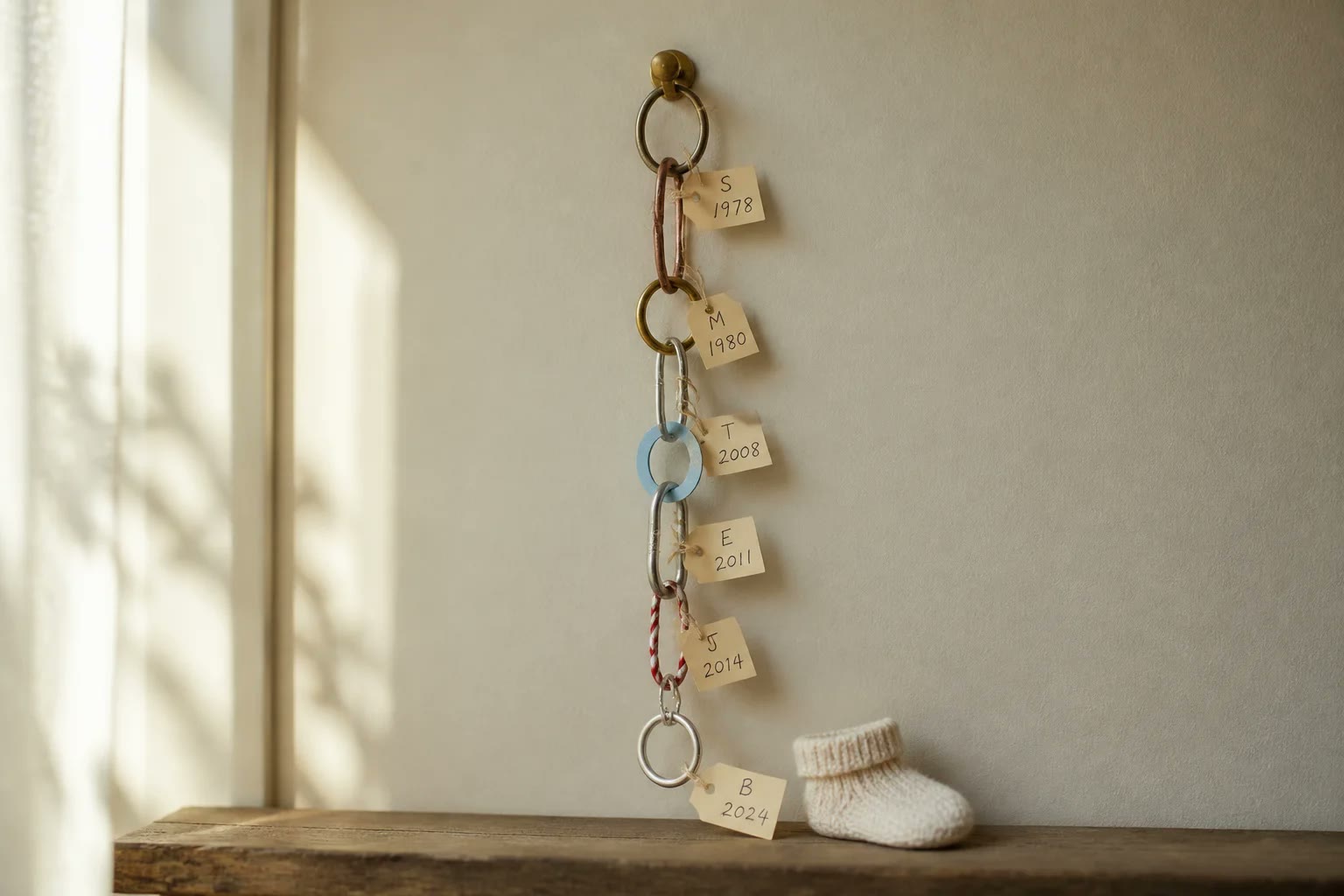
- The family chain. Every family keeps a chain with one link per member, made from whatever is at hand: a key ring, a loop of wire, a curtain ring, a paper loop, a link cut from any old chain. It hangs by the door or lives with the Time Capsule Book. (A mother who would rather wear it can keep it as a charm bracelet or necklace instead, one charm per child; a family on the move can keep it as a list on the first page of the Book.) When a baby comes home, an older brother or sister makes the new link, tags it with the baby’s initial and year, and joins it on.
- The recitation. At the first family meal or Sabbath after the baby comes home, someone holds the baby and recites the chain: “[Name], child of ___ and ___, grandchild of ___ and ___,” back as far as the family knows, then “and before them an unbroken line, back to the first life on Earth; and after you, all who are still to come.” It needs nothing but memory, and children love to learn it.
- Later, when there is time. Within the baby’s first year each parent writes a sealed letter to the child’s descendants, to be opened when this child has grandchildren. The older children choose the baby’s first gift.
- When
- The first family meal or Sabbath after the baby comes home.
- Names
- Scioning (our pick); Linking; Begetting.
- Look
- The family chain, a new link, a paper tag with an initial and a year.
- Effort
- Ten minutes; nothing to buy. The parents only have to sit there and hold the baby.
- Values
- Descendant worship; each person as one link in a chain running from the first life to the far future; children as the point of everything.
- Old roots
- The genealogies of Genesis and Matthew (“and he begat…”); the Māori recitation of whakapapa; naming ceremonies everywhere (the brit, baptism, the aqiqah, the Hindu namakarana).
Birthday · a sabbath of one’s own

We already keep a person’s birthday as a one-day sabbath for them: no productive work, rest, and time to think about God and their place in the great clockwork. A candle goes into their favorite food, whatever it is, and they choose one gift for themselves rather than being given one. We suggest five more customs:
- The wish is a plan. Techno-Puritans do not cast spells. The birthday person blows out the candle and says (or writes, privately) a wish they intend to make come true, and it goes into the Time Capsule Book to be read back on their next birthday.
- The doorframe. Height marked in pencil on the same doorframe every year, with the date.
- The same questions every year. A two-minute recorded interview with identical questions (What do you want to be? What are you best at? What is the future going to be like?), so that at eighteen a child can watch themselves answer at three, four and five.
- One honest question. The birthday person may ask each parent any one question and get a true answer.
- A letter forward. From about eight, a short letter to themselves ten years on, sealed and kept.
- When
- The birthday itself; if it falls on a school or work day, that evening and the nearest Sabbath.
- Names
- Birthday (keep it: some words should stay ordinary); Natalsabbath.
- Look
- One candle in the favorite food; the doorframe; quiet.
- Values
- Rest as a commandment; reflection on one’s place in the plan; choosing deliberately instead of wanting everything; measuring yourself against yourself.
- Old roots
- The Sabbath; the Jewish custom of extra study and charity on a birthday; the name day.
Sovereignty · coming of age

Sovereignty is the day a young person becomes ruler of their own life: no longer kept by anyone, answerable for it to God, their conscience and their descendants. We mark adulthood not by an age but by the thing that makes an adult: paying your own way. When a young person has covered their own living costs from their own work for six months, they bring their accounts to a family dinner and present them. In return they receive the adult-size silver gear (children wear the smaller one; see the wardrobe), their own key to the family vault where the Time Capsule Book is kept, a voice in family decisions, and the right to write in the Book as an adult. Their first act as a fledged adult is to pay for the family dinner.
- When
- When it happens: often between 16 and 25. Six months of self-support, presented at one dinner.
- Names
- Sovereignty (our pick: you now rule your own life); Fledge (Simone’s first pick: a bird is fledged when it can fly and feed itself); Freeman (the Puritan word: in Massachusetts Bay a freeman was a full member with a vote); Freehold; Selfhold.
- Look
- The ledger, the key, the adult gear in its box.
- Values
- Efficacy over status; adulthood as responsibility, not a birthday; the family as an enterprise each member eventually supports.
- Old roots
- Bar and bat mitzvah, confirmation, the quinceañera, Japan’s Coming of Age Day, the old craft guilds’ journeyman piece.
The Marriage Contract · a marriage
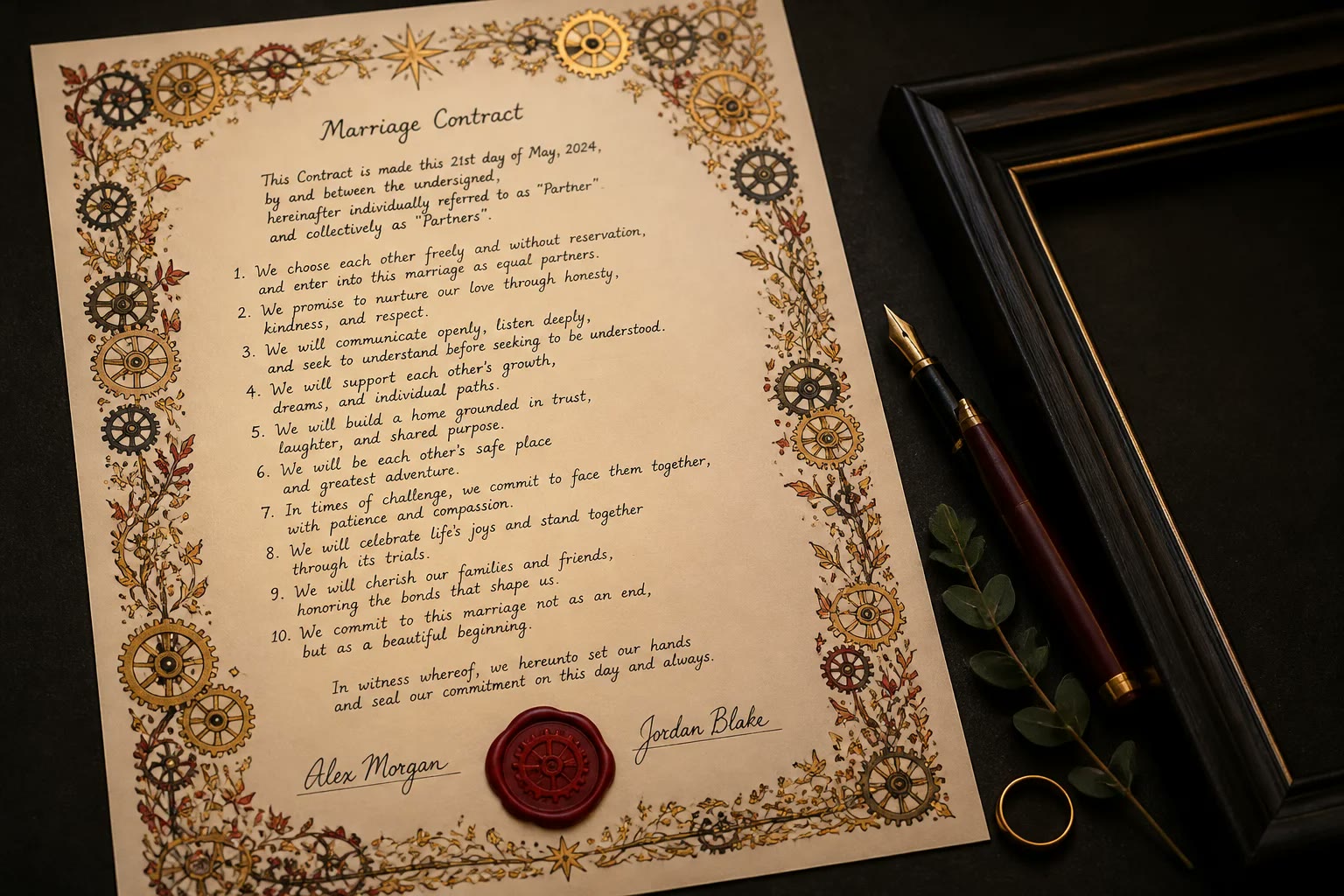
“To plight one’s troth” is to pledge one’s faithfulness. The center of a Techno-Puritan wedding is a written marriage contract, drafted by the couple well in advance with both families’ advice: what each will do, how money, children, work and religion will be handled, how disagreements will be settled, and when the contract will be reviewed (every February). On the day it is read aloud, signed, witnessed and sealed, then framed and hung in the home, illuminated with gears and stars the way old ketubot were illuminated with vines and birds. Each spouse also writes a pledge to their future descendants in the Time Capsule Book.
A small wedding, and never in a church. Techno-Puritans are strongly against making a fetish of the wedding. The marriage is what matters, not the day: no venue fees, no dress worn once, no debt to start a family under. Spend the money on the household instead. Hold the signing somewhere that honors law and learning: a law library, a public library, or a historic building such as an old courthouse or town hall. Not a church. The inevitable corruption of religious bureaucracies is one of the core points of the Jesus narrative: the men who ran the Temple turned it into a market (Mark 11:15–17), and the chief priests and scribes are the ones who plotted his death and handed him over (Mark 14:1, 15:1–15). We do not marry under that roof. The Puritans agreed: in early New England a wedding was a civil contract, made before a magistrate, not a minister.
- When
- The wedding; renewed each February on Clan Day.
- Where
- A law library, a public library or a historic building. Never a church; never an expensive venue.
- Names
- The Marriage Contract (our pick: say what it is); Plighting (Simone’s first pick); Troth; Wedding.
- Look
- The illuminated contract, wax, the black and white of our wardrobe.
- Values
- Marriage as the most important choice and a partnership built on purpose; explicit agreements; family formation as the work of a religion; thrift over spectacle; no trust in religious bureaucracy.
- Old roots
- The ketubah; the betrothal contract; the vow “I plight thee my troth”; the civil marriages of Puritan New England.
The Funeral · a death
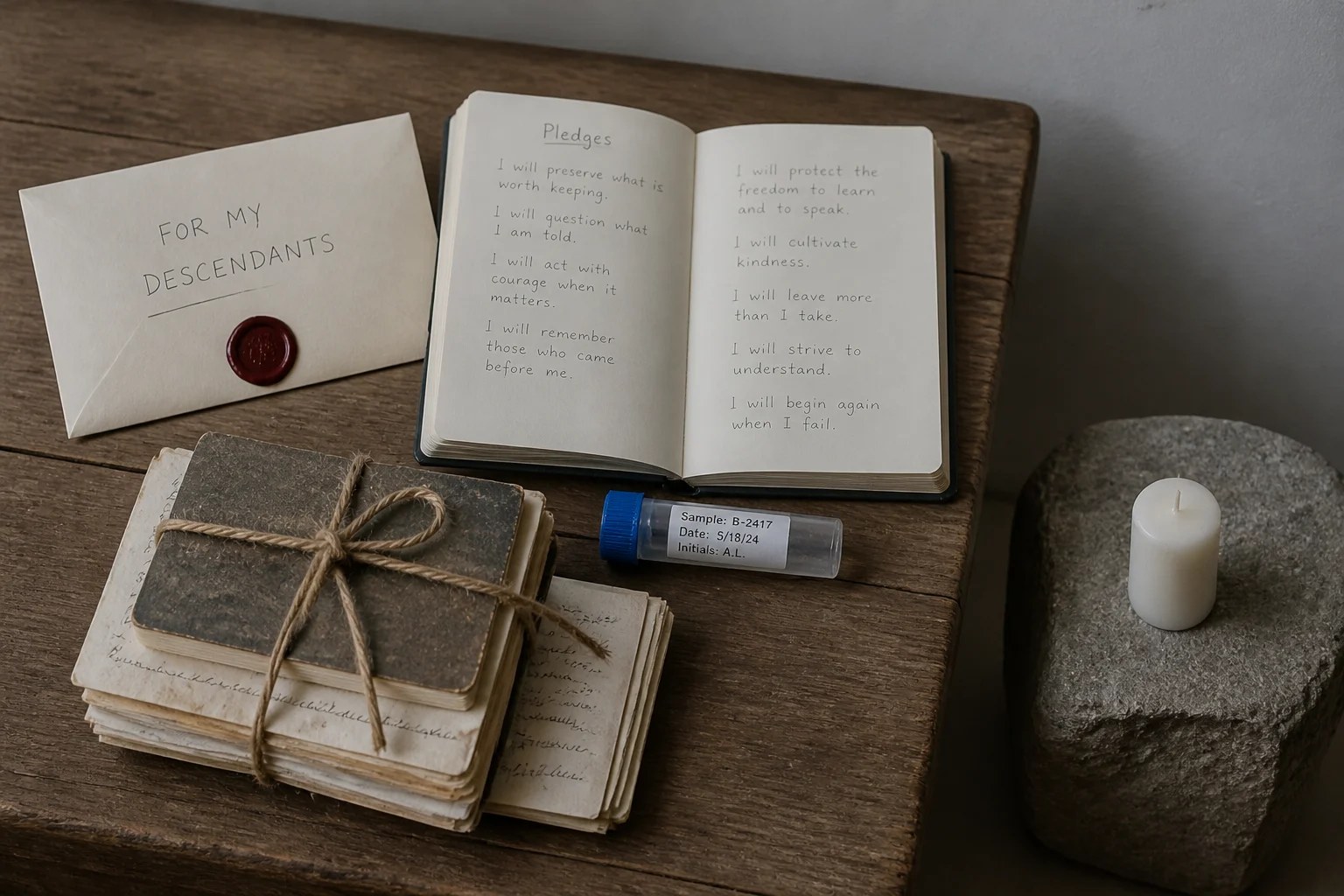
We do not believe a death should be made into a second loss. To mourn someone so long that it stops you working makes their last act on earth a destructive one. So mourning is bounded, as Judaism bounds it: seven days at home, then back to life. There is no gathering everyone has to go to. The family meets as it can, and anyone may pray for the dead wherever they are, at any unhewn stone, the only altar scripture asks for (Exodus 20:25). When the family meets it reads the dead person’s pledges and entries from the Time Capsule Book and opens the sealed letter they left for their descendants (everyone writes one at Sovereignty and updates it). Each family member takes up one unfinished pledge of the dead and says so aloud. The body is handled simply and cheaply; there is no shrine and no portrait to be venerated. The dead are remembered every year at Chain Night.
Into the Index. Where the technology allows, the dead person’s DNA is recorded in the Index, together with everything they wrote or left: letters, pledges, notebooks, recordings, anything that says who they were and what they knew. The Index is the record of families and their traditions described in The Pragmatist’s Guide to Crafting Religion (Building the Index: A Cultural Reactor), kept so that distant descendants can know where they came from and learn from how their ancestors lived.
- When
- Whenever the family can meet; seven days of mourning; yearly at Chain Night (November 2). Prayers at any unhewn stone, at any time.
- Names
- The Funeral (our pick: say what it is); Relay (Simone’s first pick); Handing-on; Bequest.
- Look
- The Book, a rough stone, one candle, plain wood.
- Values
- Life as one leg of a very long race; the dead served by finishing their work; no idols, even of the people we loved; nothing of a person lost that can be kept for their descendants.
- Old roots
- Shiva, sheloshim and the yahrzeit; the altar of unhewn stones (Exodus 20:25, Deuteronomy 27:5–6); the ethical will (the old Jewish custom of a letter of values left to one’s children).
What we still need to decide
- The names. The current picks are Providence, Clan Day, Steelman, Jackbreak and Neighbors’ Feasts for the year, and Scioning, Birthday, Sovereignty, the Marriage Contract and the Funeral for a life. Simone’s first names, Morrowtide, Troth, Truetide, Idolbreak, Sojourn, Fledge, Plighting and Relay, stay in their lists to be argued over, with the other alternatives listed with each.
- When Providence begins. The book version ran three days at the year’s end; our family has kept it through January. This page does both: the Taking and the Pledge at New Year, the month of proof through January.
- The movie-night paddles. Malcolm is not sure about them. We will try them for a year; if they feel forced, movie nights become plain talk afterwards.
- How much of February is for adults. Rejection Day asks single adults to make a real romantic approach; families with no single adults may keep it to friendships.
- Whether Jackbreak is too much smashing for small children. A two-year-old can tap a pumpkin with a wooden spoon; the bat is for the big ones.
- The age at which the Santa rule is told. We tell it the first time a child sincerely asks.
- Summer. We have left June to September empty on purpose. Families who want a summer holiday can add one; nothing here depends on it.
Sources: The Pragmatist’s Guide to Crafting Religion, chapter “Holidays and Traditions” (Future Day, Rejection Day, Lemon Week) and the sections on ritual, death, lying and descendant worship; The Pragmatist’s Guide to Sexuality, “The Mechanics of Love”; the Techno-Puritan tracts on idolatry (Tract 4), the Agents of Providence, and the Covenant of the Sons of Man (Tract 9). Research cited: Sosis, R. & Bressler, E. R. (2003), Cross-Cultural Research 37(2); Fiese, B. H. et al. (2002), Journal of Family Psychology 16(4); Eaker, D. G. & Walters, L. H. (2002), Journal of Family Psychology 16(4); Brooks, A. W. et al. (2016), Organizational Behavior and Human Decision Processes 137; Norton, M. I. & Gino, F. (2014), Journal of Experimental Psychology: General 143(1); Wiltermuth, S. S. & Heath, C. (2009), Psychological Science 20(1).