← The Technopuritan Wardrobe · the maker’s page
The Wardrobe: Build Guide
A formal black-and-white outfit on the outside. Tactical outerwear on the inside.
This page shows only the final design, and says how each piece is built. It looks like church clothes and must work like field clothes: the wearer runs, climbs, carries children, kneels in mud and washes everything hot. Where a picture and the words disagree, the words win. The pictures show the outside only; everything in the sections on movement, carry and pockets is hidden and is described in words and diagrams.
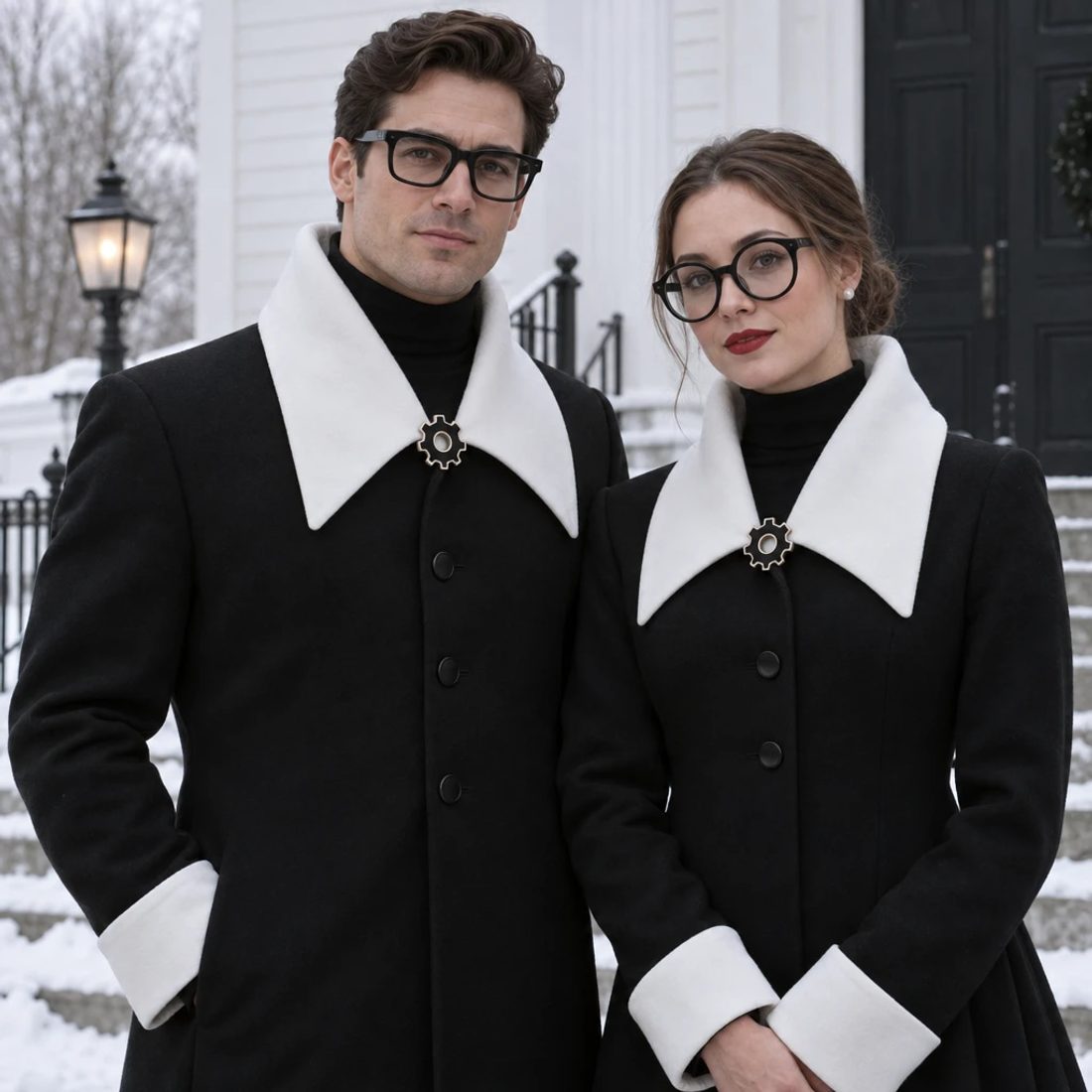
The look
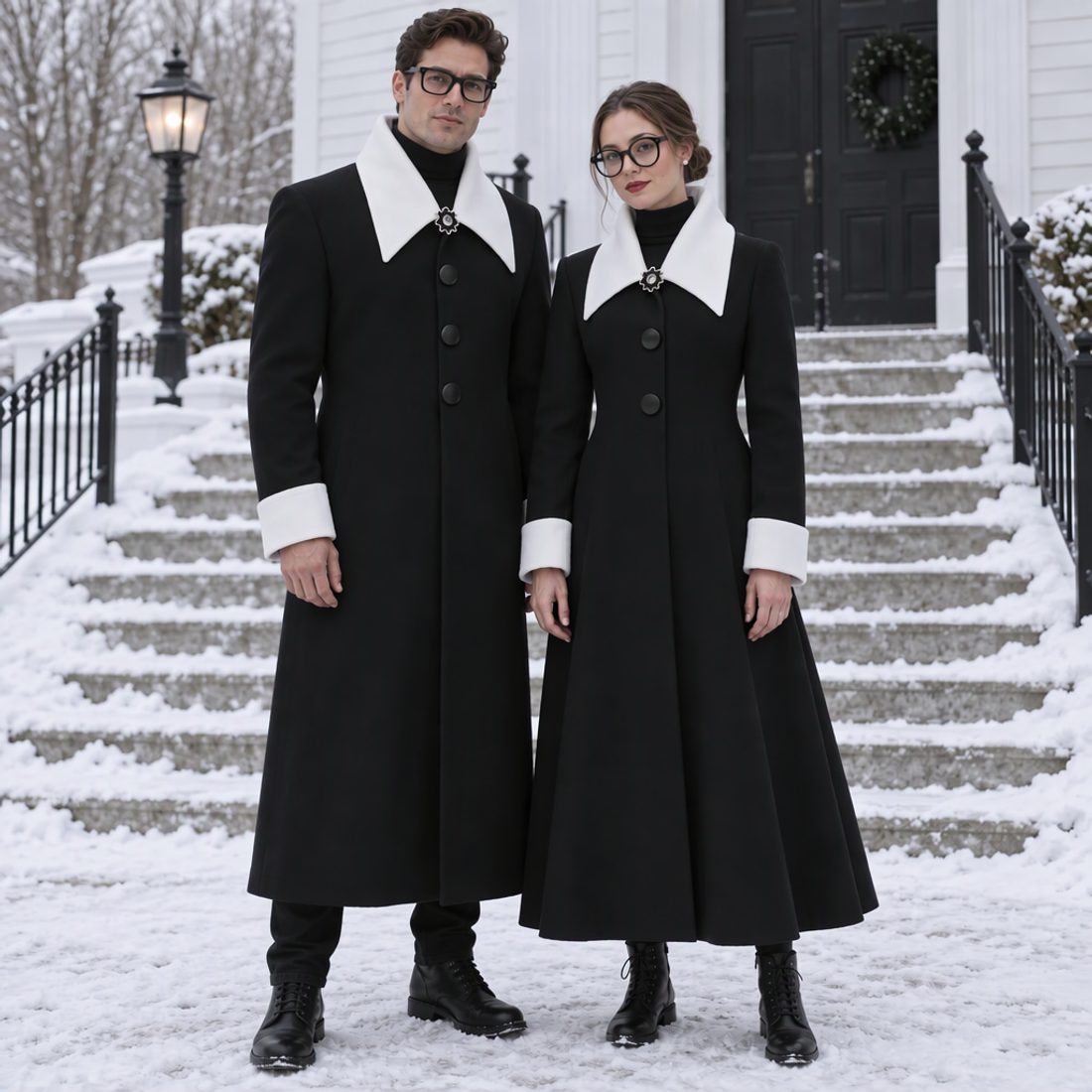
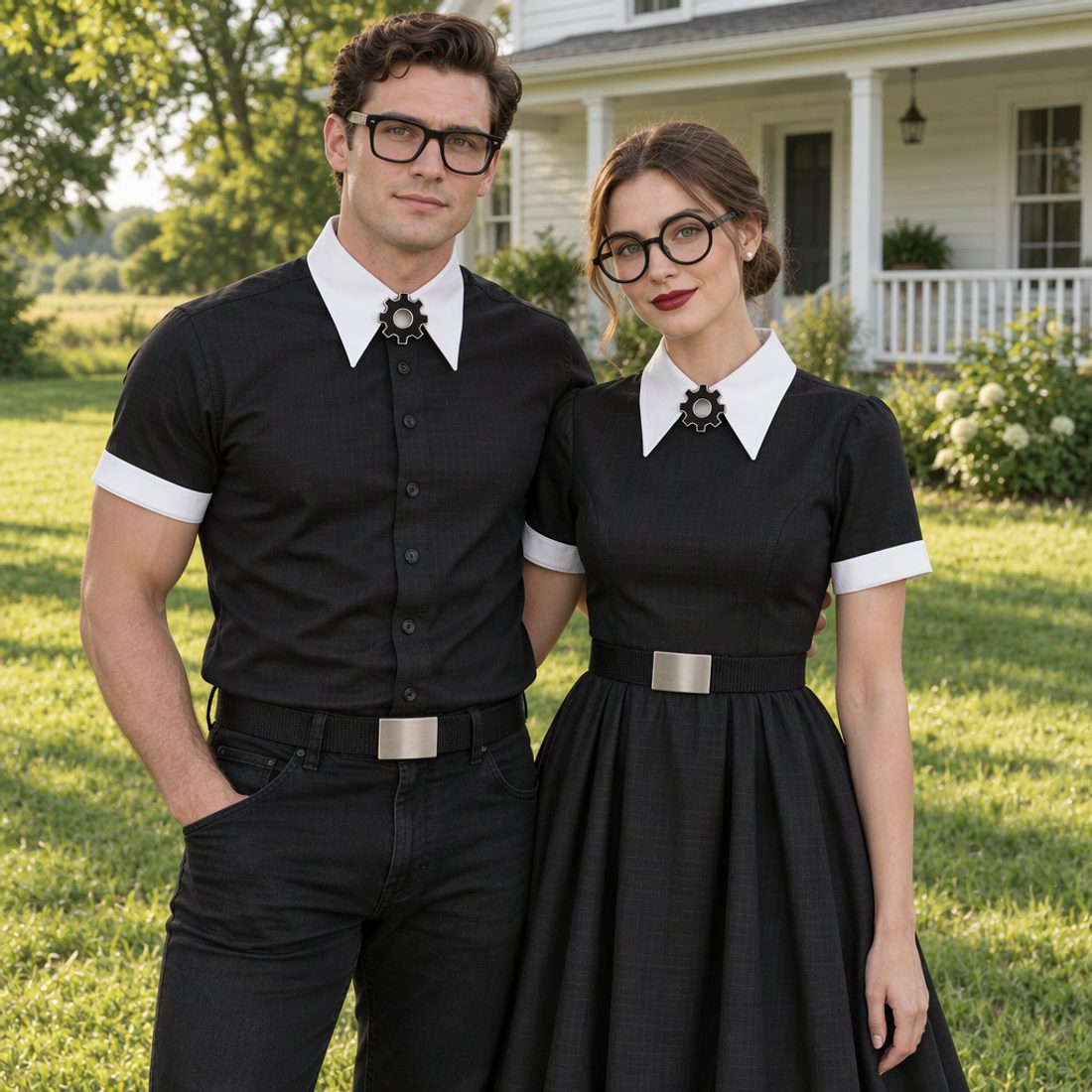
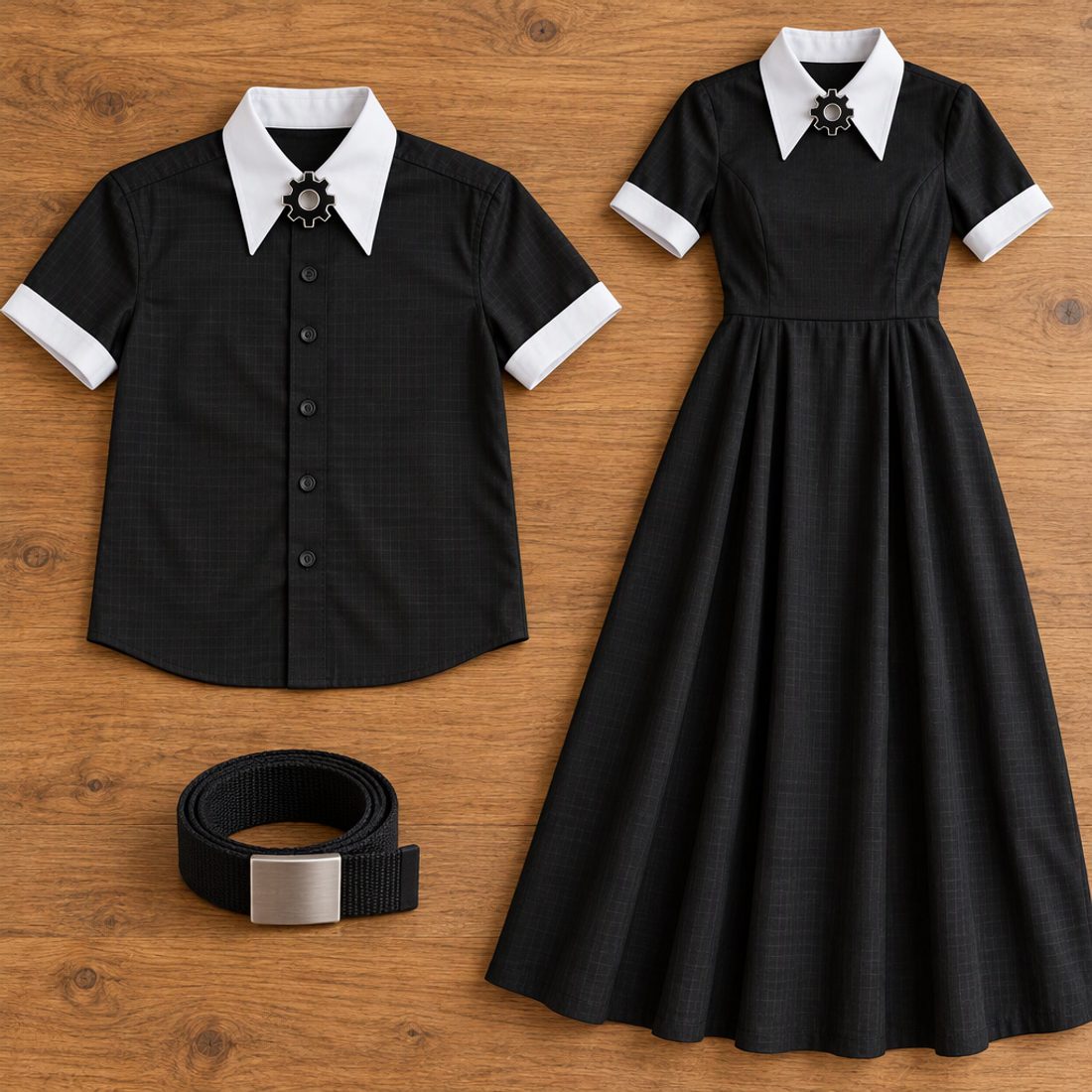
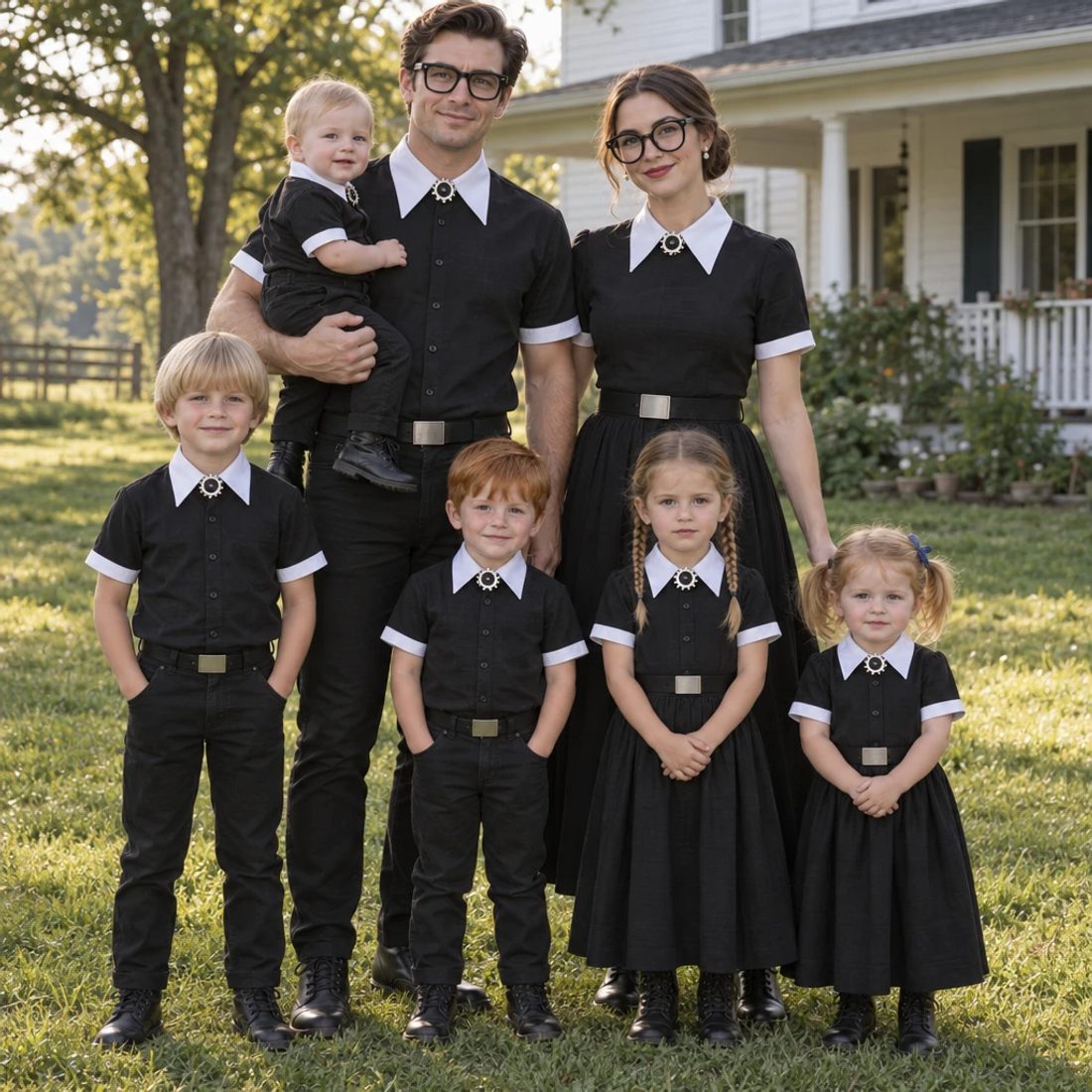
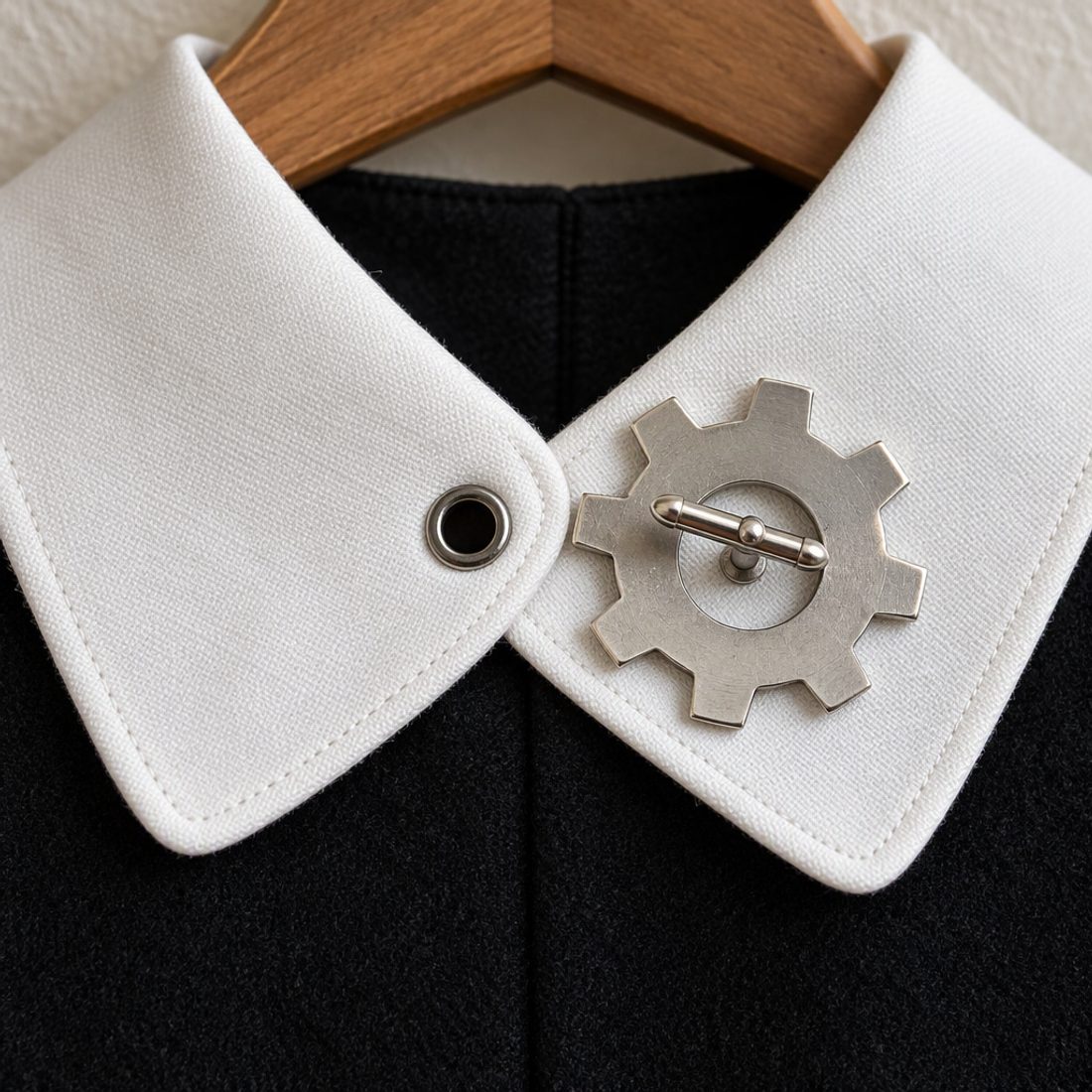
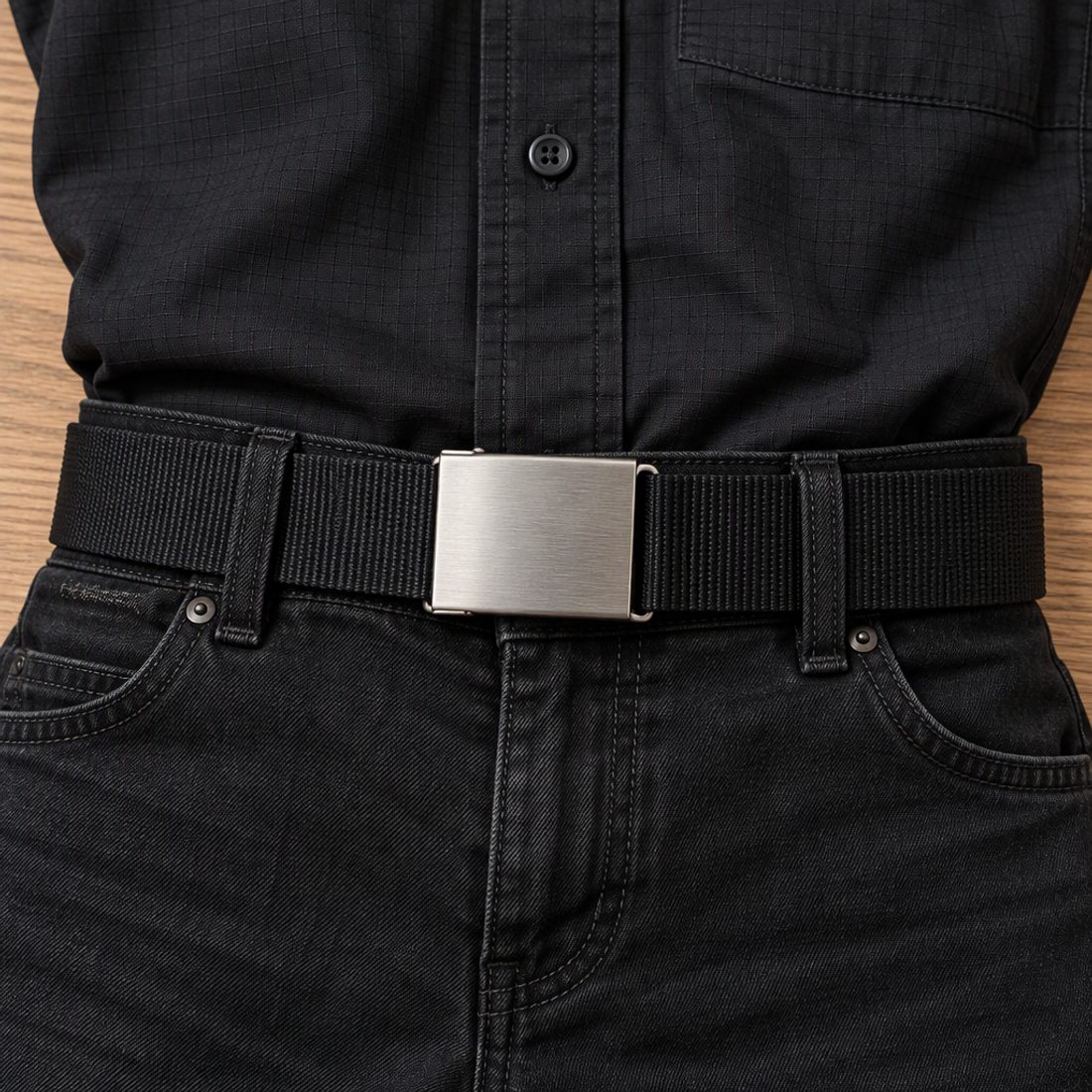
Two outfits. Winter: a long black coat with a white collar and cuffs over a black turtleneck. Summer: a short-sleeved black shirt with jeans for men and boys, a full-length black dress for women and girls, both with a white pointed collar, white sleeve bands and a belt. One silver gear clasps the collar of every piece.
Five rules that govern every piece
- The outside stays plain. Black cloth, white collar and cuffs, the gear, the buttons. No visible pockets on the chest, no flaps, no straps, no logos, no contrast stitching. Every working feature is inside, in a seam, or under the collar.
- Nothing binds. The wearer can reach both arms straight overhead, hug their own shoulders, squat fully and take a long stride with the garment fastened.
- Loads hang from the shoulders or the belt, never from the cloth. Anything heavy is carried on webbing that runs to the shoulder yoke, so the front stays flat and nothing shows through.
- Everything goes in a hot wash. The black must not stain the white. Stiffeners and the gear come out first.
- Built to be handed down. Children’s pieces pass through five children. Seams, snaps and knees must outlast that.
The coat
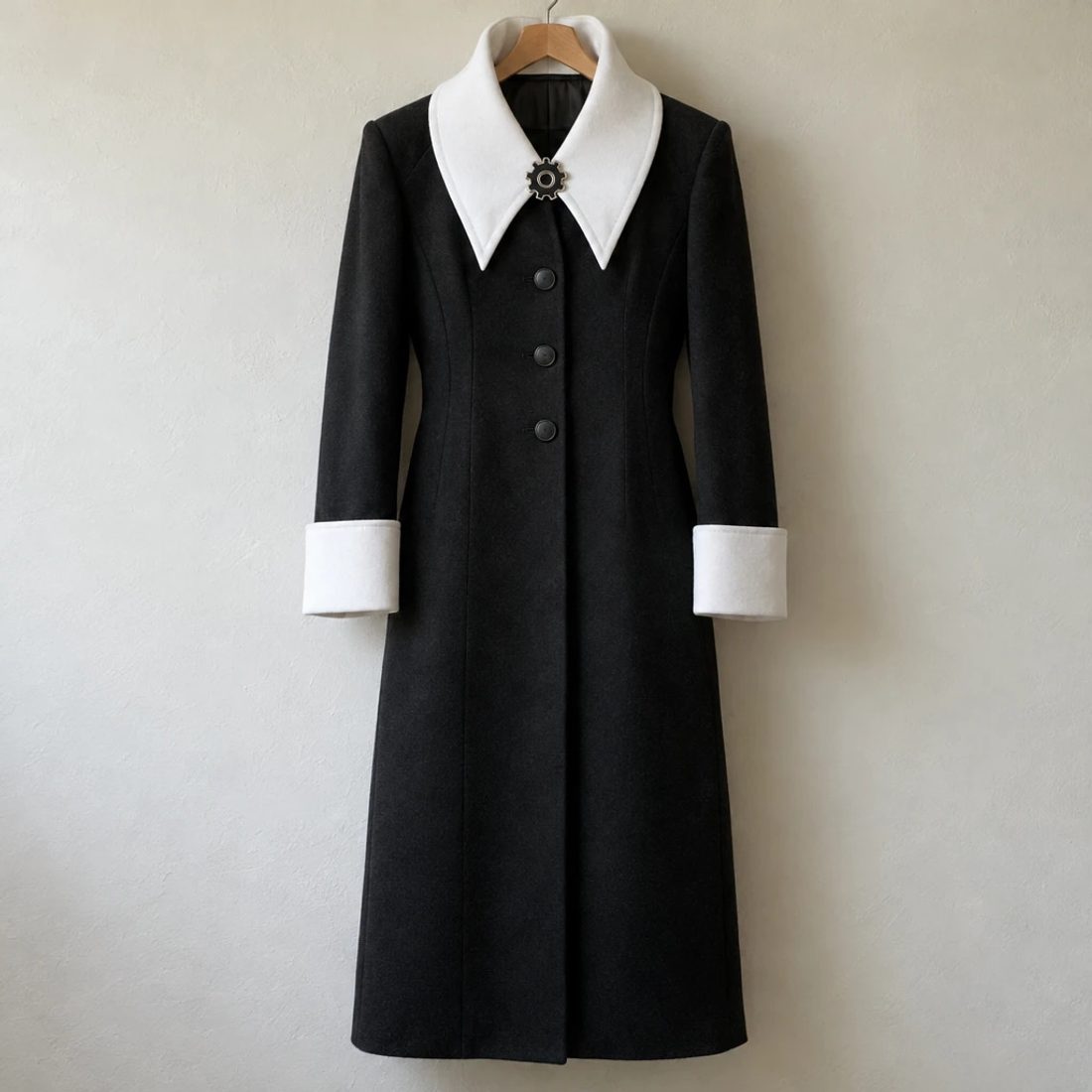
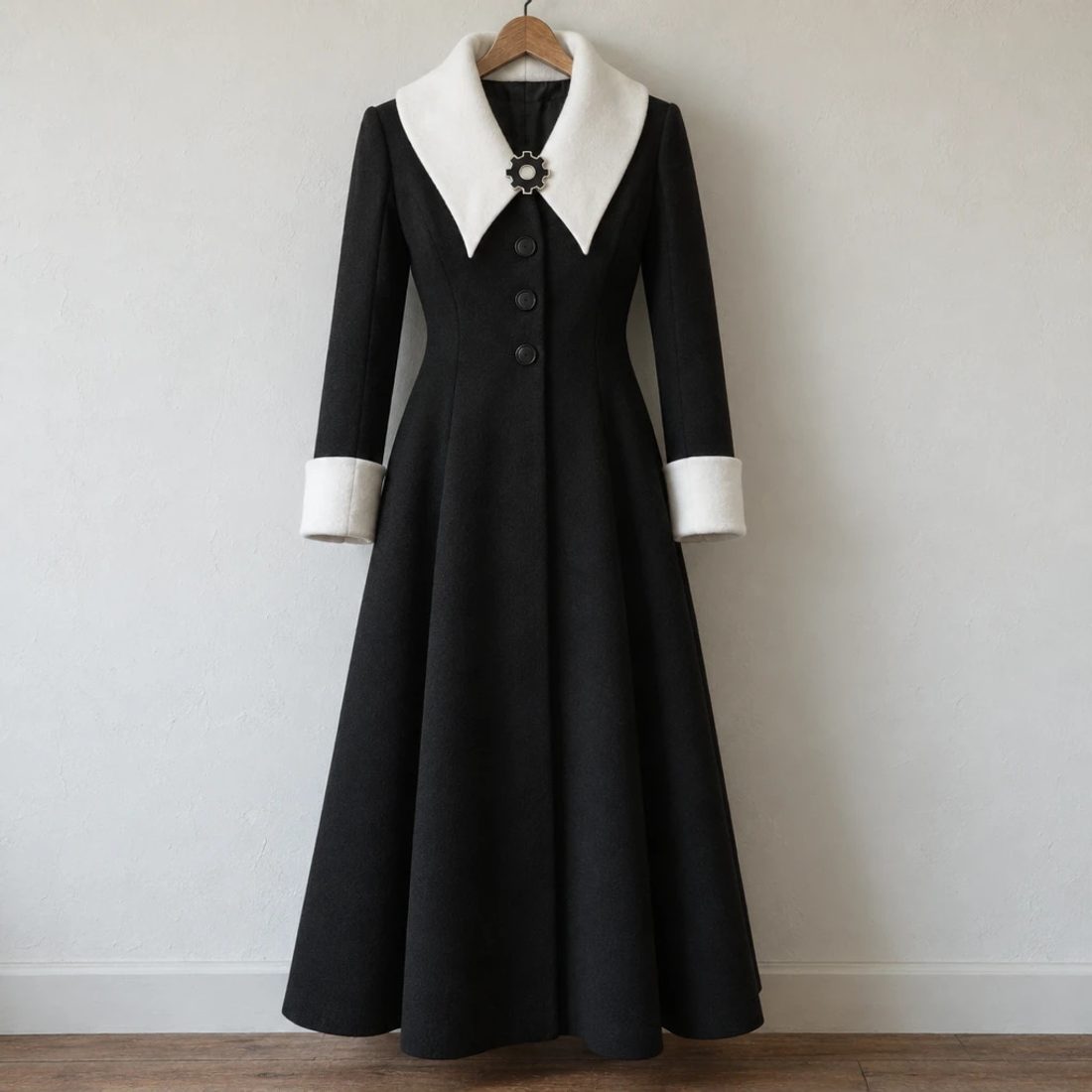
Three cuts: men’s (tailored, structured shoulders, waist taken in), women’s (fitted, full skirt) and one children’s cut. Ankle length, single-breasted, three buttons between chest and waist. The adults’ coats carry everything below; the children’s differences are in their own section.
Outside
- Cloth
- Black softshell with a matte woven face that looks like wool melton, no sheen: polyester with elastane, bonded to a soft backing, 300–350 g/m². Water-shedding finish without PFAS. Washable at 40 °C.
- Collar
- White. Stands about 5 cm at the back and sides of the neck in a soft outward roll, 2 cm clear of the neck. In front, two flat wings with straight edges, about 12 cm wide at the shoulder, each ending in one sharp point about 20 cm from the neck seam. The wings overlap 25 mm at the centre of the chest, 8 cm below the hollow of the throat; the gear point is there. A hidden snap under each point holds it to the coat so the wings do not flap when running.
- Cuffs
- White, turned back, 10 cm deep, white all round. Inside each sleeve, a hidden black knit storm cuff keeps wind out.
- Whites
- Collar and cuffs are separate pieces in heavy white polyester-cotton twill. The collar snaps to a black band at the neckline with seven concealed snaps; each cuff snaps into the sleeve end with four. Two sets per coat.
- Front
- Exactly three plain black buttons, 28 mm, each sewn through a backing button. A wind flap behind the opening. Nothing below the waist.
Movement: shoulders, arms, stride
- Shoulder seam
- Moved 2 cm forward of the top of the shoulder and stitched flat, so a pack strap or a carried child does not sit on a ridge. The shoulder area is double cloth.
- Action back
- A pleat 5 cm deep behind each shoulder, from the yoke seam to the waist, held shut by a strip of elastic inside. The back looks plain when the arms are down and opens when they reach forward. This is the feature seen on shooting jackets and field uniforms, also called a bi-swing back.
- Gussets
- A diamond gusset under each arm in the same cloth, so the coat body does not lift when the arms go up. A 20 cm two-way zip in each gusset opens to black mesh, to let heat out when working.
- Sleeves
- Two-piece, pitched forward, with a dart at the elbow so the sleeve is already slightly bent. Elbows doubled on the inside.
- Stride
- The front is open below the third button and the back vent runs from hem to hip, so the skirt never limits a stride or a squat. Inside each front corner, a tab buttons the corner back to the side seam at hip height for running, climbing or wading, as on an infantry greatcoat.
- Haul loop
- A loop of 25 mm webbing under the collar at the back of the neck, bar-tacked into the yoke. It hangs the coat on a hook and can take the wearer’s weight.
Inside: carry and pockets
- Mounting panels
- Inside each chest, below the armpit: a panel of loop fastener (the soft side of hook-and-loop) 18 × 22 cm. It takes any holster, magazine pouch or organiser with a hook back, at any angle, on either side, so the coat suits a right- or left-handed wearer and a holster can be moved between coats. Behind the panel, a pocket holds a removable 1 mm plastic stiffener sheet.
- Load webbing
- The top of each panel is sewn to 25 mm webbing that runs up inside the lining, over the shoulder, into the yoke, and across the back to the other panel. It is a shoulder-holster harness built into the coat: the weight sits on the shoulders, the two sides balance each other, and the front of the coat hangs flat.
- Holster
- We supply it. The coat supplies only the mounting. It must be a rigid holster that fully covers the trigger guard; never a bare cloth pocket.
- Chest access
- On the outside, hidden under each collar wing: a vertical slit 18 cm long through the coat front, closed by an overlapping welt and one snap. With the coat buttoned, a hand goes under the wing and through the slit to the panel inside. The wing covers the slit completely.
- Knife
- Inside each hip: a webbing ladder, three rows of 25 mm webbing bar-tacked every 38 mm, 15 cm wide (the standard that clip-on sheaths and pouches fit). Below the left one, a strap of 25–40 mm webbing with a metal snap hook, anchored into the facing and the side seam, for a belt sheath to hang straight down. Back both with a patch and stay tape. The ladder on the other side takes a torch or a tool.
- Hand pockets
- One in each side seam, zipped, lined in fleece, 20 cm deep. The pocket edge is doubled for a folding knife’s clip. Behind each pocket bag, a second zipped slit passes straight through the coat, so the wearer can reach a trouser pocket or the belt without unbuttoning.
- Document pockets
- One in each front facing at the chest, vertical zip, 16 × 22 cm. The left one has a pen slot and a soft-lined phone sleeve.
- Drop pockets
- One inside each skirt front, 25 × 30 cm, open top with a snap, pleated at the bottom so it holds a water bottle, gloves or a child’s spare clothes.
- Sleeve pocket
- A flat zipped pocket inside the left forearm lining for a card or key.
- Key leash
- A 20 cm cord with a clip, sewn inside the right hand pocket.
- Count
- Nine pockets (two hand, two document, two drop, one sleeve, and the two pass-throughs), two mounting panels, two ladders, one sheath strap. None shows from outside.
Laws on carrying a firearm or a knife differ from place to place; that is the wearer’s business, not the maker’s. The children’s coats have none of the carry fittings.
The summer shirt and dress
One top made two ways: a shirt for men and boys, the top of a full-length dress for women and girls. For adult women the dress is two pieces that read as one: a top and a skirt, with the belt over the join. In pregnancy the skirt is simply worn higher, above the bump.
- Cloth
- Black polyester-cotton ripstop (about 65/35), 200–230 g/m², with a little stretch. The black is solution-dyed or proven not to run.
- Collar
- White polyester-cotton twill, sewn on, lightly fused so it lies flat without ironing. Two points 10 cm long on adults, 6–7 cm on children, as in the laid-flat picture: longer and sharper than an ordinary shirt collar and no more. The gear point is at the two ends of the collar band.
- Sleeves
- Short, above the elbow, ending in a white twill band 4 cm deep, sewn on and turned back.
- Shirt front
- An ordinary placket with six plain black buttons that show. No chest pockets on the outside.
- Movement
- A panel of black stretch knit down each side from armpit to hem. A gusset under each arm. A shallow pleat each side of the back below the yoke.
- Cooling
- The back yoke is a loose flap over black mesh, open along its lower edge, so air passes through. It lies flat and reads as a plain yoke seam.
- Shirt pockets
- Two, hidden: a vertical zip just inside each edge of the front placket opens to a flat pocket 14 × 18 cm lying inside the chest. Reached with the shirt tucked in. Nothing shows when closed.
- Shirt tails
- Long, with a strip of silicone gripper tape inside the hem so it stays tucked. The shirt is thin enough to tuck over an inside-the-waistband holster with tuckable clips.
- Women’s dress
- Two pieces. Worn together with the belt over the join, they look like the one-piece dress in the pictures.
- Its top
- The same collar and sleeves on a fitted bodice with a plain front and no buttons; a short zip at the back of the neck. It ends 15 cm below the waist, so it stays tucked under the skirt whether the skirt sits at the waist or above a bump. Stretch side panels, as on the shirt.
- Its skirt
- Full, to the ankle at the natural waist, wide enough for a full stride and a squat. A waistband that is flat across the front, with elastic across the back and a button tab at each side to take it in or let it out by 12 cm, so it fits at the waist and also under the bust. Belt loops on the waistband, bar-tacked. An 8 cm hem to let down, because the skirt hangs shorter when worn high.
- In pregnancy
- Nothing is changed or added. The skirt is pulled up over the bump and fastened under the bust, the top stays tucked inside it, and the belt goes on at the new height.
- Girls’ dress
- One piece: the same top joined to the skirt at the waist, a back zip, belt loops, and an 8 cm hem to let down.
- Dress pockets
- One in each side seam, 22 cm deep, with a zipped security pocket inside it. On the women’s skirt, the right pocket bag has a second zipped opening through to the inside of the skirt, to reach a thigh or waist holster worn underneath.
- Nursing
- Women’s tops, as an option to quote: a hidden vertical zip in each front bodice seam.
- Strength
- Double-stitched seams; bar tacks at pocket ends, belt loops and the top of every zip.
The belt
- Strap
- Black nylon webbing, 38 mm wide for adults and 25 mm for children. The adults’ belt is two layers with a stiffener between, so it carries a holster or pouches without sagging or rolling.
- Buckle
- A plain flat rectangular plate of brushed stainless steel, about 50 mm wide, nothing on it. Behind the plate the belt must lock, not just grip: it has to hold a 2 kg load on the belt without slipping.
- Worn
- Through the jeans’ loops with the shirt; through the dress’s own loops over the dress.
The gear clasp and the gear point
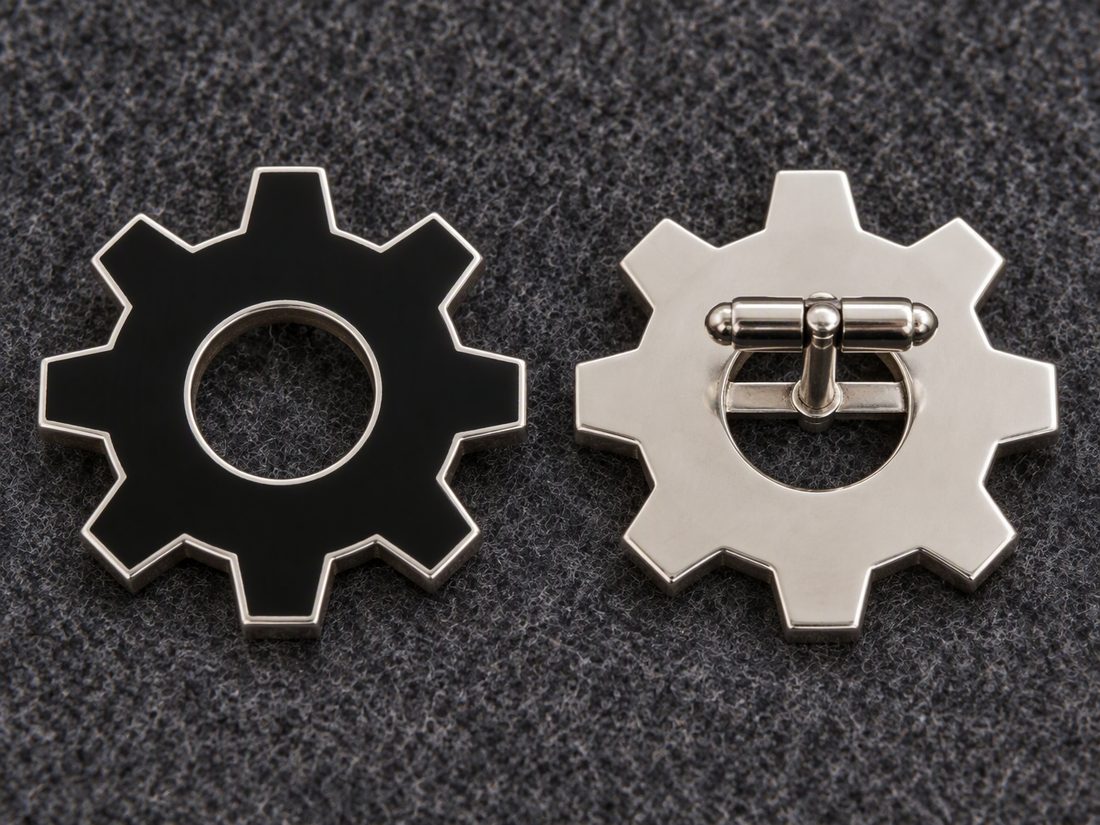
The gear is a separate piece, one per person. It works like a cufflink, made larger. Each garment has the same fitting for it. A jeweller makes the gear; the garment maker fits the gear points.
- Gear
- Eight blunt teeth and a round hole. 50 mm across for adults, 38 mm for children from three; 2 mm thick; under 20 g. Sterling silver with a black hard-enamel face and a polished rim. The hole is closed at the back by a thin black plate set 1 mm below the face. (The photograph shows an open bar across the hole; the plate is what we want.)
- Back
- A cufflink fitting of the bullet-back kind, scaled up: a round post 4 mm thick and 8 mm long at the centre of the back plate, ending in a swivel bar 25 mm long and 6 mm thick. No pin, no magnet, no loose part. It must hold a straight pull of 90 N.
- Gear point
- A black eyelet with an 8 mm opening (black-finished brass or stainless steel, with washer, rust-free in a hot wash) through each of the two edges the gear joins. A hidden patch of two layers of twill, 25 mm square, behind each. Where the cloth is thin, a spacer so the two edges together are 5–6 mm thick. A concealed black snap beside it, so the garment closes without the gear.
- Where
- Coat: where the collar wings overlap. Shirt and dress: the two ends of the collar band, in place of a top button.
- Under three
- No eyelet and no clasp. The gear is embroidered in black and grey thread where the gear point would be.
Children’s pieces
The same look, made for handing down through five children and for being put on a small child quickly.
- Coat
- One cut for boys and girls: the men’s cut made small. The action back, gussets, shaped doubled elbows, back vent and haul loop are all kept; the haul loop is how a parent catches a child. Three snaps with black caps that look like the buttons, for under-fives.
- Left out
- No mounting panels, no chest access slits, no webbing ladders, no sheath strap.
- Coat pockets
- Two zipped hand pockets, one zipped inside pocket, and a loop inside each cuff for mitten strings.
- Growth
- A 5 cm tuck inside each sleeve and an 8 cm hem, both to let down. A label inside for the age range.
- Shirt
- As the adults’, with snaps under button caps for under-sixes and one hidden placket pocket.
- Dress
- One piece, without the pass-through. Side-seam pockets, back zip, deep hem.
- Seams
- Every seam double-stitched; snaps set through a reinforcing patch.
Materials and hardware
| Item | What | Used for |
|---|---|---|
| Coat shell | Black matte wool-look softshell, 300–350 g/m², PFAS-free finish | Coat body, gussets |
| Shirt cloth | Black solution-dyed poly-cotton ripstop, 200–230 g/m² | Shirt, dress |
| White | Heavy white poly-cotton twill, matte | Collars, cuffs, sleeve bands |
| Stretch | Black poly-elastane knit, same black | Shirt side panels, storm cuffs |
| Lining | Black polyester taffeta; black mesh at the upper back and vents | Coat |
| Webbing | Black nylon, 25 mm and 38 mm | Load harness, ladders, strap, haul loop, belt |
| Loop fastener | Black, sew-on, 18 × 22 cm panels | Mounting panels |
| Zips | Black coil, locking sliders; two-way at the gussets | All pockets, vents, dress back |
| Snaps | Black ring or post snaps, rust-free | Whites, gear points, collar points, children’s fronts |
| Eyelets | 8 mm opening, black brass or stainless, with washers | Gear points |
| Buttons | Plain black, 28 mm coat, 11 mm shirt, with backing buttons on the coat | Fronts |
| Thread | Black bonded polyester; heavier for bar tacks and webbing | Everything |
| Stiffener | 1 mm plastic sheet, removable | Behind mounting panels |
Order of work for the coat
- Wash test. Sew a piece of each black cloth to a piece of the white twill, wash at 60 °C, and photograph it. Do not cut until the white is still white.
- Toile. Make the coat body once in cheap cloth with the action pleats, gussets and sleeves, and check the movement tests below on the wearer before cutting softshell.
- Fronts and facings first. Build everything that lives on the fronts while they are flat: document pockets in the facings, mounting panels with their stiffener pockets, hip ladders, sheath strap anchors, drop pockets, the chest access slits and their welts.
- Harness. Sew the load webbing to the tops of the mounting panels. Leave the free ends long.
- Back. Make the yoke in double cloth. Form the two action pleats, sew in the elastic, and make the vent.
- Join. Shoulder seams, forward and flat. Carry the load webbing over the shoulders and bar-tack it into the yoke and to its opposite number across the back. Sew in the haul loop.
- Sleeves. Make the two-piece sleeves with elbow darts and doubled elbows; set them with the gussets and gusset zips.
- Side seams. Sew them with the hand pockets and their pass-through slits in place.
- Neck and wrists. The black neck band with its seven snaps; the storm cuffs; the four snaps inside each sleeve end.
- Lining. Bag the lining, leaving the harness, panels and ladders on the facing side so they are never covered.
- Finishing. Buttons with backing buttons, buttonholes, button-back tabs, bar tacks at every stress point.
- Whites. Make the collar and cuffs in twill, fit their snaps to match, set the two eyelets and the hidden snap at the collar overlap, and the snaps under the two collar points.
- Fit the gear. Try the sample gear through the eyelets. The gear should sit flat and firm and come out with one hand.
Tests before we accept a sample
Movement, with the coat buttoned
- Both arms straight overhead: the hem rises no more than 5 cm and the collar stays closed.
- Arms crossed to grip the opposite shoulders: no strain across the back.
- A full squat and a long lunge: nothing pulls at the buttons.
- A ten-metre run: the collar points stay down.
Load and wash
- 1.2 kg on one mounting panel and 0.5 kg on the other: seen from the front, the coat hangs level and flat.
- A hand reaches each mounting panel through the chest slit in one movement, and the slit cannot be seen with the collar down.
- A 2 kg pull on the sheath strap and on each ladder row: no stitch moves.
- The haul loop holds the wearer’s weight.
- Five washes at the stated temperature: the white is white, nothing has shrunk, every snap still holds.
Messages to send
To a maker of uniforms, tactical or outdoor clothing. Change the numbers to fit.
Hello! I would like to ask about a custom order: matching outfits for a family of [number] (two adults and [number] children). They look formal and must be built like tactical outerwear: tough, machine washable, free to move in.

1. Long black coats in a matte softshell that looks like wool: ankle length, single-breasted, three black buttons, a large white pointed collar and white turned-back cuffs that snap off for washing. Hidden inside: an action (bi-swing) back, underarm gussets with vent zips, a loop-fastener mounting panel in each chest hung on webbing from the shoulder yoke, a hidden chest access slit under each collar wing, webbing ladders and a sheath strap at the hips, and nine pockets. Men's, women's and one children's cut (the children's without the carry fittings).

2. Short-sleeved black ripstop shirts for the men and boys: white pointed collar, white sleeve bands, visible black buttons, stretch side panels, a vented back yoke and two hidden zip pockets behind the placket.

3. Full-length black ripstop dresses for the women and girls with the same collar and sleeves and deep side pockets. The women's is two pieces that look like one dress, a top and a full skirt with an adjustable waistband, so the skirt can be worn above the bump in pregnancy; the girls' is one piece with a back zip.

The black must not run onto the white in a 60 °C wash. Each collar closes with a separate silver gear clasp that we supply; we need an 8 mm black eyelet and a hidden snap fitted where it goes.

The full build guide, with pictures, diagrams, materials, the order of work and our acceptance tests, is here: https://technopuritan.com/wardrobe/build/

Could you make some or all of this? What would one coat and one shirt cost as samples, what would the full set cost, how long would it take, and which measurements do you need? Thank you!
To a jeweller:
Hello! I would like [number] clasps made from our emblem, a plain gear with eight blunt teeth and a round hole (image attached).

• [number] at 50 mm across and [number] at 38 mm, 2 mm thick, under 20 g.
• Sterling silver with a black hard-enamel face and a polished rim. Please also quote the 38 mm ones in 316 stainless steel.
• The hole is closed at the back by a thin black plate set 1 mm below the face.
• On the back, at the centre: a cufflink fitting (bullet back), made larger than on a cufflink. A round post 4 mm thick and 8 mm long, ending in a swivel bar 25 mm long and 6 mm thick. It must pass through an 8 mm eyelet and hold a straight pull of 90 N (20 lb).
• No pin, no magnet, no loose parts.

Details and a diagram: https://technopuritan.com/wardrobe/build/#gear

Could you make one sample first? What would the sample and the full order cost, and how long would they take? Thank you!
The photographs on this page are renderings of how the garments should look; they are not photographs of a product for sale. How we arrived at this design, with every earlier sample, is on the wardrobe page.